
You can see all three of the historic sub-machine guns discussed below in our latest video, where Raz examines each example in detail and places them in their historical context. Watch the full feature on Facebook, Instagram and YouTube to see these iconic British weapons up close and in hand before reading on.
British sub-machine gun development tells a story of urgency, adaptation and refinement. From the finely machined naval Lanchester of the Second World War, through the brutally simple Sten, to the highly refined Sterling of the Cold War, Britain’s SMGs reflect changing priorities in warfare, industry and doctrine across three decisive decades.
Though these weapons are not simple “one replaced by the next” design evolutions, they are undeniably connected by shared manufacturers, engineers, combat experience and institutional learning. Together, they chart Britain’s journey from wartime improvisation to post-war professionalisation.
The Lanchester Mk.I (1941–43) - Britain’s First Modern Wartime SMG
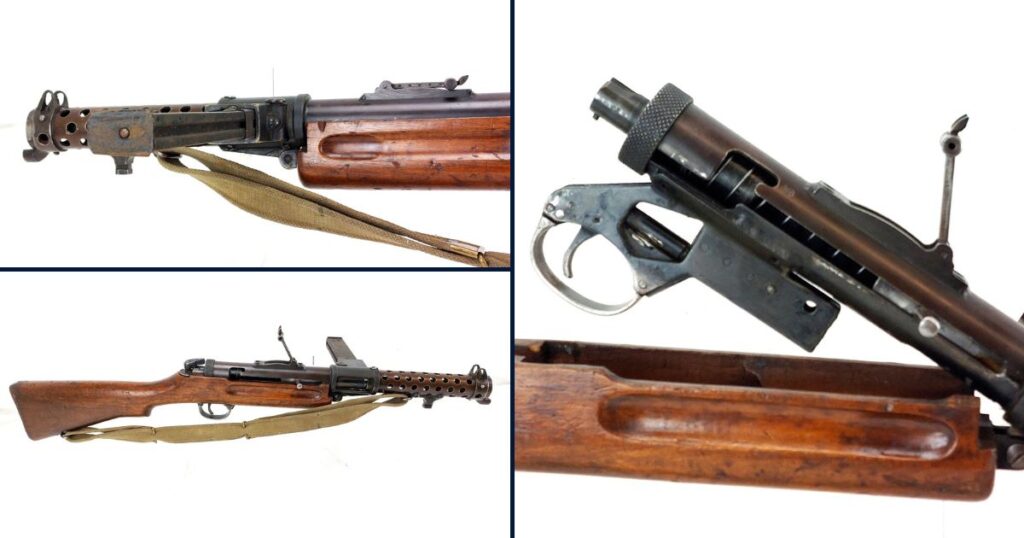
When Britain found itself critically short of sub-machine guns following the evacuation of Dunkirk in 1940, the immediate response was not simplicity, but quality.
Developed in 1941 by George Herbert Lanchester at Sterling Armaments, the Lanchester Mk.I was designed to meet the Royal Navy’s demanding requirements for shipboard and dockyard defence. Rather than start from a blank sheet, Lanchester closely based his design on the proven German MP 28/II, a weapon already respected for reliability and controllability.
The result was a robust, finely engineered sub-machine gun featuring a solid walnut stock, brass fittings resistant to salt corrosion, and even a bayonet lug for the SMLE Pattern 1907 bayonet - an unusual but telling nod to naval doctrine and tradition. The Mk.I variant added a fire selector and long-range tangent rear sight, underlining its intended role as a durable service weapon rather than a disposable emergency arm.
At around £14 per unit, the Lanchester was expensive and slow to produce. While this made it unsuitable for mass Army issue, it proved ideal for the Royal Navy, RAF Regiment and Commonwealth naval forces, remaining in frontline and reserve service well into the 1960s. Crucially, Sterling’s experience producing the Lanchester laid the industrial and engineering groundwork for everything that followed.
The Sten Mk II (1941–45) - Wartime Necessity Made Real
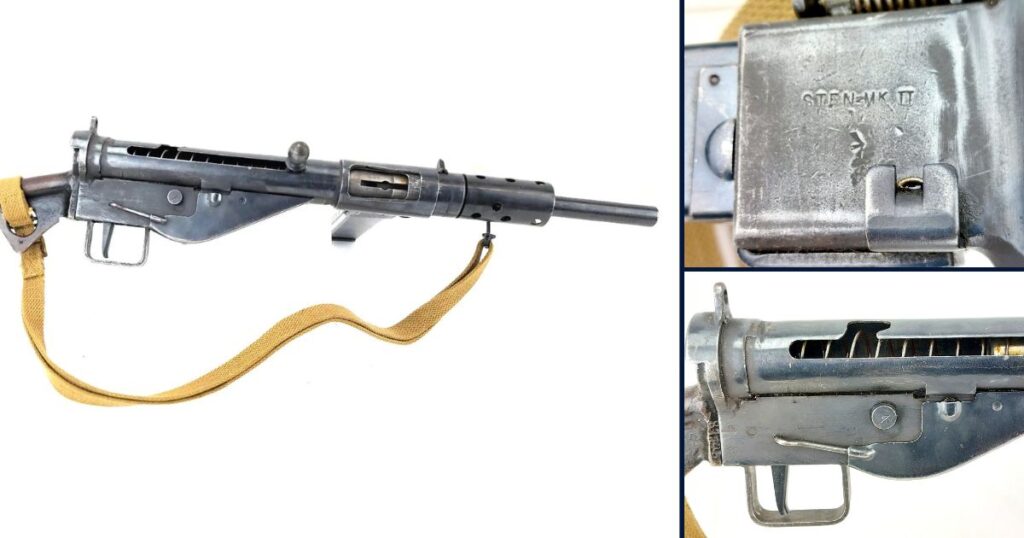
If the Lanchester represented quality, the Sten represented survival.
Designed in 1941 at the Royal Small Arms Factory, Enfield, by Major Reginald V. Shepherd and Harold J. Turpin, the Sten was Britain’s response to a stark reality: the country needed hundreds of thousands of sub-machine guns immediately, and it needed them cheaply.
The Sten Mk II stripped the sub-machine gun concept to its bare essentials - a tubular receiver, simple blowback action, welded construction and minimal machining. It could be produced by a dispersed network of factories and subcontractors, from major Royal Ordnance plants to small engineering firms better known for bicycles or household goods.
While often criticised for crude finish and ergonomics, the Sten worked - and crucially, it could be built for around £2 per unit. Over 2.6 million Mk II Stens were produced, arming British and Commonwealth troops, airborne forces, the Home Guard, SOE agents and resistance fighters across occupied Europe.
Although not mechanically derived from the Lanchester, the Sten benefited indirectly from Britain’s early wartime sub-machine gun experience. Lessons about 9×19mm ammunition, magazine design, controllability and training all fed into its adoption and widespread use. By the end of the war, however, the Sten’s limitations were clear.
Britain needed something better, but not something complicated.
The Sterling Mk.4 / L2A3 (1950s–Cold War) - Refinement, Not Reinvention
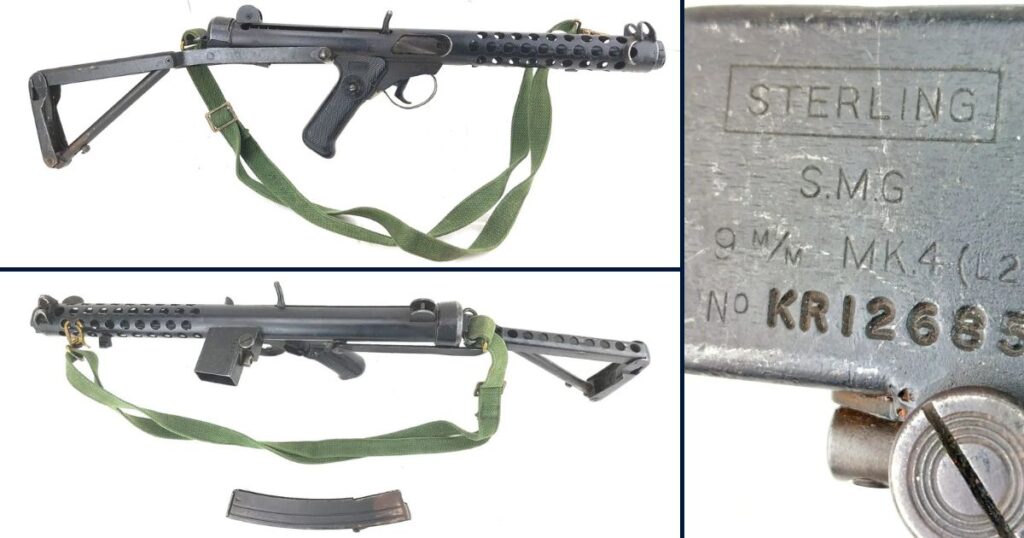
That “something better” came from a familiar name.
Sterling Armaments - the same firm that had produced the Lanchester - had been working throughout the late 1940s on improved sub-machine gun designs, led by George Patchett, whose earlier experimental weapons had already influenced late-war thinking. Drawing directly on the strengths and weaknesses of the Sten, Sterling refined the concept rather than discarding it.
Adopted as the Sterling Mk.4 (L2A3) in British service during the 1950s, the new weapon retained the Sten’s simplicity but addressed its flaws. A curved, double-stack magazine dramatically improved reliability. A roller-follower system reduced friction and stoppages. Improved ergonomics and balance enhanced controllability, while higher manufacturing standards ensured consistency without excessive cost.
The result was one of the finest sub-machine guns of the Cold War era - compact, dependable and remarkably durable. The Sterling served with British forces and Commonwealth units around the globe, from jungle warfare to armoured crews, remaining in service into the 1990s and achieving significant export success.
Unlike the Lanchester and Sten, the Sterling was not born of desperation. It was the product of hard-won experience, combining wartime lessons with post-war engineering maturity.
Not Direct Evolutions - But a Clear Lineage
It is important to be precise: the Lanchester, Sten and Sterling are not direct design evolutions of one another in a strict mechanical sense.
However, they are part of a continuous British developmental story. There were shared manufacturers, particularly Sterling Armaments. There were overlapping designers and engineers. There was progressive refinement of doctrine, ergonomics and reliability, and a clear shift from quality, to quantity, to balance.
Seen together, these three weapons illustrate how Britain adapted its infantry arms to meet the realities of total war, and then refined them for the professional, global commitments of the Cold War.
Available to Buy - In Store and Online
All three of the historic sub-machine guns discussed above are available to purchase, fully deactivated to current EU and UK specification and supplied with the appropriate Birmingham Proof House certification.
- The Lanchester Mk.I (1942, Royal Navy pattern) is a scarce, high-quality naval sub-machine gun with exceptional markings and post-war Danish service history.
- The Sten Mk II (World War Two, ROF Fazakerley) is a classic wartime example complete with its original MECO 1943 sling.
- The Sterling Mk.4 / L2A3 (Cold War) is a beautifully preserved post-war British service sub-machine gun with original magazine and sling.
Each is available in store and online, ready for display, study or inclusion in a serious British military collection.