
Communication has always been one of the most important elements of warfare. During the Second World War and the decades that followed, armies, navies, and air forces relied on rugged mechanical communication systems to coordinate operations across land, sea, and air.
Long before the digital age, soldiers depended on wired field telephones, headsets, microphones, and specialised communication equipment to relay orders and intelligence. These devices were designed to operate in the most demanding environments imaginable - from muddy trenches and armoured vehicles to the flight decks of aircraft carriers and the cramped cockpits of wartime bombers.
Today, surviving examples of this equipment offer fascinating insight into the technological ingenuity of the period. Each piece tells a story not only of military engineering, but also of the men and women who relied on these tools during some of the most significant events of the twentieth century.
Below we explore a selection of historic military communication equipment spanning the Second World War and the Cold War era.
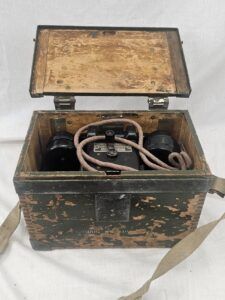
WW2 British Army Telephone Set F with Shoulder Strap
Among the communication equipment used by the British Army during the Second World War, the Telephone Set F was a dependable and practical field instrument. Designed to be portable and rugged, it allowed soldiers to maintain communication between command posts, observation points, and frontline units.
Encased in a durable housing and often carried with a shoulder strap, the set was built specifically for field conditions where reliability was essential. One of its key features was the hand-cranked generator, which produced the electrical current needed to ring another telephone connected along the field wire network.
Unlike modern communications equipment, these field telephones required no external power source. Their mechanical design meant they could operate in remote locations and harsh environments where electricity was unavailable.
Equipment such as the Telephone Set F formed the backbone of British Army communications during the war, helping commanders maintain contact with their troops during operations across Europe, North Africa, and beyond.
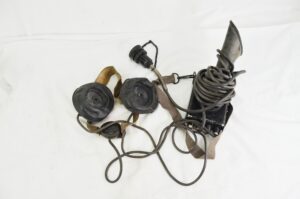
British WW2 Chest Microphone and Headphones by Ericsson
Specialised communication equipment was vital for operators working with radio systems and signal equipment during the war. One such device is the British Army chest microphone and headphone set manufactured by Ericsson.
Founded in 1876, Ericsson began as a small workshop repairing telegraph equipment before developing into one of the world’s leading telecommunications manufacturers. By the time of the Second World War, the company was producing a wide range of communication devices used by both civilian and military organisations.
This headset was designed to allow operators to communicate clearly while keeping their hands free to operate other equipment. The chest-mounted microphone enabled speech to be transmitted without holding a handset, while the headphones allowed operators to hear incoming signals even in noisy environments.
Sets like this were often used by radio operators, vehicle crews, and signal personnel responsible for maintaining communication links across the battlefield.
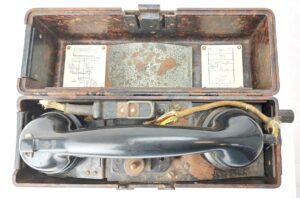
German WW2 Feldfernsprecher 33 (FF33) Field Telephone – 1943
The Feldfernsprecher 33, commonly known as the FF33, was the standard field telephone used by German forces throughout the Second World War. Introduced in 1933, it replaced earlier First World War communication systems and remained in widespread use for the duration of the conflict.
Field telephones like the FF33 provided secure wired communication between military positions. Unlike radio transmissions, which could potentially be intercepted, telephone lines allowed messages to be sent directly and reliably between command posts, artillery batteries, and defensive positions.
Manufactured by Telefonbau und Normalzeit of Frankfurt, the FF33 featured a robust Bakelite clamshell case, a press-to-talk handset, and a hand-cranked generator used to ring other telephones on the line.
These telephones played an essential role in coordinating military operations, particularly for artillery units and frontline commanders who depended on accurate and timely information.
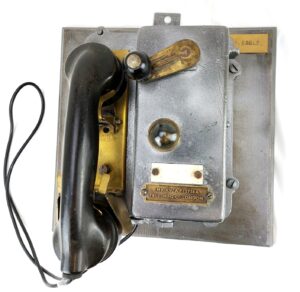
Royal Navy Sound-Powered Bulkhead Telephone – HMS Eagle
Communication aboard a warship required constant coordination between multiple departments, from the bridge and flight deck to engine rooms and damage control stations. One of the most reliable systems used by the Royal Navy during the Second World War was the sound-powered telephone.
Unlike conventional telephones, sound-powered sets required no batteries or electrical supply. Instead, they converted the energy of the speaker’s voice directly into electrical signals capable of travelling through the ship’s communication network.
Manufactured by the Telephone Manufacturing Company in London, the Mark XV Admiralty Pattern A.P.13734A telephone was designed to withstand the harsh environment aboard naval vessels. Heavy cast alloy construction and robust fittings ensured reliability even under battle conditions.
This particular example is engraved to HMS Eagle, the Royal Navy aircraft carrier that served extensively in the Mediterranean during the war before being sunk in 1942 during Operation Pedestal. Equipment associated with historic vessels such as this offers a powerful connection to Britain’s wartime naval history.
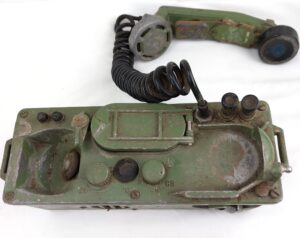
Yugoslav People’s Army M-63 Field Telephone by Iskra
Following the Second World War, military communication technology continued to evolve as nations modernised their armed forces. The M-63 field telephone, produced for the Yugoslav People’s Army, represents this later generation of military communications equipment.
Introduced in the early 1960s as a successor to earlier designs, the M-63 was developed for use in field conditions where reliable wired communication was still essential. The design shows clear influence from American field telephones, particularly the TA-43 system.
Manufactured by the Slovenian company Iskra, the telephone was capable of transmitting signals across field wire networks up to 30 kilometres in length. It could operate within several different communication systems, including local battery and central battery exchanges.
Despite the growing use of radios during the Cold War, wired communication systems like the M-63 remained important because they offered greater security and were less vulnerable to interception or electronic interference.
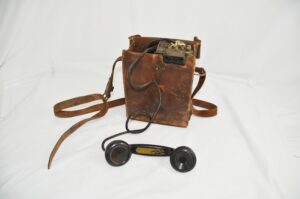
US Army Signal Corps EE-8 Field Telephone
The EE-8 field telephone was one of the most widely used communication devices employed by the United States Army during the Second World War. Introduced in the 1930s, the telephone remained in service for decades and continued to see use during later conflicts.
Housed within a rugged leather carrying case, the EE-8 was designed for mobility and durability. Signal Corps soldiers could carry the telephone with them as they laid miles of communication wire connecting command posts and frontline units.
The telephone used D-cell batteries to power voice transmission and a hand-cranked generator to ring the telephone at the other end of the line. Under suitable conditions, communication could be maintained across distances of up to seven miles.
Behind many wartime operations were the Signal Corps personnel responsible for establishing and maintaining these communication networks, often under extremely dangerous conditions.
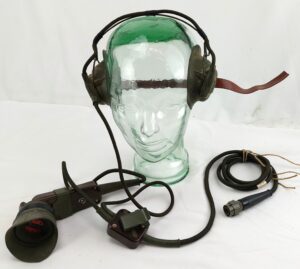
British Army Larkspur A41 Tank Commander’s Communications Headset
During the early years of the Cold War, the British Army introduced the Larkspur radio system to modernise battlefield communication. Developed in the late 1940s, Larkspur equipment remained in use for several decades before eventually being replaced by the Clansman radio system.
The Larkspur A41 radio was commonly used in armoured vehicles, allowing crews to communicate with other vehicles and command units using VHF radio transmission.
This communications headset was designed specifically for use inside armoured vehicles where engine noise and vibration made ordinary speech difficult. The headset features rubber earcups to reduce noise and a secure headband design to keep the unit in place during movement.
Paired with a handheld push-to-talk microphone, the system allowed tank commanders and vehicle crews to maintain clear communication while keeping their hands free to operate equipment.
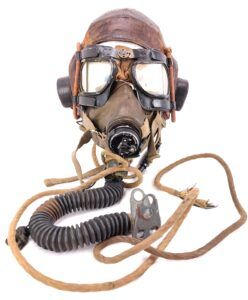
RAF Type C Flying Helmet, Goggles and Oxygen Mask Set
Few artefacts capture the atmosphere of the Second World War quite like the equipment worn by RAF bomber crews. Flying at high altitude in extreme conditions, airmen relied on specialised clothing and communication equipment for both safety and operational effectiveness.
The RAF Type C flying helmet, introduced during the early 1940s, represented an important development in aircrew equipment. Made from leather and fitted with internal wiring for radio receivers, the helmet allowed pilots and crew members to communicate clearly during flight.
Accompanying the helmet are RAF Mark IVB flying goggles and a G Type oxygen mask introduced in 1942. The oxygen mask incorporates the Type 48 magnetic microphone, allowing speech to be transmitted directly through the aircraft’s intercom system.
Together, these items represent the equipment worn by the crews of iconic RAF aircraft such as the Lancaster bomber, which carried out long and dangerous missions across occupied Europe.
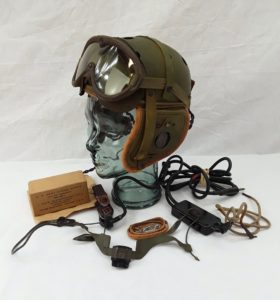
US M1938 Tanker Helmet Communication Set by Rawlings
Armoured warfare presented unique communication challenges. Inside a tank, the noise of engines, weapons, and moving tracks made normal conversation impossible. To overcome this, specialised helmets with integrated communication equipment were developed.
The US M1938 tanker helmet, produced by Rawlings, became standard issue for American armoured crews during the Second World War. The padded leather construction provided protection while allowing headphones and microphones to be integrated into the helmet.
This complete communication set includes the helmet with earphones and goggles, along with associated microphones and communication equipment used by tank crews.
Such systems allowed crew members to communicate internally and maintain contact with other vehicles in their unit during combat operations.
Military communication equipment played a vital role in the outcome of twentieth-century conflicts. From field telephones linking frontline units to headsets used by tank crews and bomber pilots, these devices allowed commanders and soldiers to coordinate complex operations in some of the most challenging conditions imaginable.
Today, surviving examples provide a fascinating window into the technology and history of the period. Each piece tells its own story of innovation, service, and the people who relied upon it during wartime.
All of the historic items featured in this article are available to view and purchase both online and in our shop, offering collectors and enthusiasts the opportunity to own a genuine piece of military communication history.