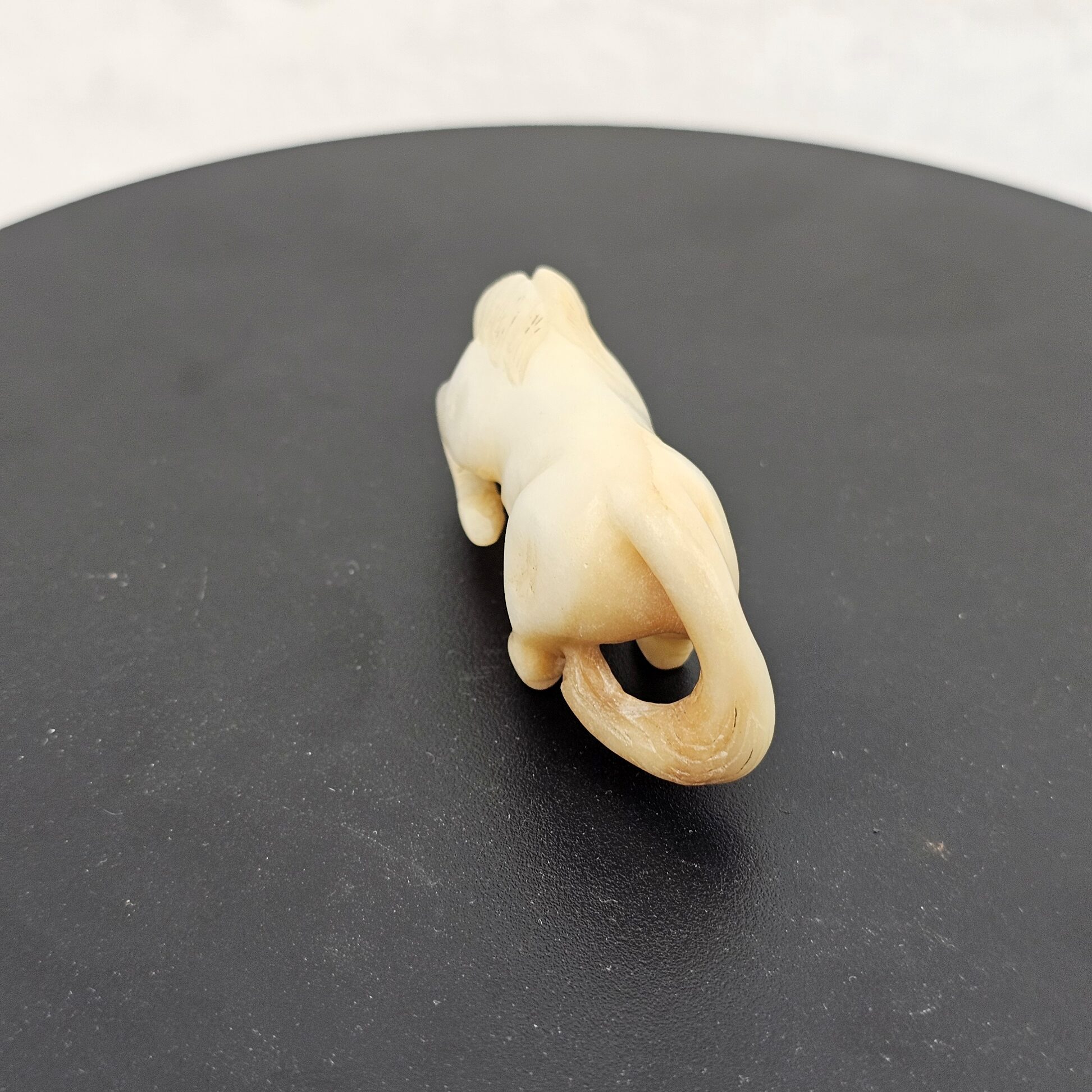
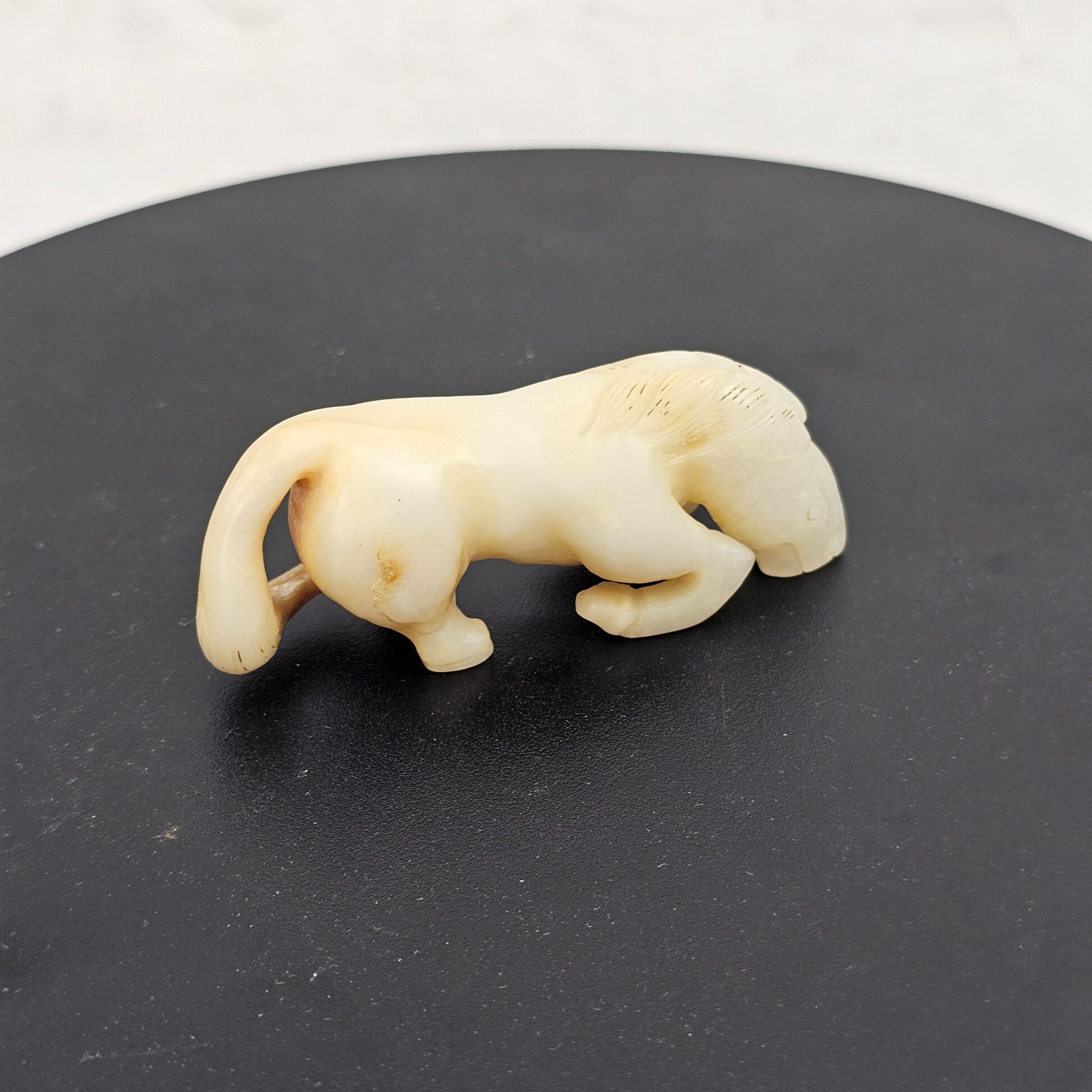
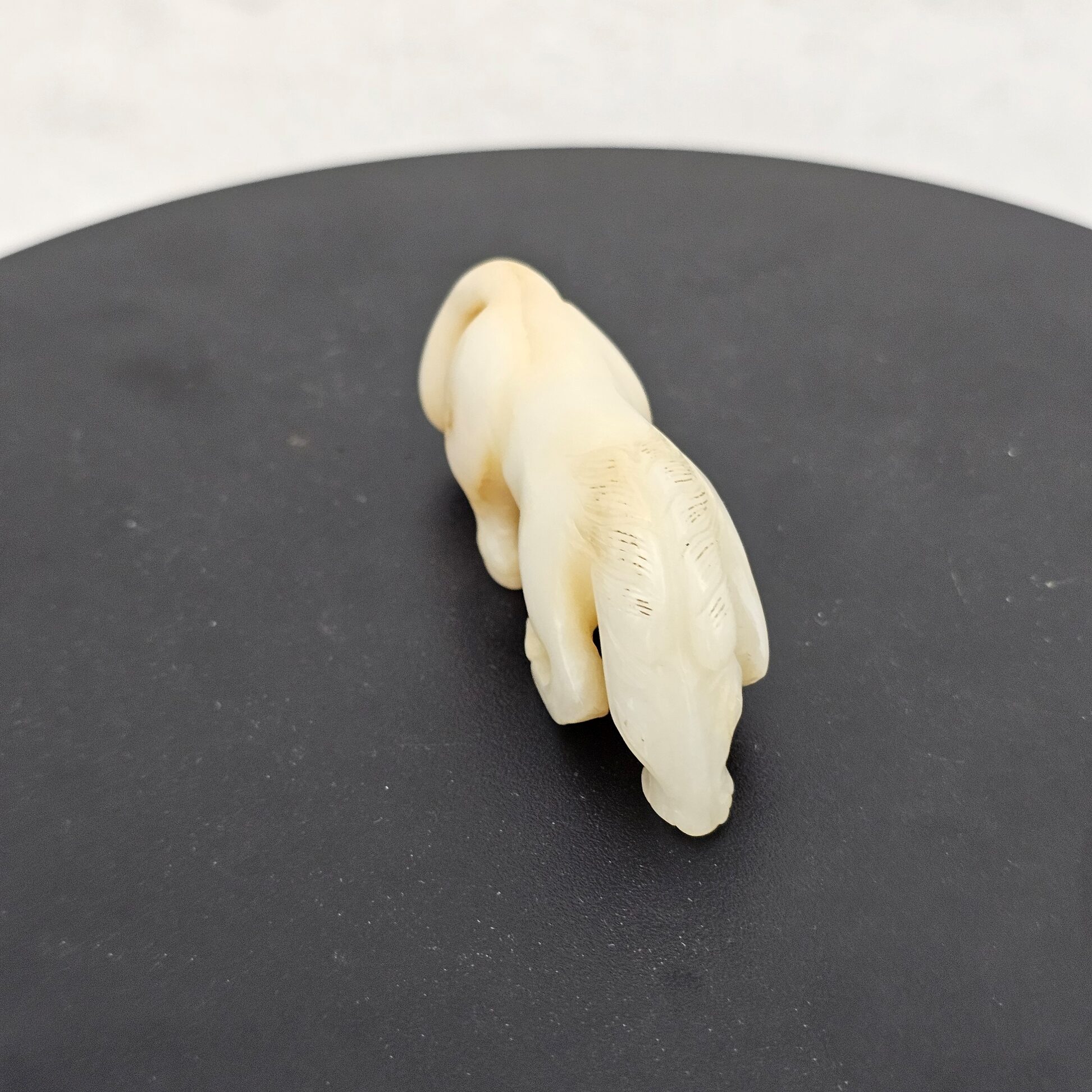
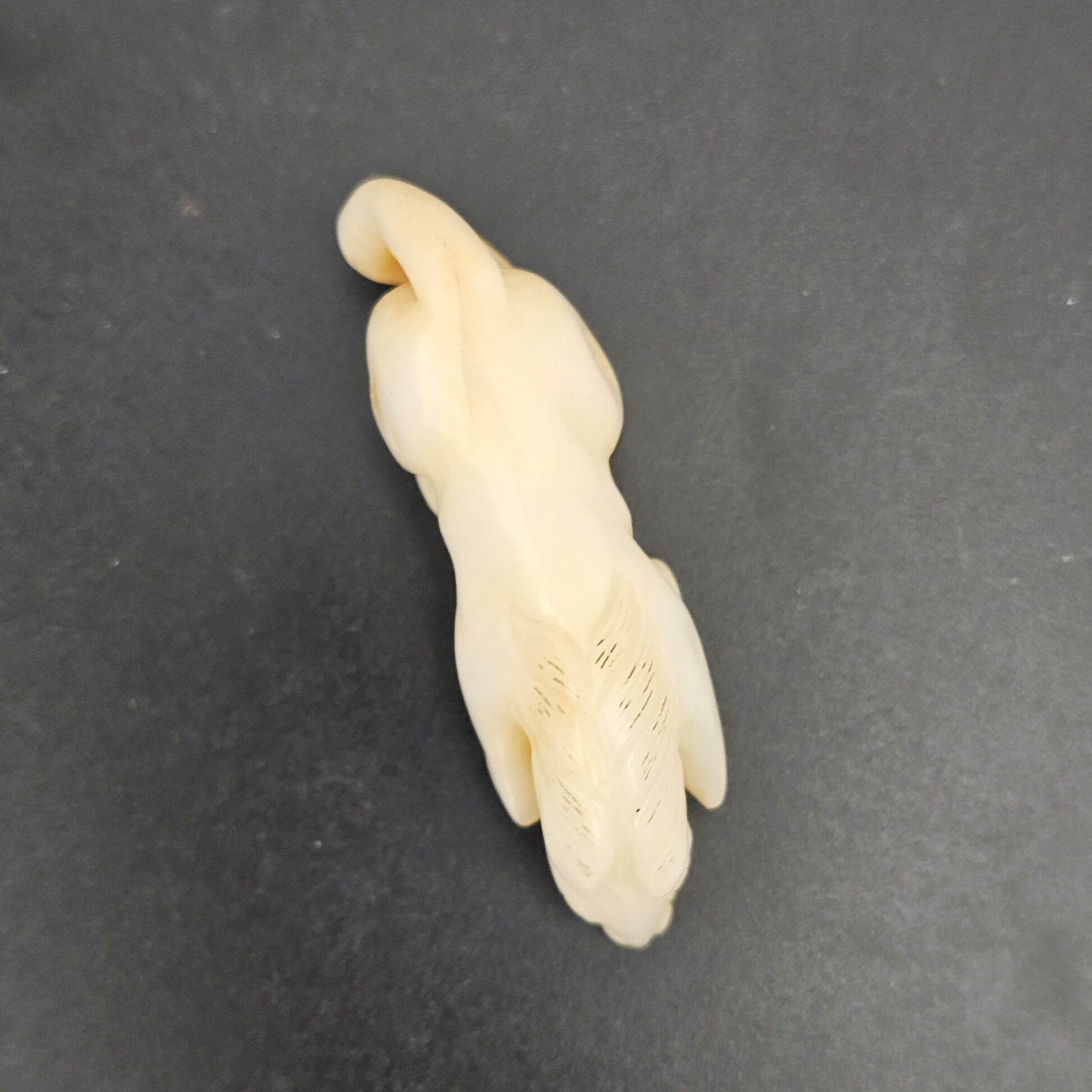
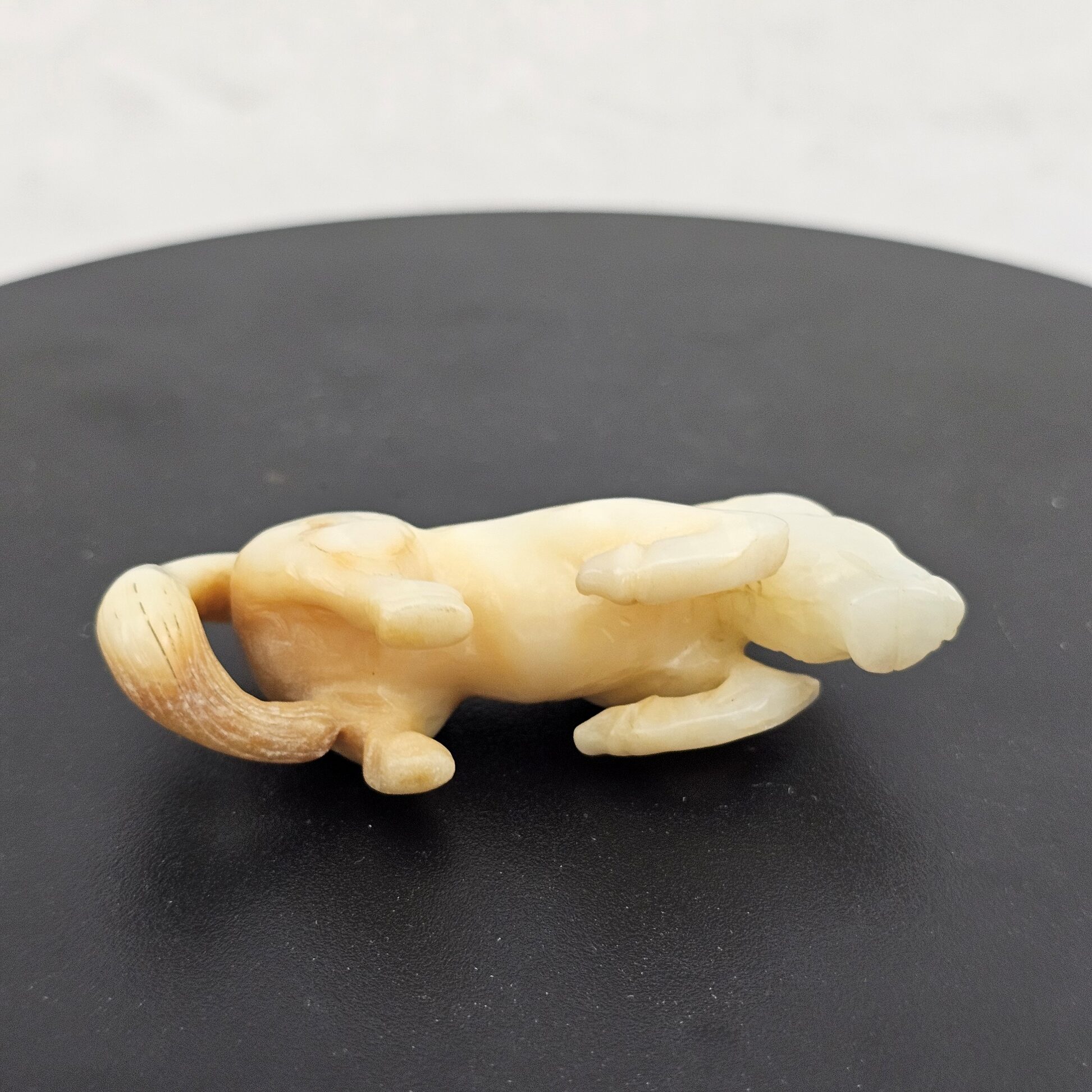
~ Chinese White and Russet Nephrite Jade Carving of a Kneeling Horse, Possibly Ming Dynasty ~
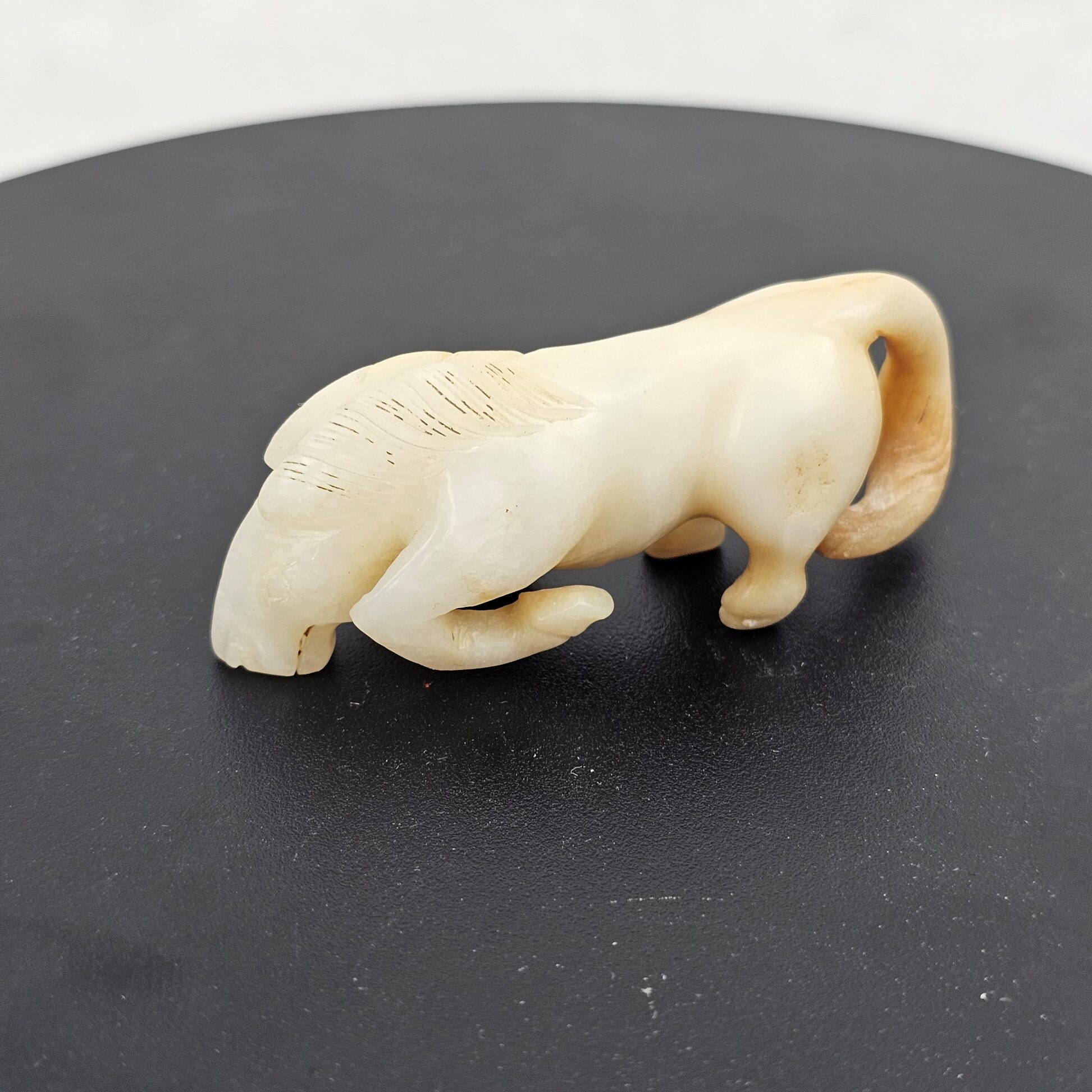
A finely carved nephrite jade sculpture of a horse in a kneeling, bowing posture, depicted with its front legs folded beneath the chest and the head lowered in an attitude of humble submission or rest. The piece is carved fully in the round from a single stone and intended as a scholar's desk object for handling and contemplation rather than as a pendant, no suspension hole being present.
The horse's body is broadly proportioned in the characteristic manner of Chinese jade horse carvings of the Ming and Qing periods, with a rounded, substantial physique and a powerful neck. The mane is rendered with confidence via densely incised fine parallel lines running across the neck and extending down to the shoulder, a technique clearly visible in multiple images. The tail is a notably distinctive feature, curling back on itself in a tight spiral or loop, which is a recurring stylistic hallmark of Ming dynasty jade horse carving. The hooves and leg joints are suggested with simple incised lines, and the ears are pricked and alert despite the bowed posture.
The stone is a warm cream to ivory-white nephrite with small russet and amber inclusions, particularly concentrated at the haunches and tail where they contribute a warmth to the composition, the russet zone at the tail being integrated naturally into the carved spiral. Overall the stone surface retains a fine waxy polish consistent with long and careful handling.
~ Historical Context ~
The horse occupies a uniquely prestigious position in Chinese culture and imperial symbolism. There is growing interest in jades from the Ming dynasty and earlier, which typically are of less pure tones, as the best quality jades were simply not as available at the time to craftsmen, making well-carved Ming jade animals of established type particularly sought after in today's market.
The kneeling horse, bai ma (拜馬, literally "horse paying homage"), has an exceptionally long lineage in Chinese art, with roots in Han dynasty bronze and ceramic traditions where the bowing horse signified loyalty, submission, and the celestial horse of Heaven presenting itself to the emperor. A directly comparable pale green and russet jade carving of a horse of Ming dynasty date, carved kneeling with its legs tucked beneath the large body, the arched neck with neatly-parted incised mane and pricked ears, was sold at Bonhams with distinguished provenance tracing to Captain E.G. Spencer-Churchill (1876-1964) of Northwick Park, Gloucestershire, and thence through Christie's London in 1965. The close correspondence between that piece and this one, in pose, mane treatment, general proportions, and the use of russet inclusions at the hindquarters, strongly supports consideration of a Ming dynasty attribution for this carving.
Ming dynasty jade animal carvings are characterised by a certain robustness of form combined with restrained but skilful incised detail, and by the use of jade available at the time, which was typically of mixed colour rather than the purer white stones that became more prevalent in the Qing period after the conquest of Xinjiang.
~ Condition ~
Body: The main carved body of the horse appears structurally sound; no fractures or major damage visible to the torso, hindquarters, or legs.
Mane: The incised mane detail is well-preserved and clearly legible throughout.
Tail: The spiraling tail appears intact.
Head and mouth: Close examination of images 1 and 5 reveals what appears to be a crack, old repair, or fissure in the region of the lower jaw or mouth of the horse. This must be examined carefully in person and disclosed to prospective buyers. It is unclear from photographs whether this represents a repaired break or a natural fissure in the stone that was present during or before carving.
Surface: Good waxy polish retained throughout; some minor age-related marks and surface patina consistent with long handling.
Underside: The flat base of the piece appears smooth and intact; no suspension hole is present, confirming this is a desk/display object rather than a pendant.