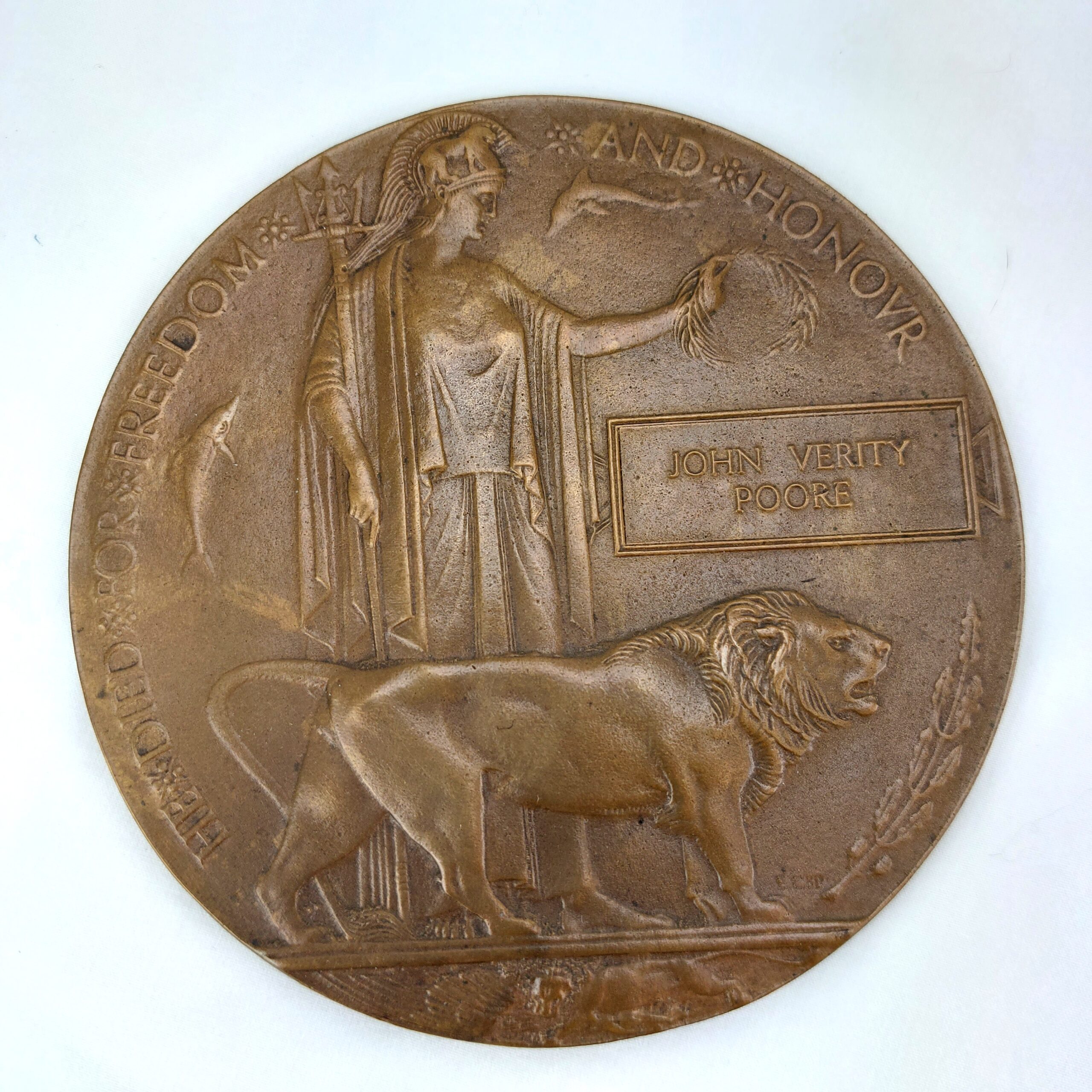
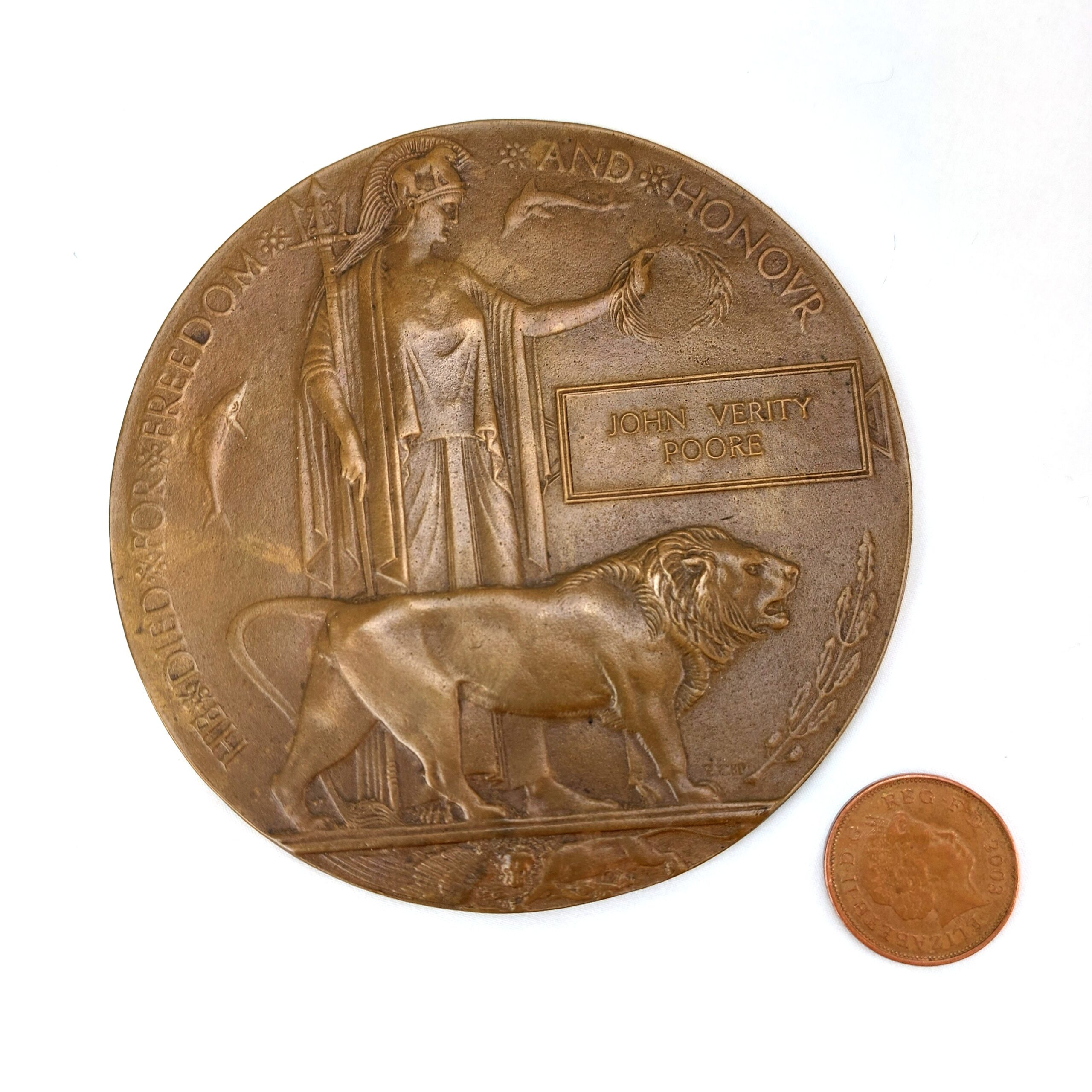
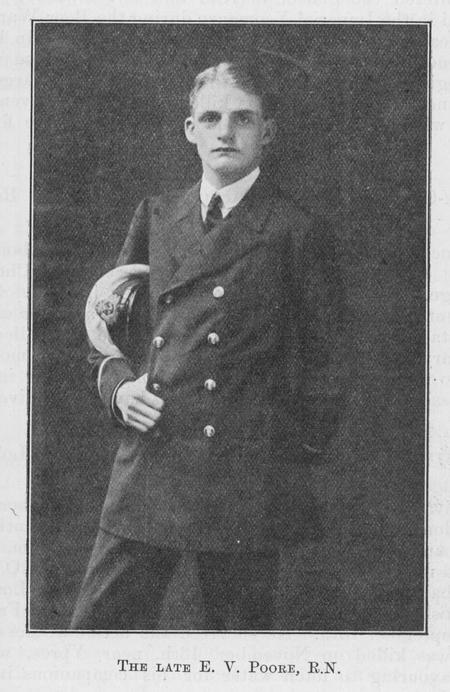
*British, WW1, Memorial Plaque "Death Penny" No. 48 - John Verity Poore.*
Approx 12cm
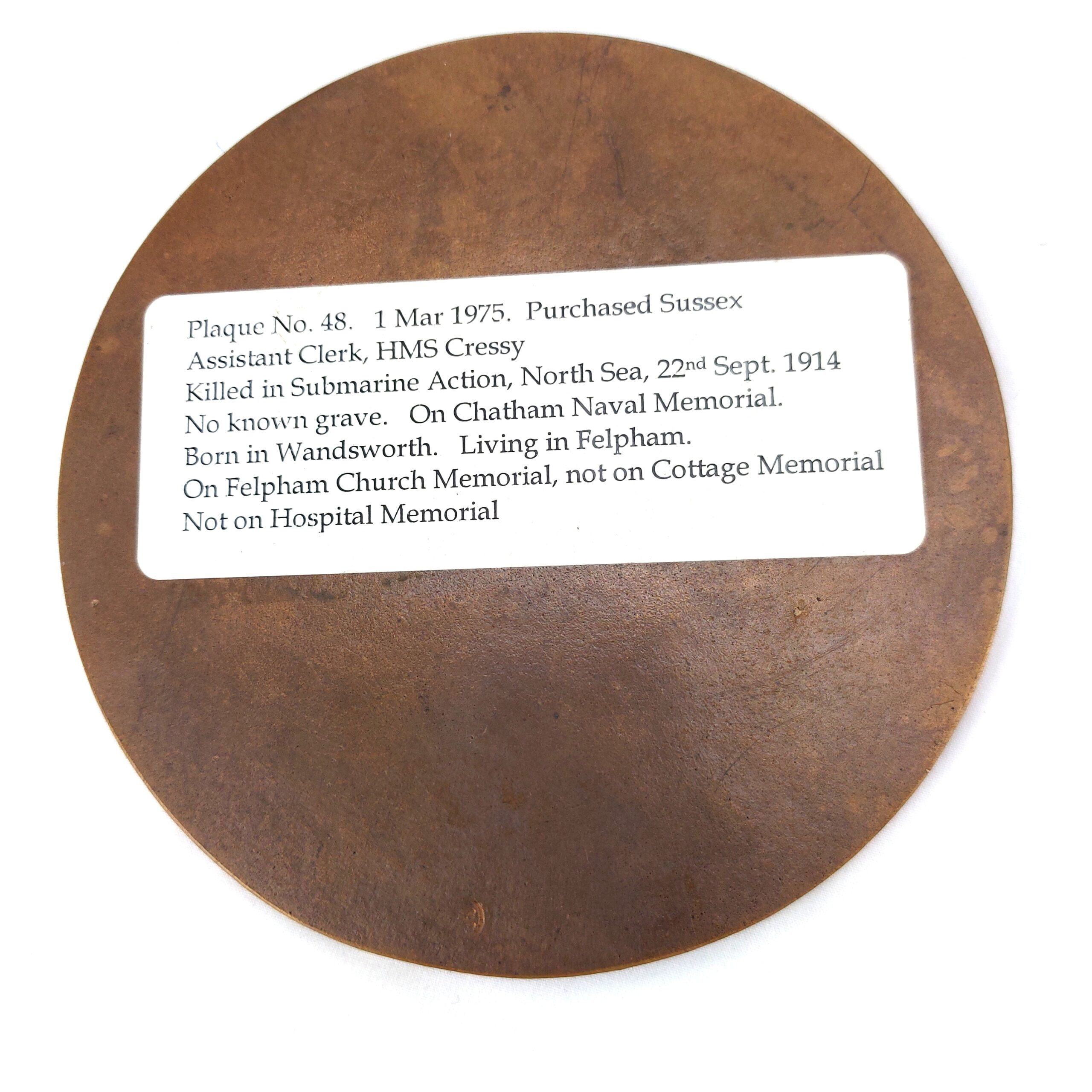
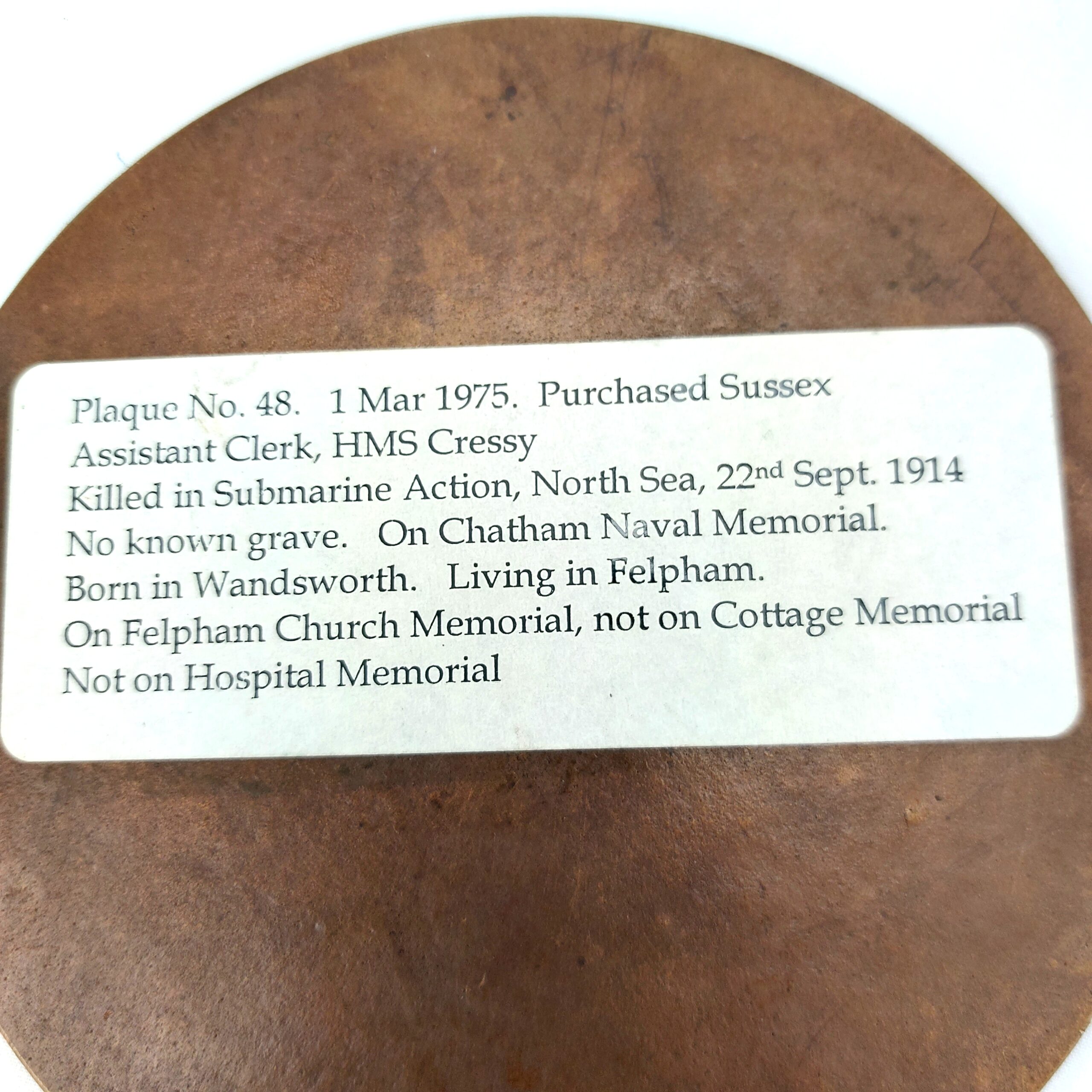
Issued to John Verity Poole, Assistant Clerk, H.M.S. Cressy, Killed in Submarine Action, North Sea, 22nd Spt 1914. John was aged 17 and was a clerk and the youngest officer on board Cressy having been in post for 8 weeks. He plunged into the sea but drowned despite being a capable swimmer. He is commemorated on the Chatham Naval Memorial, Kent. Went to Merchant Taylors School, NorthWood.
Shortly after 6:30am, 22 September 1914, three cruisers, HMS Cressy, Hogue and Aboukir were taking part in a patrol in the North Sea, Aboukir was hit by two torpedoes fired by the German submarine U9. It sank in 10 -15 minutes. Hogue and Cressy stopped to pick up survivors Hogue was sunk next and the last torpedo sunk Cressy. On HMS Cressy 1459 were lost and 837 rescued.
The Board of Enquiry after the battle criticized all senior officers involved. Rear Admiral Campbell told the enquiry he didn’t know what the purpose of the command was. The bulk of the blame was laid at the Admiralty for persisting with a patrol which was dangerous and of limited value against the advice of seagoing officers. Cressy and her sister ships, Aboukir and Hogue were older cruisers and unable to maintain the 12-13 knots asked of them. They were described as 3 inefficient cruisers, too slow and with an inexperienced crew of predominantly reservists and cadets. Cressy was built 1898-1901, was 12,000 tons and was the first British sea-going ship not to be copper-bottomed but to use antifouling paint (a saving of £40,000 and 500 tons displacement). It was state of the art in its day but past it by WW1.
John was born in Louiville Rd Balham, 21st June 1897, his parents were John Barter, a civil servant at the Board of Education, and Jessie Poore. The family later moved to 293 Trinity Road. His elder brother, Eric Vincent, 3 yrs older, was in the army services corps and appears to have survived the war. He also had a sister, Joan Verity, who was 6 years younger. John was educated at Highfield School, Trinity Rd, and Merchant Taylors. He was the War’s first fatality amongst Merchant Taylor old boys, and appears on their Roll of Honour.
The First World War memorial plaque, also known as the “Dead Man’s Penny,” was issued to the next-of-kin of British Empire service personnel who died in the war. These bronze plaques, about 4.72 inches (120 mm) in diameter, were awarded to commemorate the deceased. A total of 1,355,000 plaques were issued, using 450 tons of bronze. The design of the plaque was chosen through a public competition, with over 800 submissions. Sculptor Edward Carter Preston, using the pseudonym Pyramus, won the competition. The designer’s initials, E.CR.P., appear above the front paw. In her outstretched left hand Britannia holds an olive wreath above the ansate tablet bearing the deceased’s name cast in raised letters. Below the name tablet, to the right of the lion, is an oak spray with acorns. The name does not include the rank since there was to be no distinction between sacrifices made by different individuals. Two dolphins swim around Britannia, symbolizing Britain’s sea power, and at the bottom a second lion is tearing apart the German eagle. The reverse is blank, making it a plaquette rather than a table medal. Around the picture the legend reads (in capitals) “He died for freedom and honour” (a different plaque was made for women). The plaques were initially manufactured in Acton, London, starting in 1919. Early Acton-made plaques did not have a number stamped on them but later ones have a number stamped by the lion’s back leg. This one has no 48.
*Condition*
This death penny is in excellent condition. Photograph of John Poore not included. Please see photographs as part of the condition report.
RQMFOXAAO_9442156440