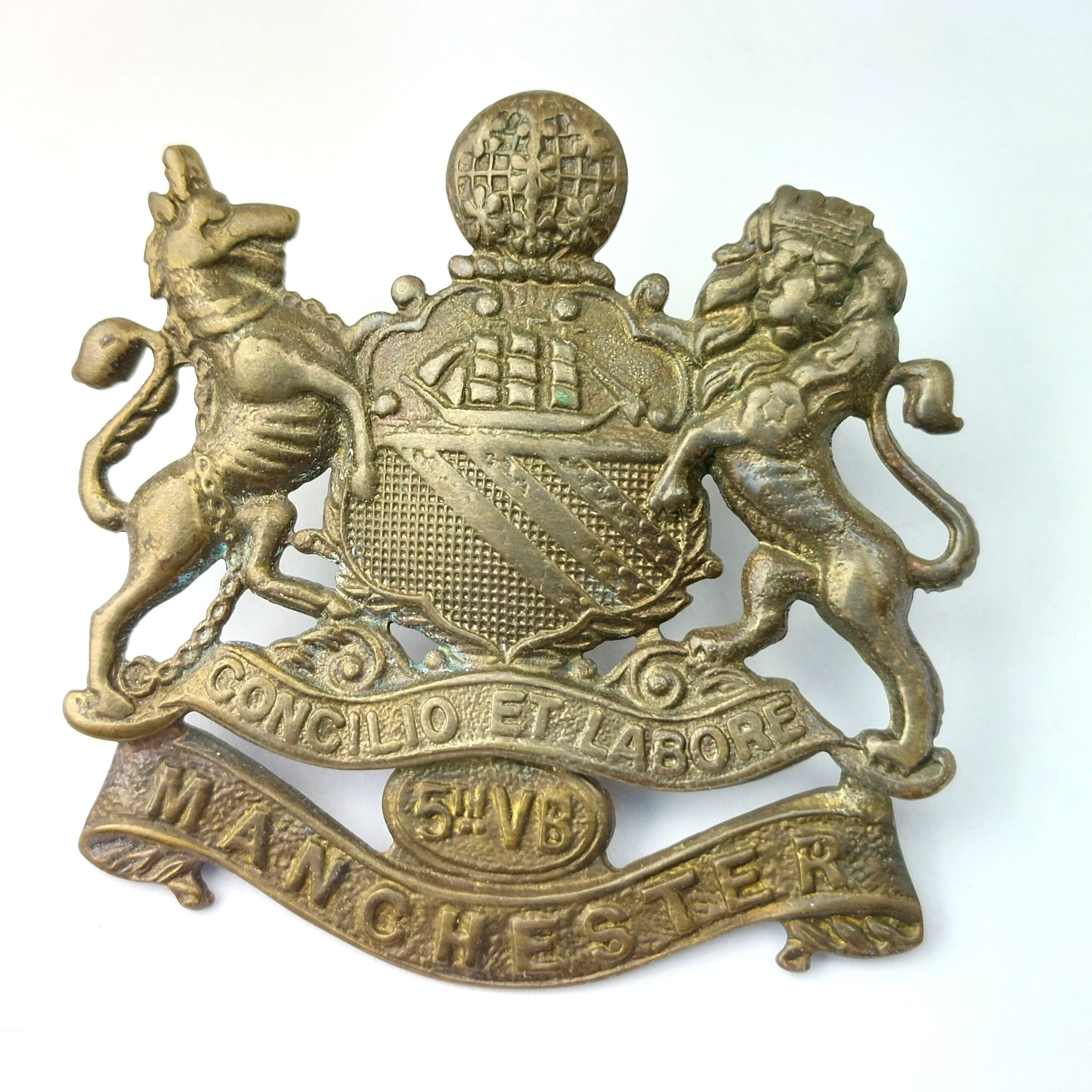
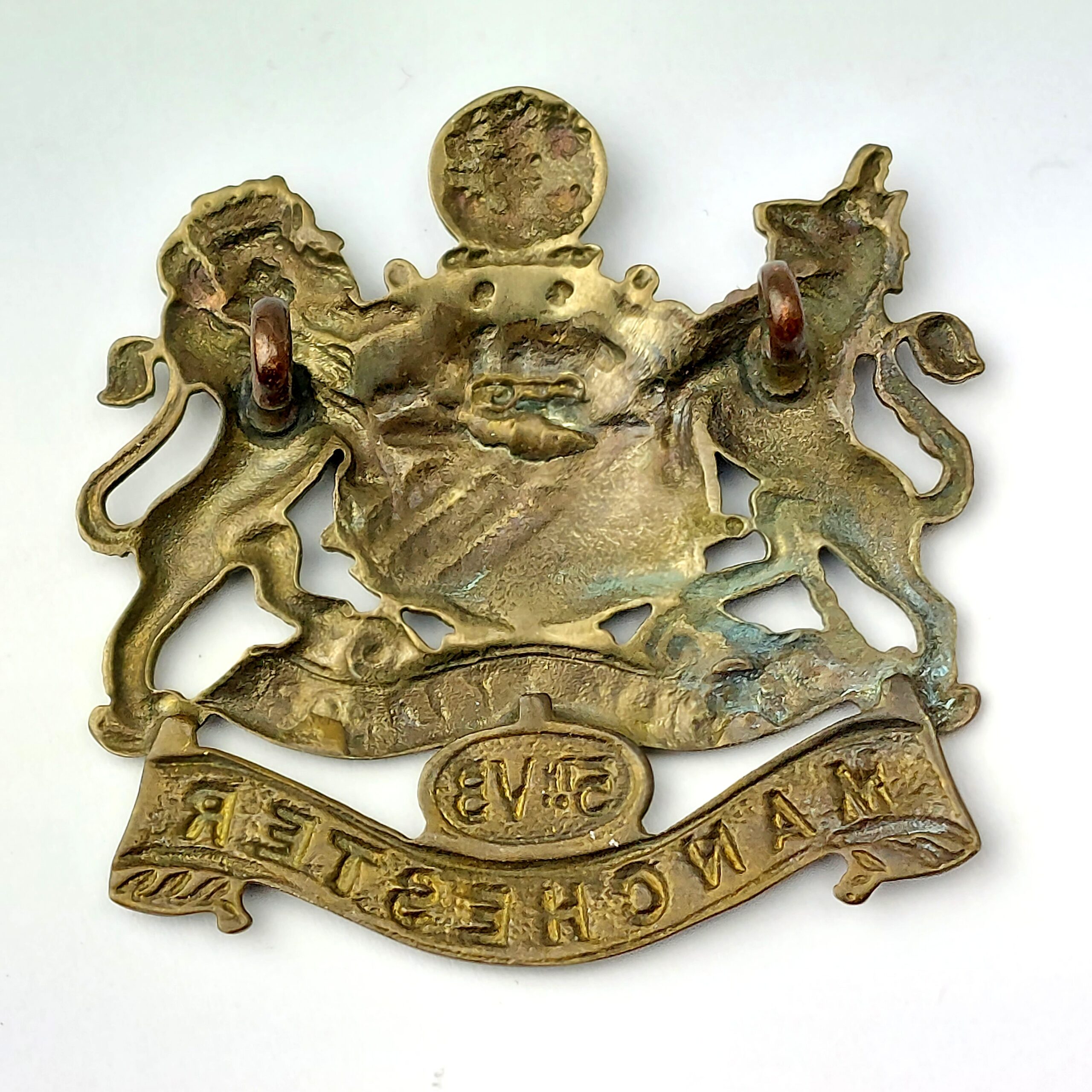
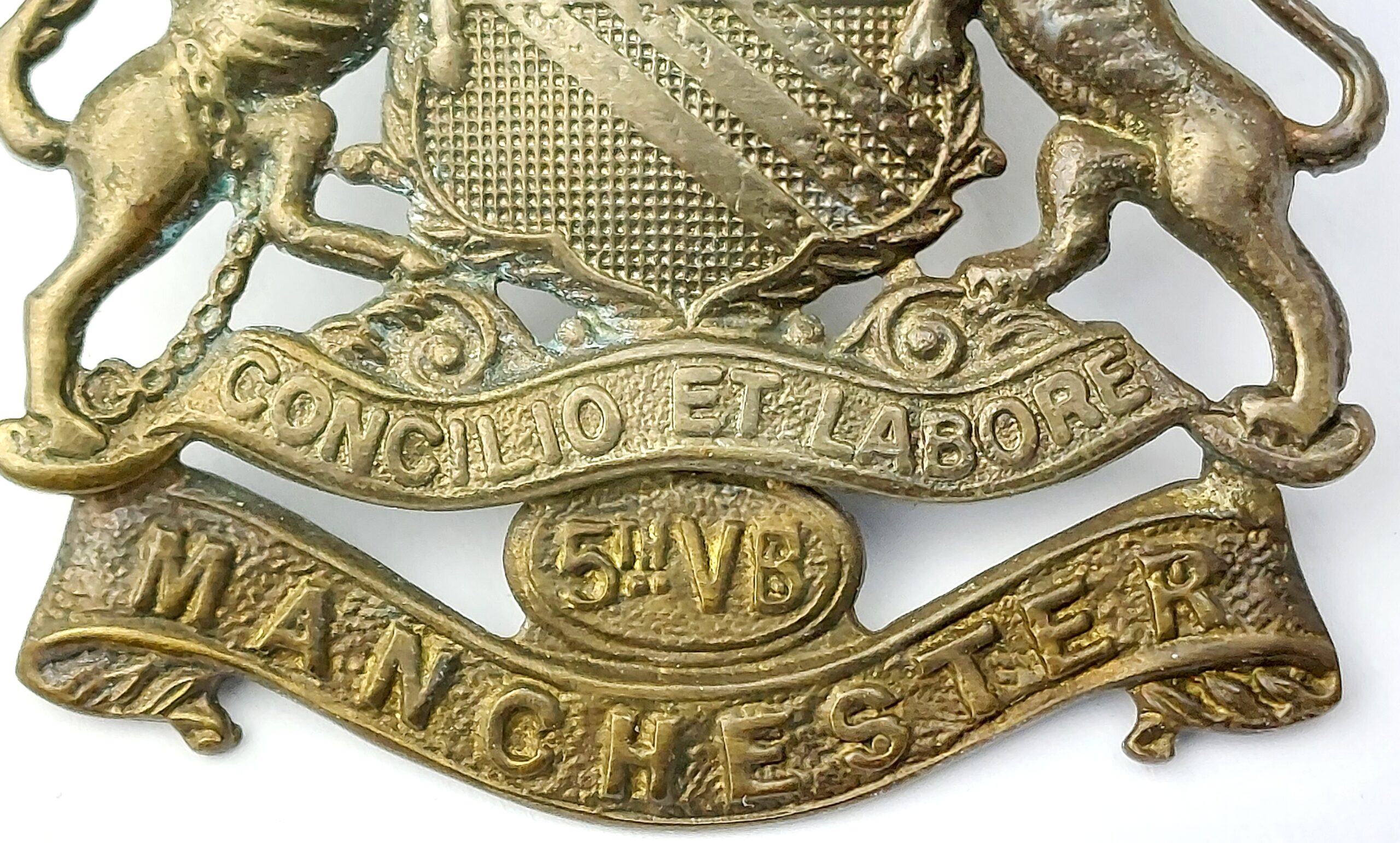
*British, Late Victorian / Edwardian c.1896–1908, Manchester Regiment 5th Volunteer Battalion Cap Badge, Brass, City of Manchester Arms, 2 Lugs*
A well-detailed Victorian-period brass cap badge of the 5th Volunteer Battalion, Manchester Regiment, featuring the full City of Manchester coat of arms with the regimental designation “5th VB” prominently displayed beneath the motto scroll.
The badge shows the heraldic shield of Manchester supported by a lion and antelope, with the Latin civic motto “Concilio et Labore” (“By wisdom and effort”) above a scroll bearing “Manchester.” At the centre is the oval “5th VB” designation identifying the 5th Volunteer Battalion, one of the volunteer infantry units attached to the Manchester Regiment prior to the Territorial reforms of 1908. The design reflects Manchester’s civic identity and industrial symbolism, incorporating the distinctive globe with bees crest above the shield — representing the city’s industrious character and its importance as a centre of global trade during the late nineteenth century.
Approx. Measurements – 5 cm x 5 cm.
History Note:
The Manchester Regiment was formed in 1881 as part of the Childers Reforms, which reorganised the British Army’s infantry regiments. Alongside the regular battalions, a number of Volunteer Battalions were raised for local defence and part-time service.
The 5th Volunteer Battalion (VB) was one of these units and was closely associated with the industrial towns of Lancashire, particularly Wigan, where its drill hall stood on Powell Street. Like many volunteer formations of the era, its members were largely drawn from local tradesmen, clerks, and factory workers — part-time soldiers often referred to colloquially as “Saturday night soldiers.” Volunteer battalions were not initially intended for overseas service, but during the Second Boer War (1899–1902) many volunteers from units such as the 5th VB served in South Africa through specially formed volunteer service companies attached to regular battalions.
The cap badge illustrated here uses the Manchester civic arms, which served as the regiment’s badge from the regiment’s formation until the early twentieth century. Some soldiers disliked the design — nicknaming it the “tram conductor’s badge” because of its large size and elaborate civic heraldry. In the years following the First World War, the regiment adopted the simpler fleur-de-lis emblem more commonly associated with Manchester units.
In 1908, the Haldane Reforms reorganised the Volunteer Force into the Territorial Force, and the 5th Volunteer Battalion became the 5th Battalion, Manchester Regiment, a unit that would later see extensive service during the First World War, including at Gallipoli and on the Western Front.
Badges with lug fittings, such as this example, are typical of earlier manufacture prior to the widespread adoption of slider fittings on later twentieth-century cap badges.
*Condition*
Good original condition for its age. The brass retains a pleasing period patina with some light age-related surface wear and small areas of verdigris visible to the reverse. Both original tall lug fittings remain intact to the reverse, no pin. Please see photographs as part of the condition report.
JAQ#3093E_2311237402