
~ 19th Century Victorian Staffordshire Figural Group of a Sailor and Fruit Seller, c.1860–1880 ~
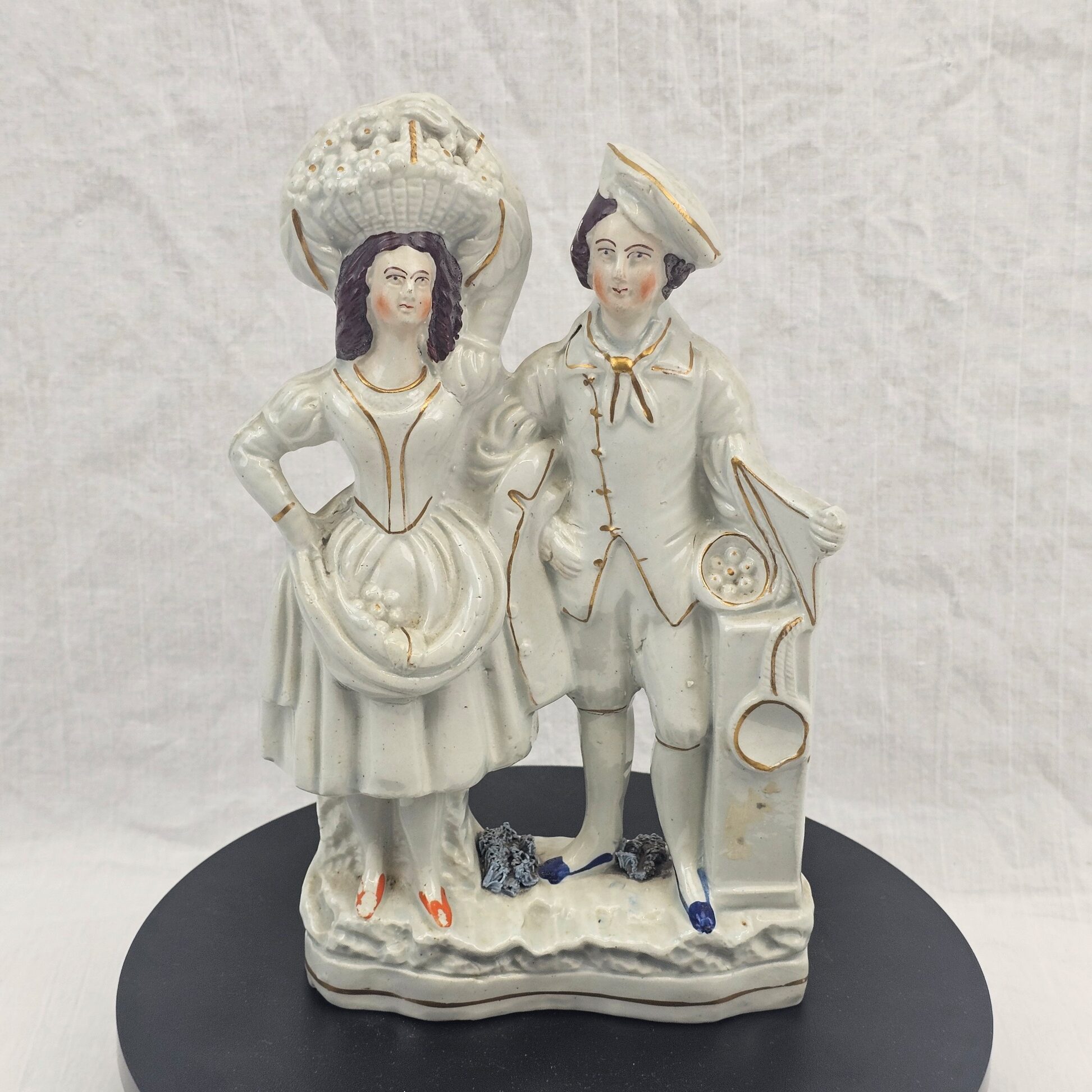
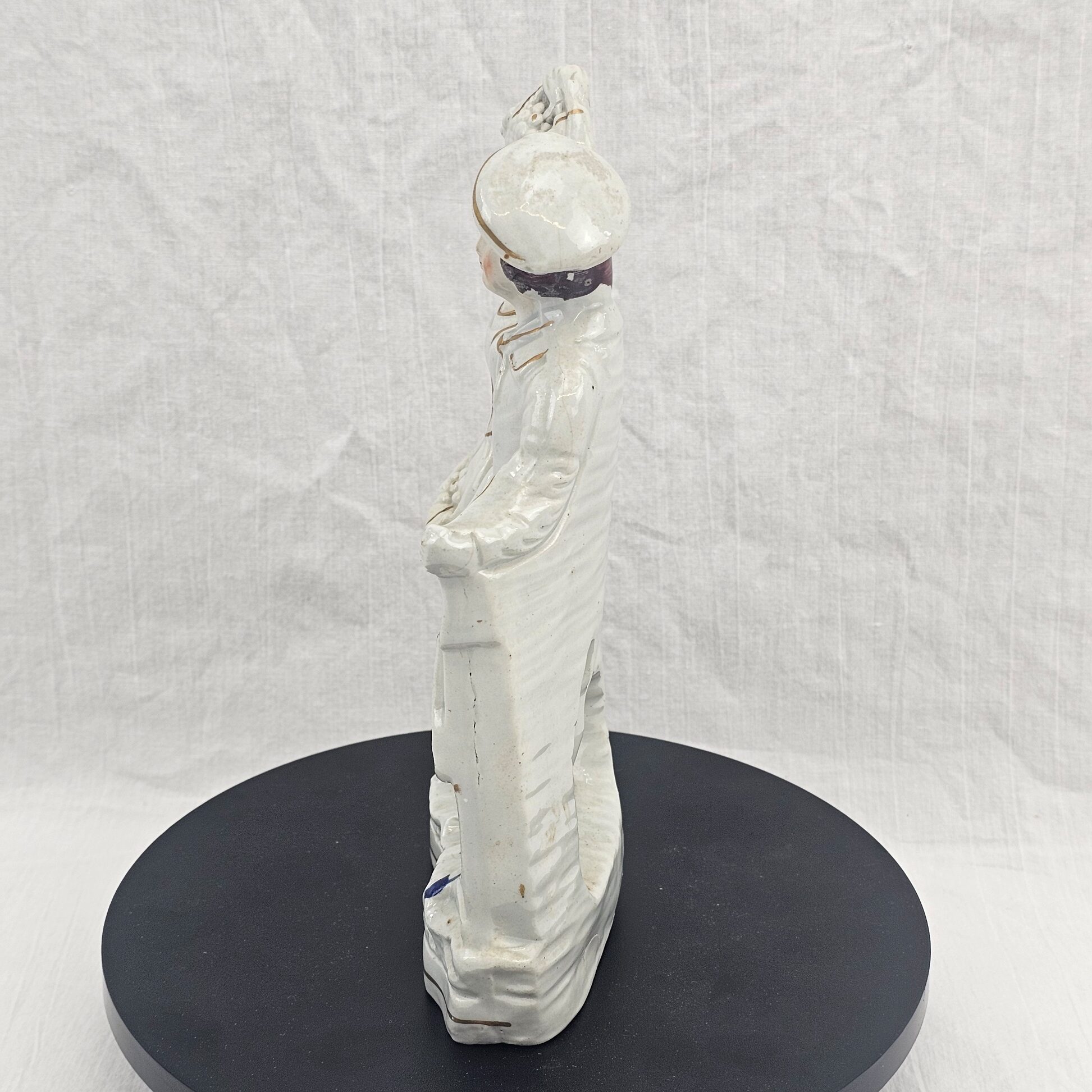
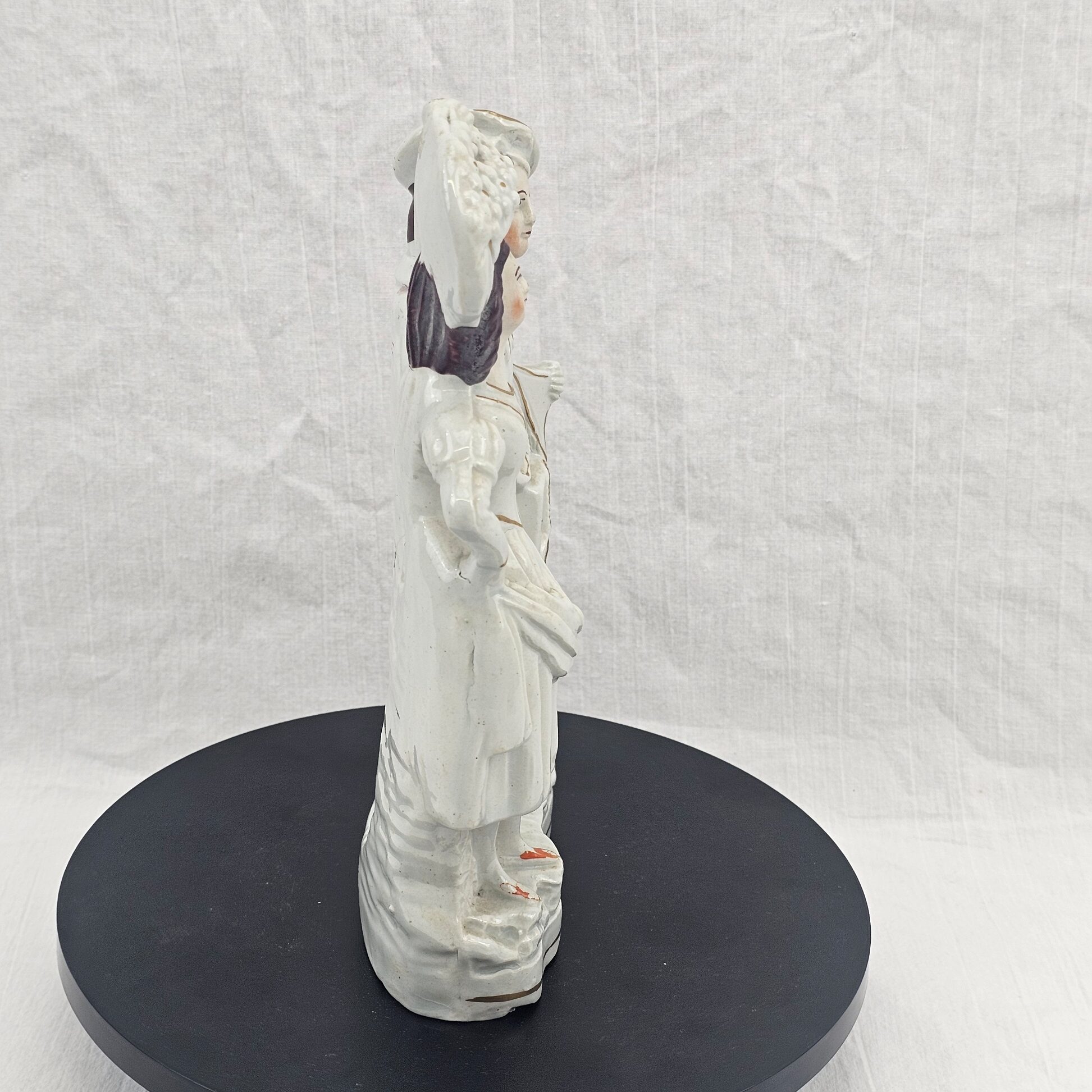
A Victorian Staffordshire pottery flatback figural group modelling a standing sailor and a fruit seller, on a naturalistically moulded base with moulded seaweed details at the feet and a gilt-line decorated plinth. The fruit seller (left) stands with hands on hips, her long dark hair falling to her shoulders, wearing a white dress with red shoes and balancing a large, richly moulded overhead basket heaped with fruit and foliage, with arching gilt handles. The sailor (right) wears a white hat with gilt band, white jacket with gilt-highlighted buttons and cravat, and holds a circular gilt-ringed attribute — likely a telescope — at his side. The group is predominantly white-glazed with gilt highlights throughout and very sparse polychrome colour — the treatment characteristic of later Victorian Staffordshire production when bright enamels gave way to a more restrained, gilt-dominant palette. The reverse is the typical undecorated flatback white. Unmarked, as is standard for this ware type. Approximate height 22 cm (8.75 inches); width 14 cm (5.5 inches).
~ Historical Context ~
Figural groups pairing a sailor with a female companion — variously identified as fruit sellers, flower sellers, or wives awaiting a return from sea — were among the most popular subjects in Victorian Staffordshire cottage-ware production, reflecting the central place of maritime life in British national consciousness throughout the nineteenth century. The sailor figure embodied patriotism, adventure, and domestic sentiment simultaneously, and the pairing with a market-woman or sweetheart was a well-established visual convention across popular prints, theatrical productions, and decorative wares of the period.
The predominantly white and gilt palette of this group, with only minimal use of enamel colour, is characteristic of the later phase of Staffordshire flatback production, broadly from the 1860s through to the 1880s. Most Victorian Staffordshire figures were designed to stand on a shelf or mantelpiece and are only modelled and decorated where visible from the front and sides — these are known as flatbacks. The large overhead fruit basket is a distinctive and ambitious moulded feature, and the overall quality of the moulding places this in the competent middle tier of Victorian Staffordshire group production.
~ Condition ~
This piece carries multiple significant condition defects that must be fully disclosed.
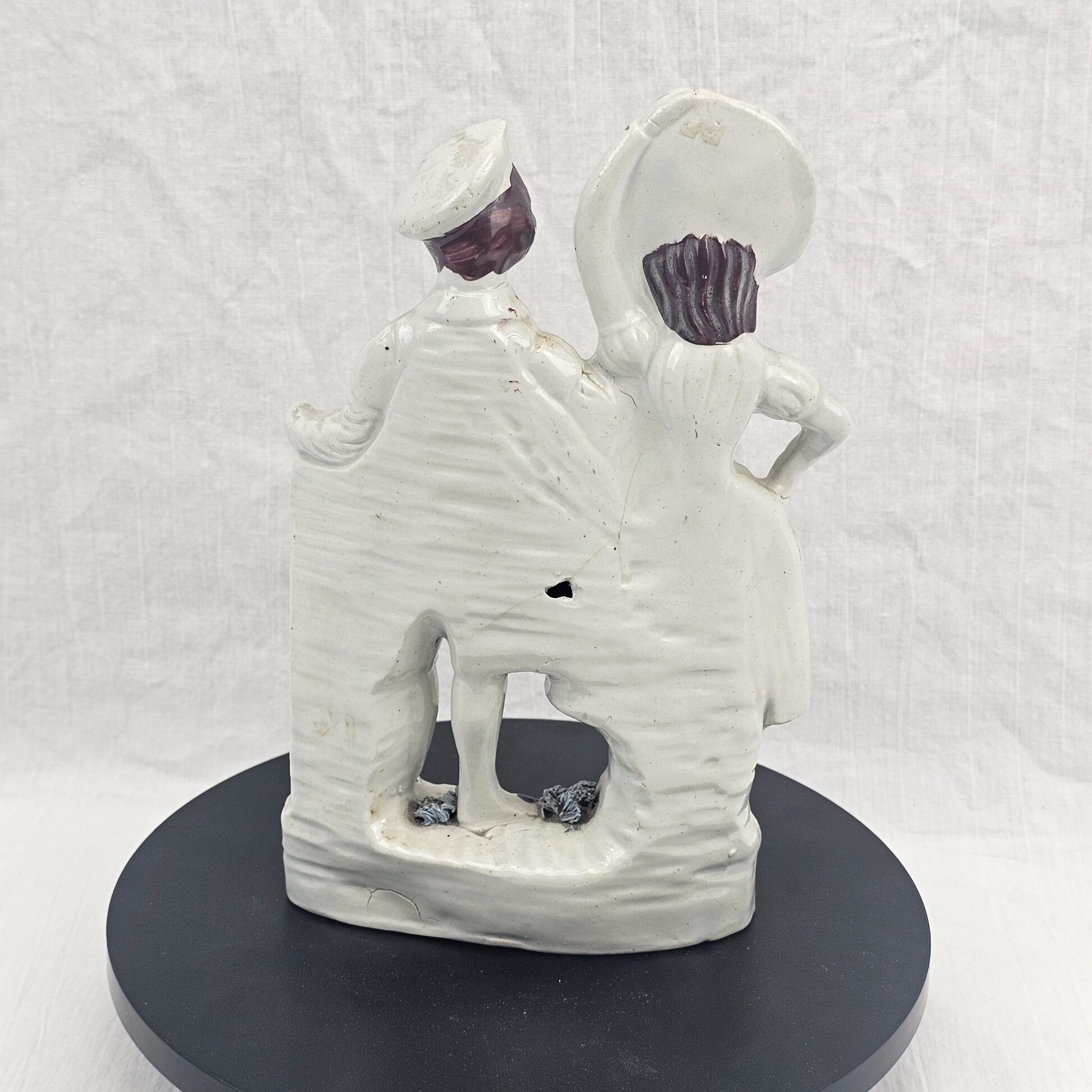
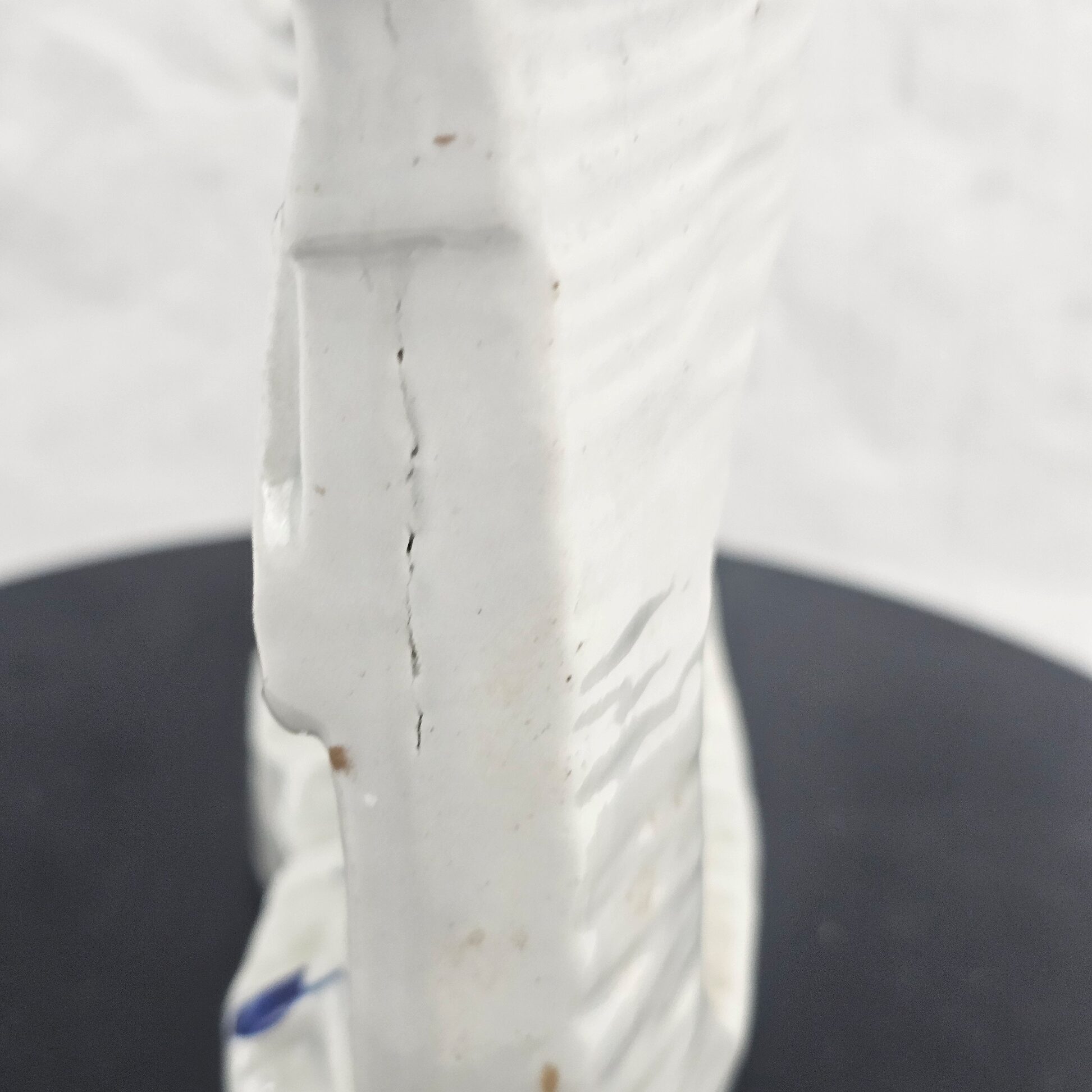
Rear body crack (Images 3 & 5): A substantial crack running vertically through the flatback support structure behind the sailor is clearly visible. This is more than a hairline — it is a significant structural fracture running the length of the backing column.
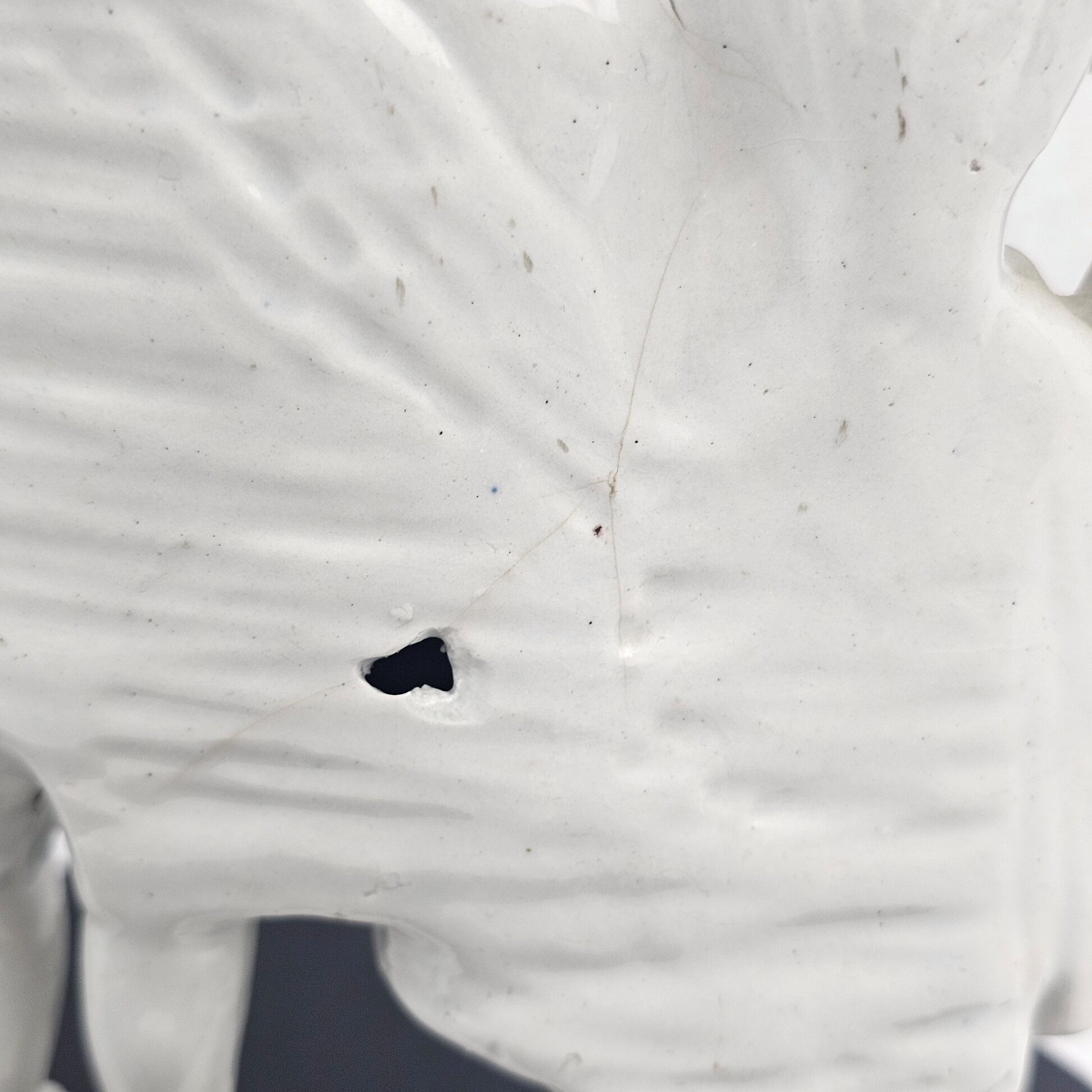
Rear body hole/loss (Image 6): In addition to the crack, there is an actual hole — a break-through loss of material — in the rear body surface, clearly visible as a dark void. This represents missing ceramic and is a serious defect.
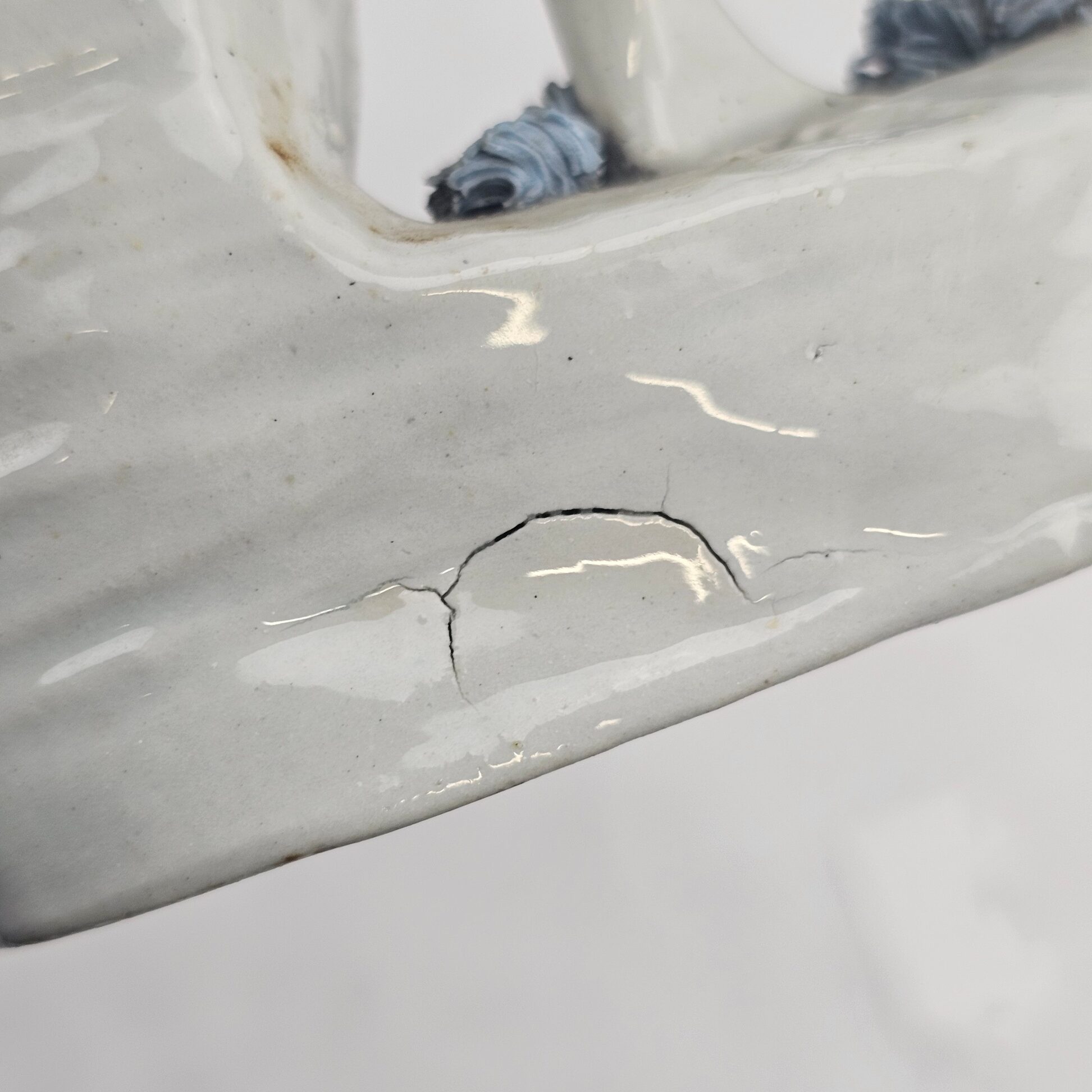
Base fracture (Image 7): A semi-circular crack/fracture is clearly visible at the base plinth, running through the white glazed surface. This is consistent with a stress fracture or impact damage.
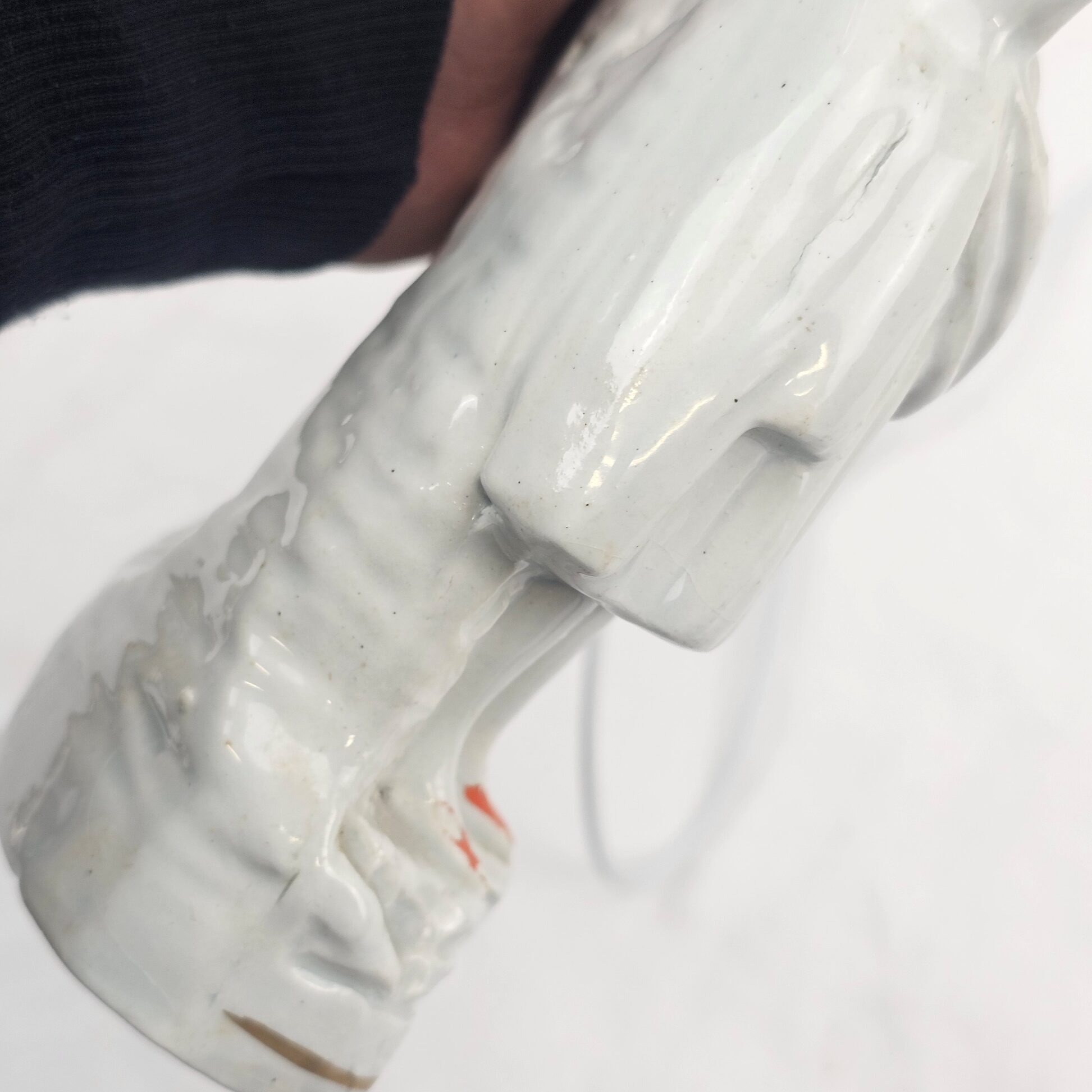
Base underside (Image 8): Confirms stress cracking and glaze fracturing to the underside; a chip/loss is also visible.
Kiln vent hole (Image 3): The circular hole visible mid-rear body is a standard kiln firing vent — a production feature, not damage.
Front face (Image 1): The front presentation is relatively good, with the moulding and gilt detail intact. Minor loss to enamel on the lady's shoes.
~ Dimensions ~
The piece is 22 cm (8.75 inches) tall and 14 cm (5.5 inches) wide.
Reviews
There are no reviews yet.