~ Volkstedt 'The Shoe Fitter', c.1880–1920 Porcelain Figurine Set ~
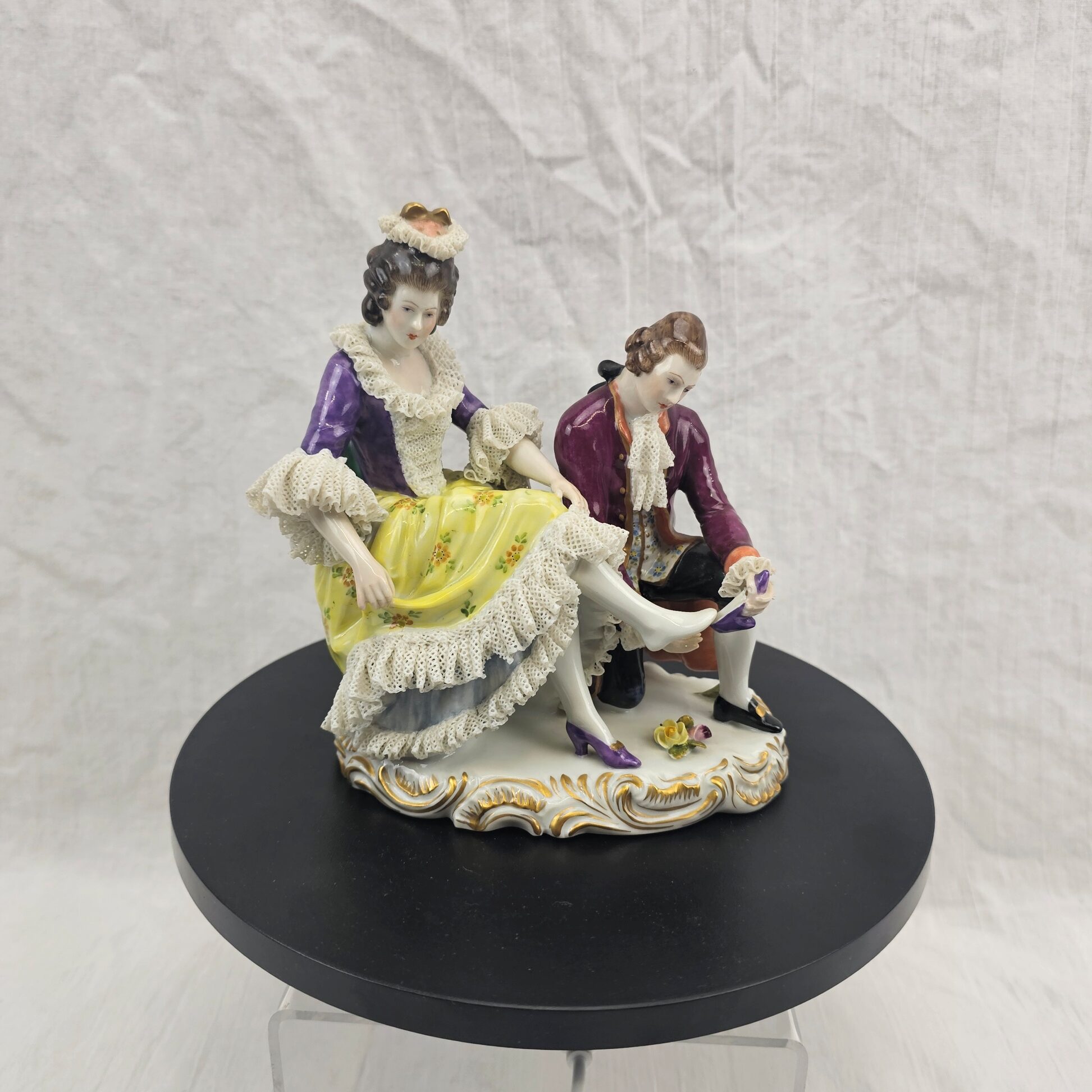
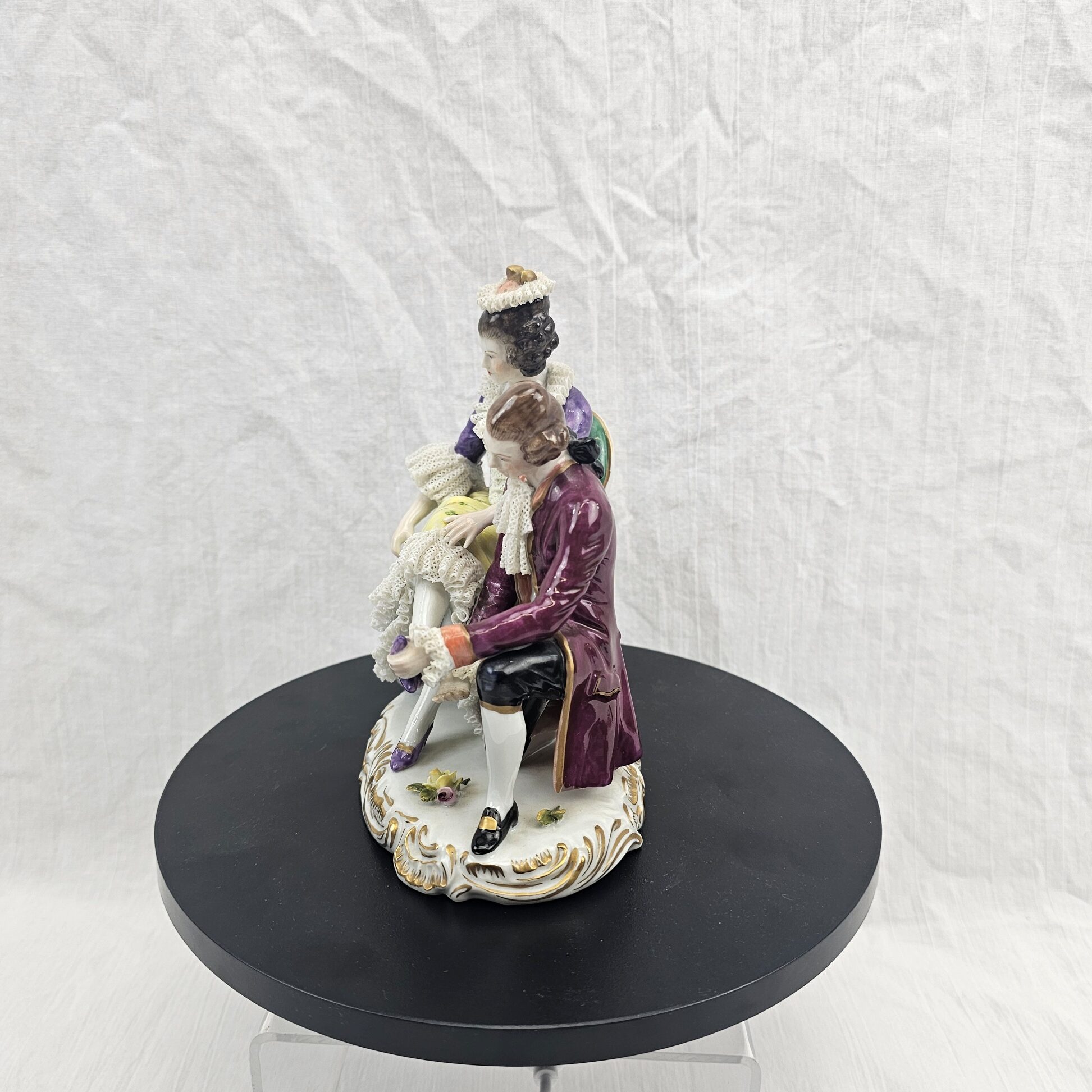
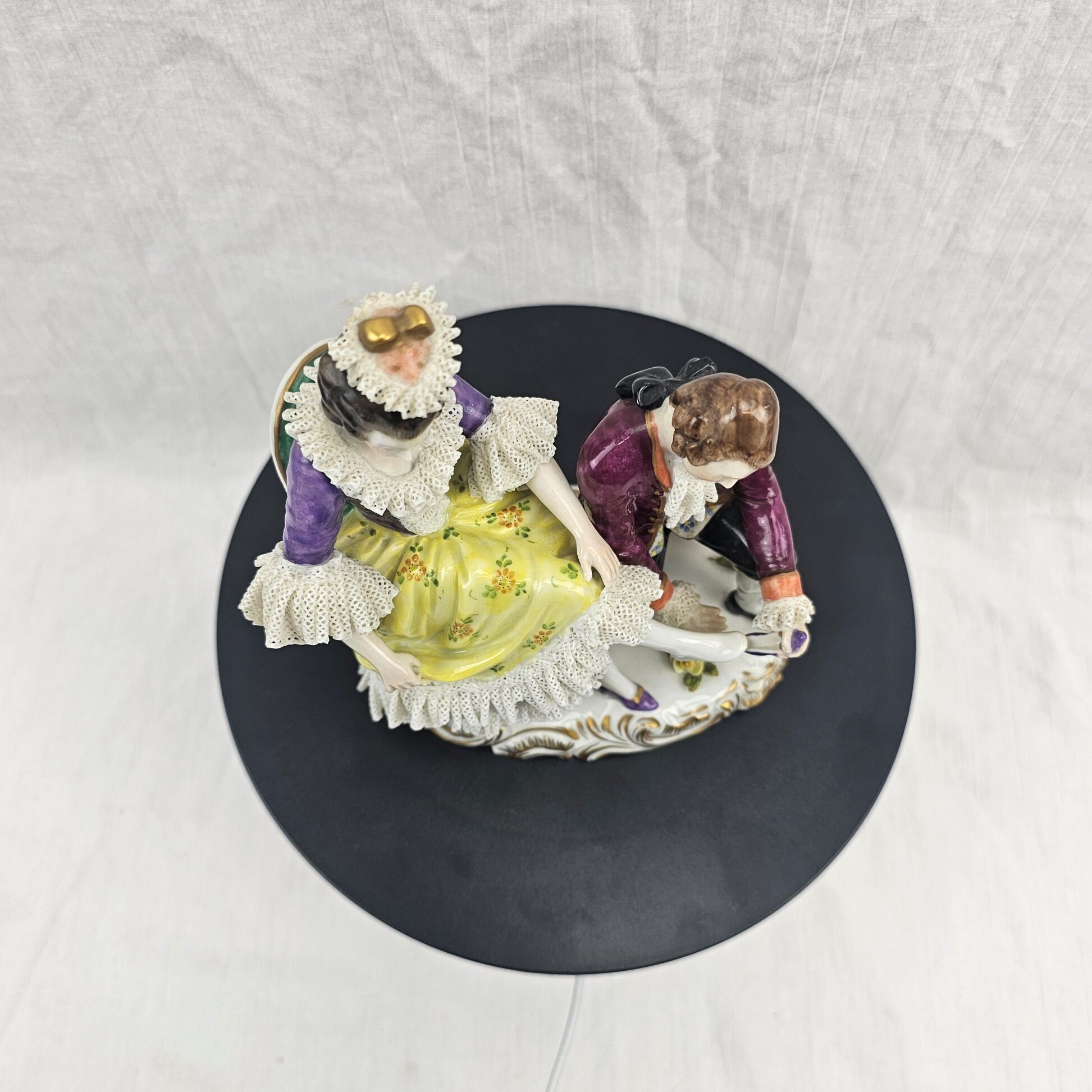
This delightful two-figure group is a fine example of the romantic Rococo revival subjects for which the Volkstedt porcelain factory became celebrated. The scene depicts a gallant gentleman kneeling attentively before a seated lady, carefully fitting a small purple-blue slipper onto her extended foot — a subject laden with the flirtatious, courtly undertones beloved of 18th century porcelain tradition, evoking the Cinderella narrative and the gallant pursuits of Rococo aristocratic life.
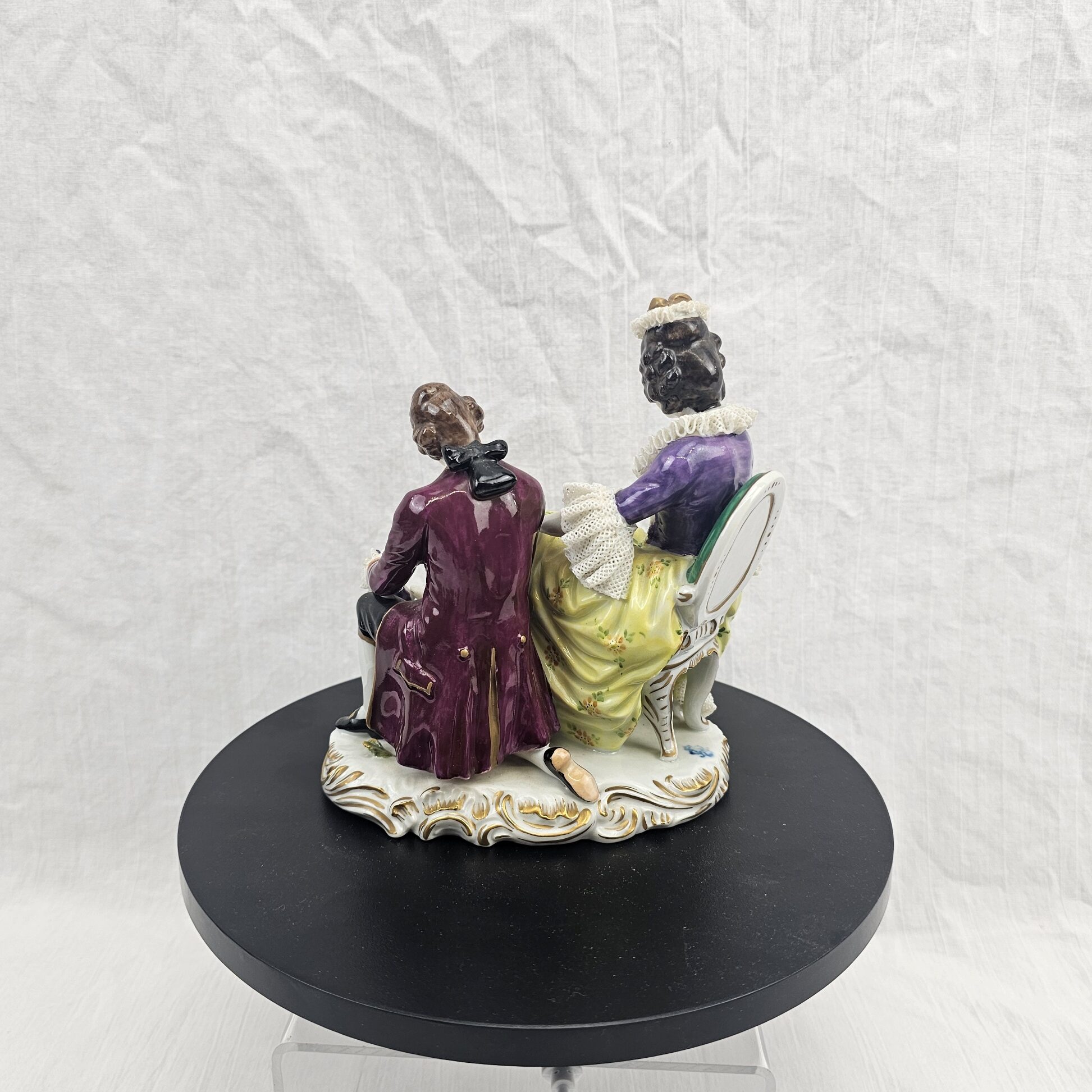
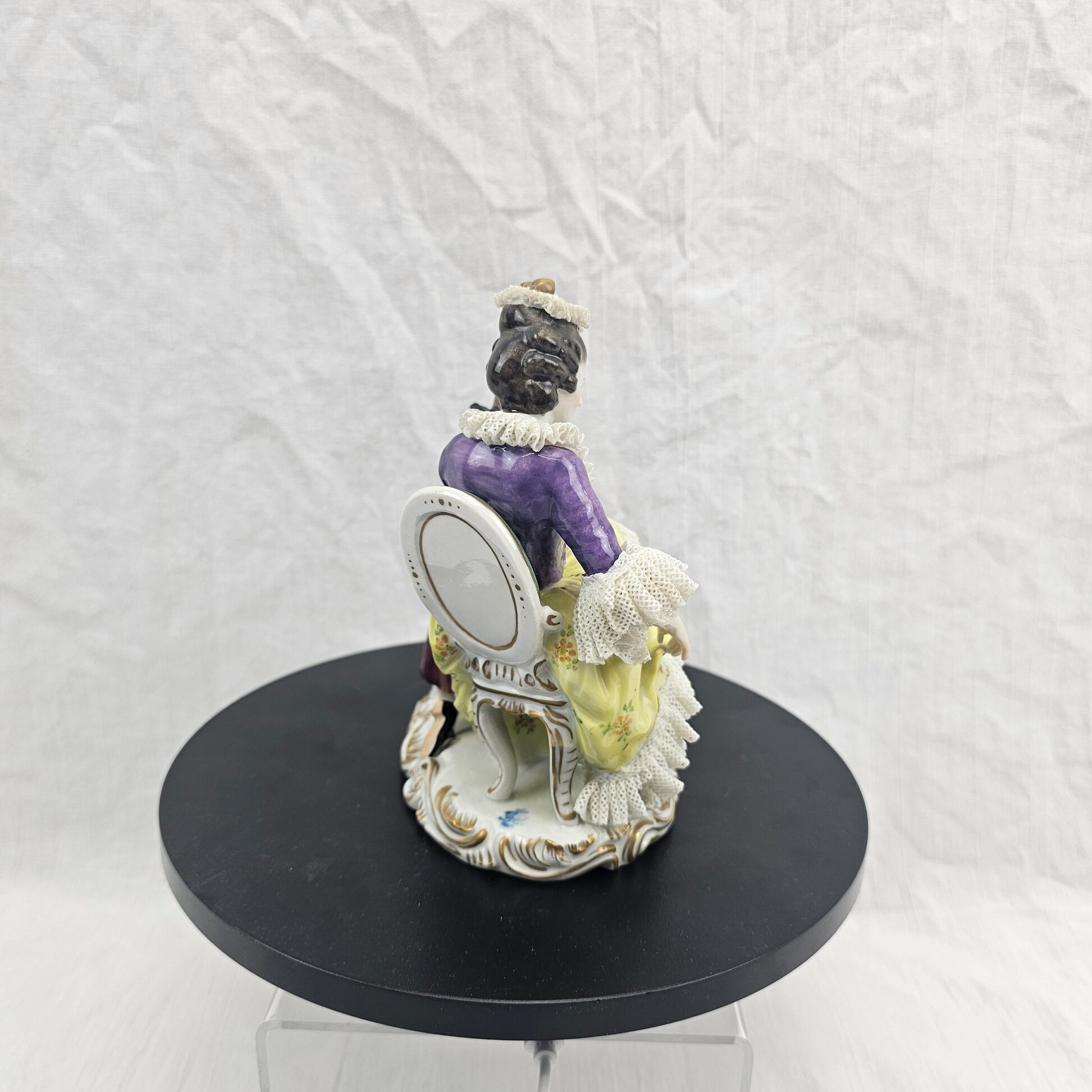
The lady is seated on a white and gilt Rococo-scrolled chair, turned gracefully to one side with an air of composed amusement. She wears a richly painted yellow gown decorated with scattered orange and green flowers, over which cascades an abundance of crisp Dresden-style porcelain lace - dipping from her collar, billowing from her sleeves, and forming multiple flounces around her skirts. Her purple bodice is trimmed with more lace at the décolletage, and her elaborate dark hair is crowned with a white lace cap with a small gilt floral ornament. Her complexion is finely painted with characteristic rose-tinted cheeks and careful facial modelling. Her extended leg shows a white stocking, and the displaced purple shoe lies on the base alongside a small hand-painted bouquet.
The gentleman kneels with focused attention, dressed in a rich purple/maroon tail coat with a white lace cravat and gilt-trimmed buttons, black breeches with orange-trimmed cuffs, white stockings, and black buckle shoes. His brown hair is curled at the sides in the 18th century manner, with a black ribbon at the nape. He holds the lady's ankle and the shoe with both hands, completely absorbed in his courtly task.
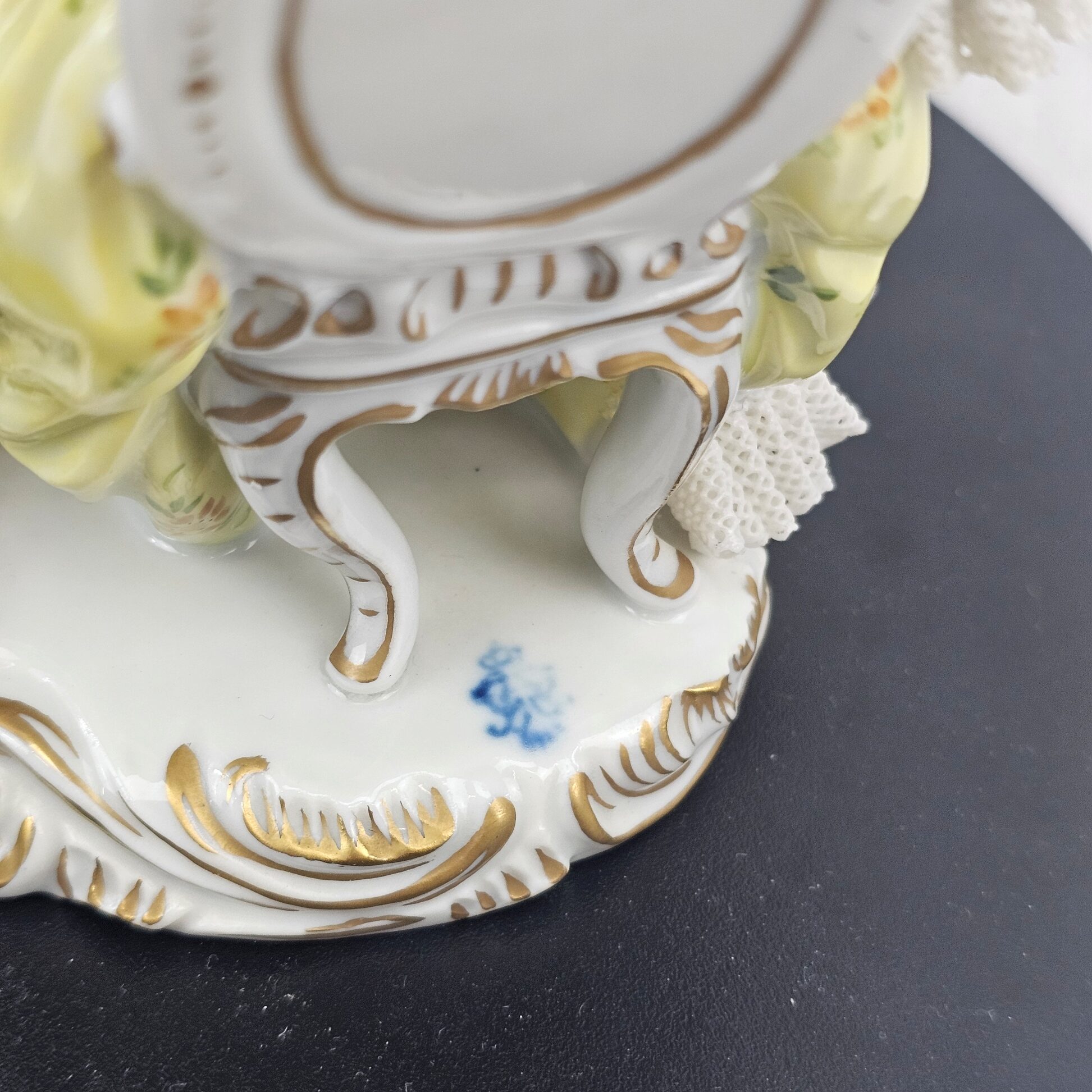
The piece is set on a Rococo-scroll oval base in white and gold, with gilded acanthus and rocaille decoration enriching the perimeter. Small scattered painted flowers add freshness to the composition. The gilding throughout is applied with care and precision and retains good brightness.
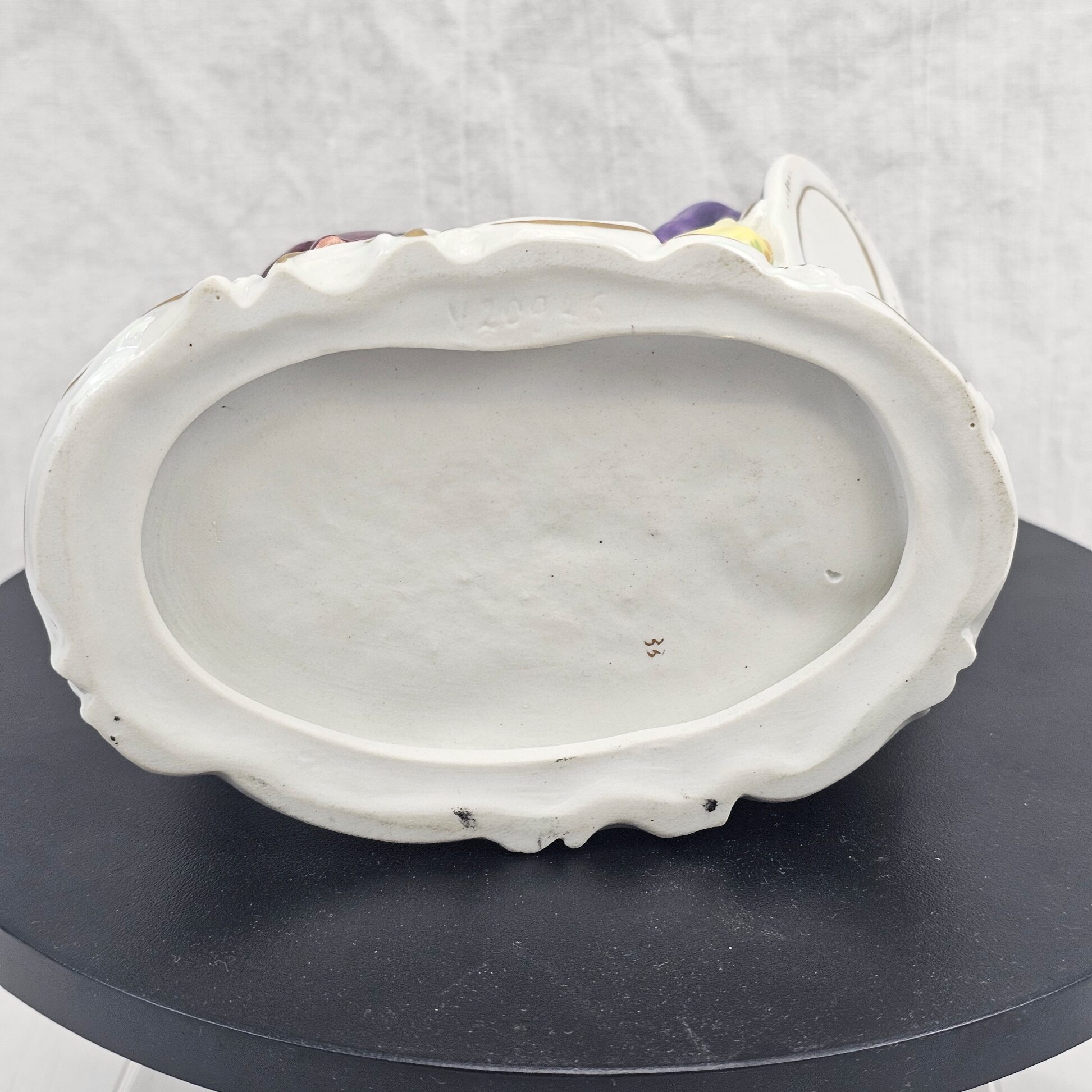
The underglaze blue factory mark is clearly visible on the base (image 6) — consistent with the Volkstedt manufactory mark of the late 19th to early 20th century period. The impressed number 35 is also present on the base interior.
~ Volkstedt ~
The Volkstedt porcelain manufactury sited in Rudolstadt, Thuringia, Germany, was the earliest porcelain manufactory in Thuringia. It was in business as Aelteste Volkstedter Porzellanmanufaktur, the "Oldest Volkstedt Porcelain Manufactory", which was integrated into the VEB Vereinigte Zierporzellanwerke Lichte, which in turn formed part of the Kombinat Feinkeramik Kahla.
The factory had its origins in an official request made 8 September 1760 by the porcelain maker Georg Heinrich Macheleid (1723-1801). Macheleid had long worked in the glass manufactory at Glücksthal and had gained the arcana of porcelain-making by his own researches, apparently independent of Ehrenfried Walther von Tschirnhaus and Johann Friedrich Böttger, the ceramists at Meissen. He wished to open a privileged porcelain factory, making true hard-paste porcelain, intended to be sited in Sitzendorf. In 1762 the privilege was granted by Johann Friederich, Fürst von Schwarzburg-Rudolstadt, a great patron of the arts and music, specifying that the manufactory was to be set up near his princely court of Schwarzburg-Rudolstadt, under his personal direction.
Volkstedt gained a reputation for its finely painted and carefully modeled porcelain figures that it holds for collectors today.
In 1797 Ernest Constantine, Landgrave of Hesse-Philippsthal, acquired the porcelain manufactory in Volkstedt, which he sold two years later. Following the reunification of Germany, in 2006/07 the factory buildings were restored to their 18th-century appearance and opened to the public.
During the 19th century the manufactory attracted subsidiary and rival workshops in Rudolstadt: they included Beyer & Bock, Karl Ens, Kämmer & Kramer, Ernst Bohne Söhne, Műller & Hammer.
Marks, in underglaze blue, include the ubiquitous crowned N adopted from Capodimonte by many manufactories, closed crown and R (Rudostadt) with crossed swords (adopted from Meissen) or 1762.
~ Condition ~
The piece is in excellent condition, free from chips and cracks. Their is a small area of loss to the lacework by the ladies left knee. The glaze and gilding remains excellent.
~ Dimensions ~
The group has a width of 14.5 cm (5 inches), a depth of 9 cm (3.5 inches) and a height of 16 cm (6.25 inches). It weighs 0.55 Kg.
#9172