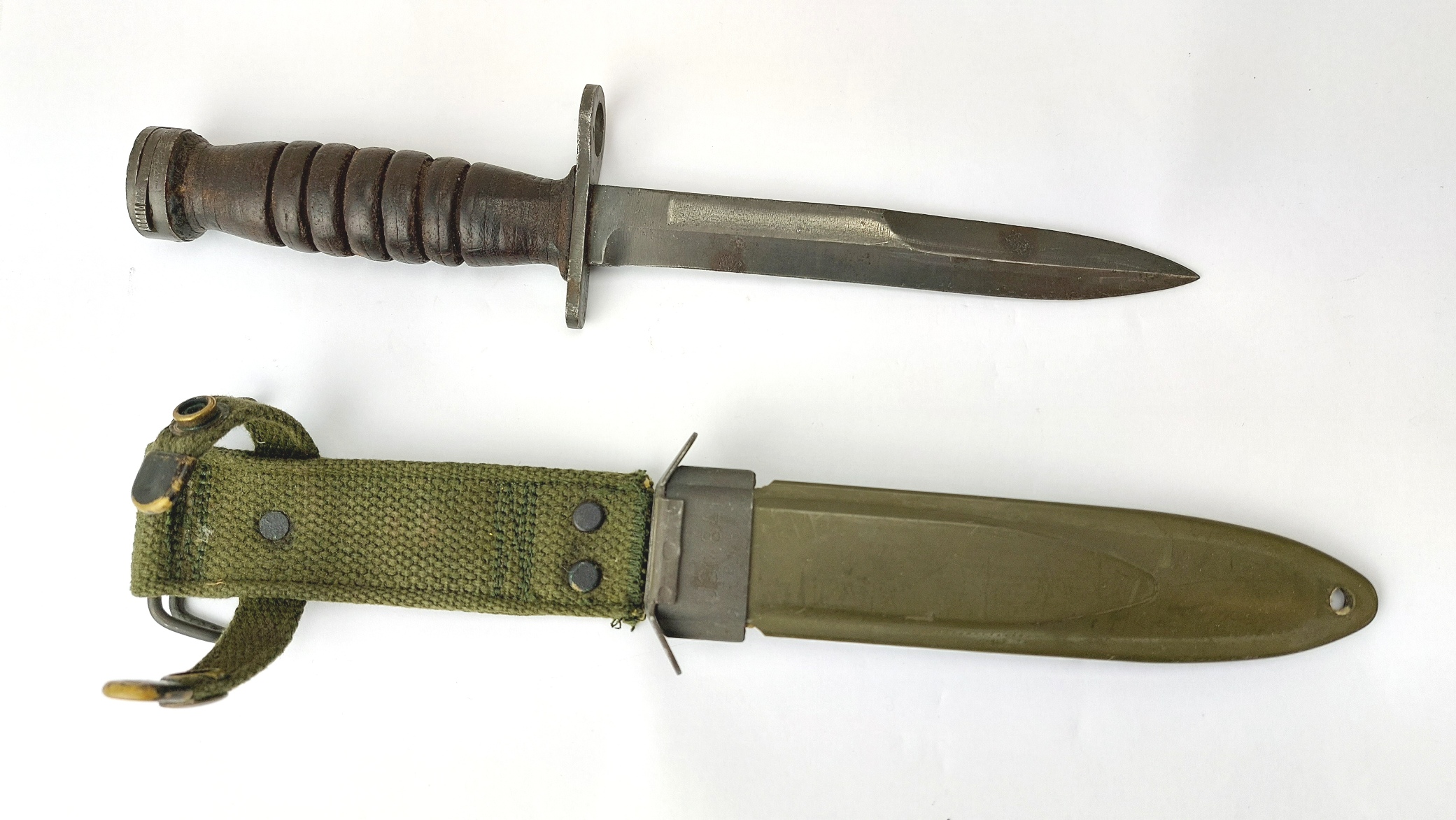
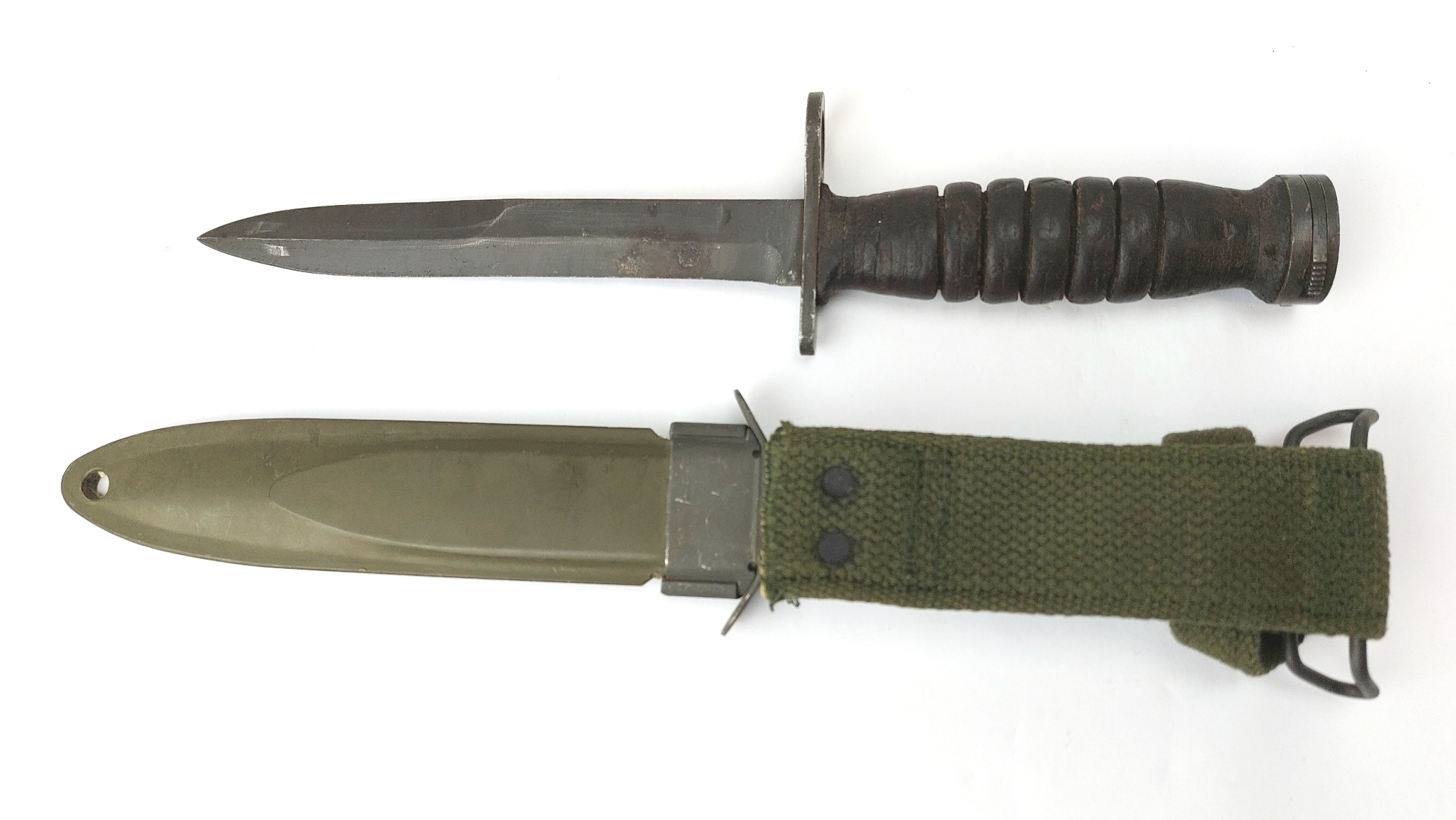
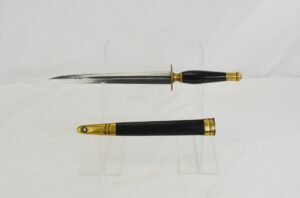
*USA, WW2, M4 Bayonet Knife by Utica Cutlery Co., with Vietnam era M8A1 Scabbard by PWH (Pennsylvania Working Home for the Blind)*
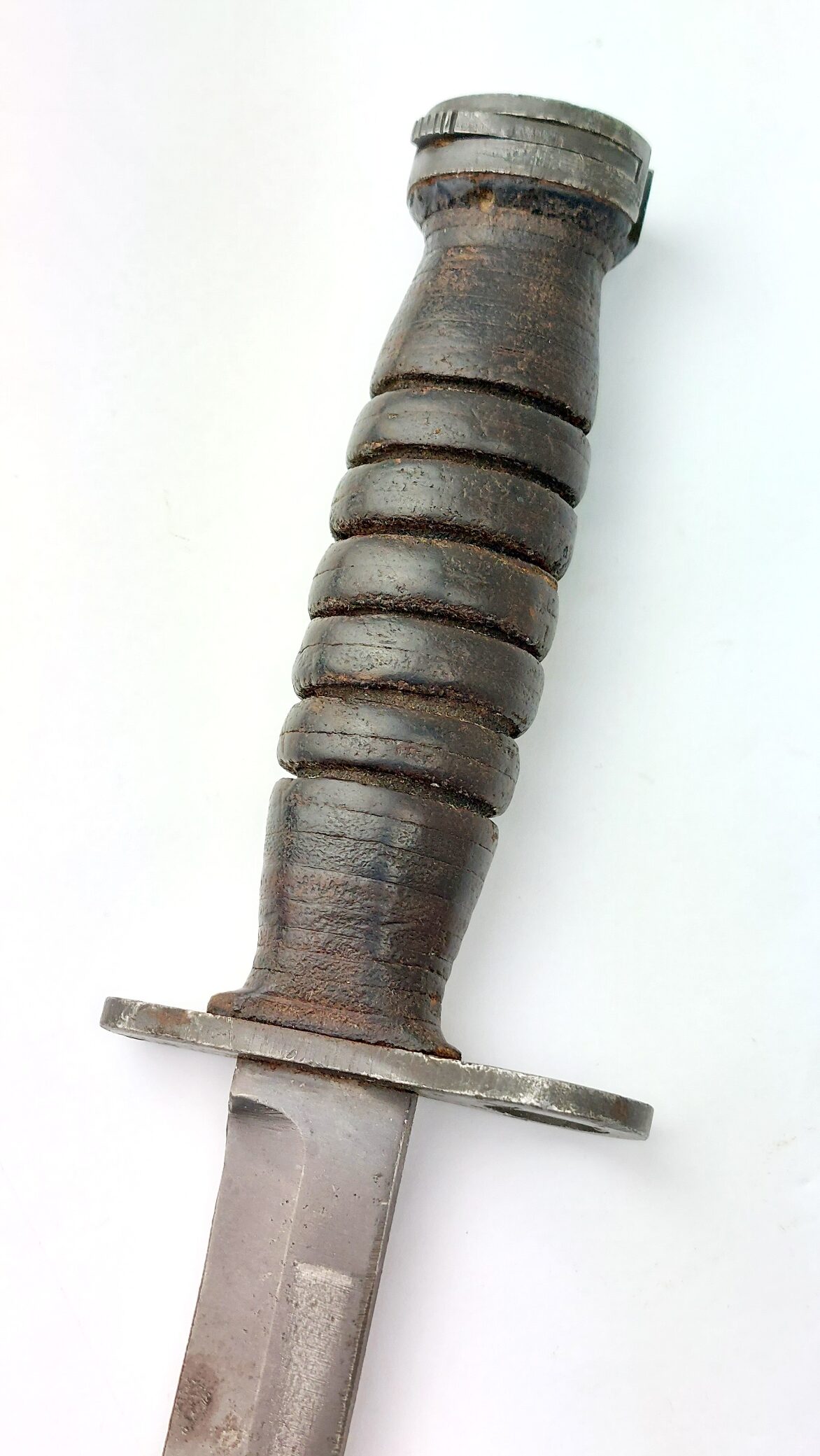
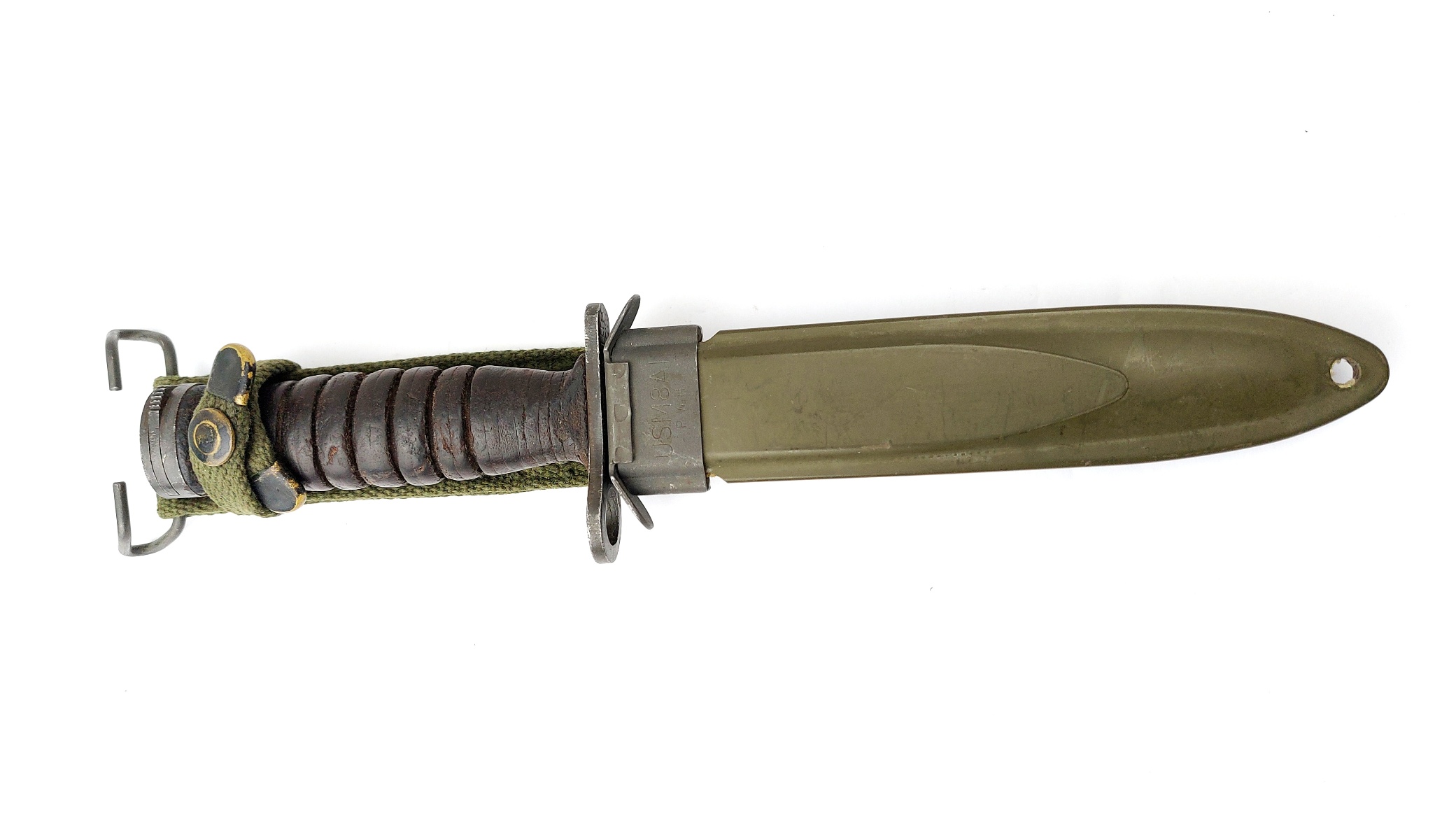
An original Second World War U.S. M4 bayonet manufactured by Utica Cutlery Company, retaining its U.S. Ordnance “Flaming Bomb” acceptance mark, complete with a Vietnam-era M8A1 scabbard by PWH.
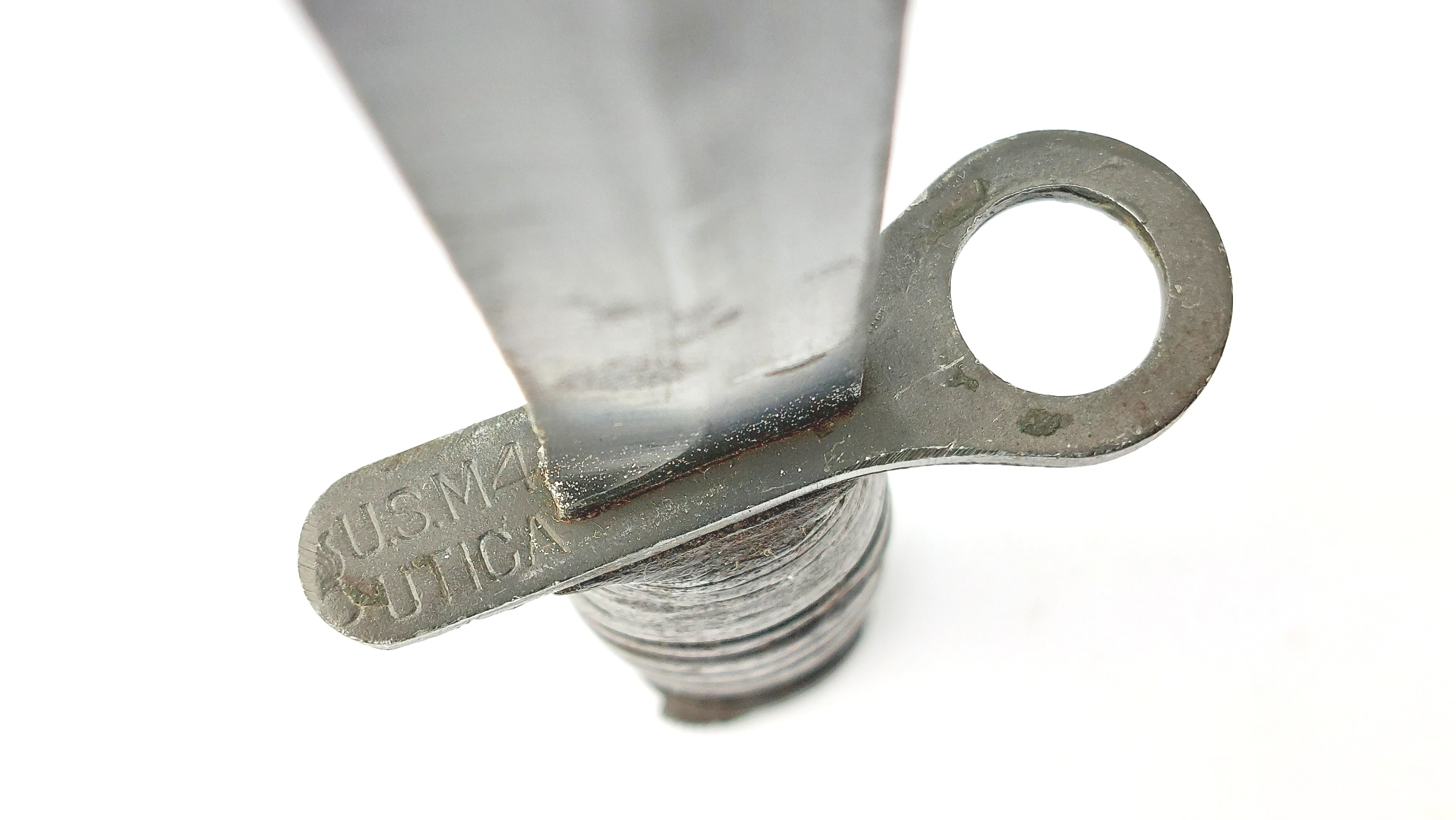
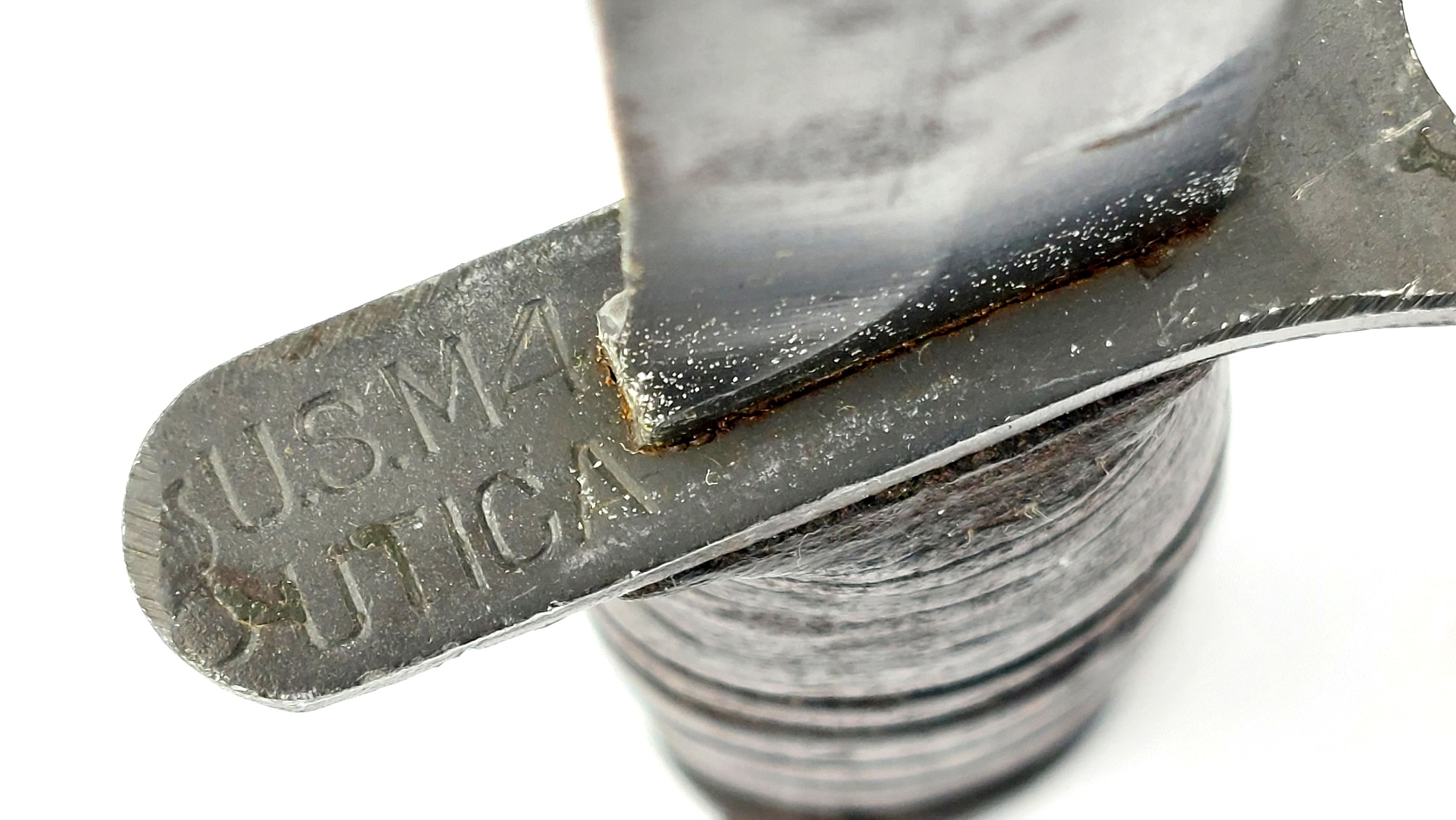
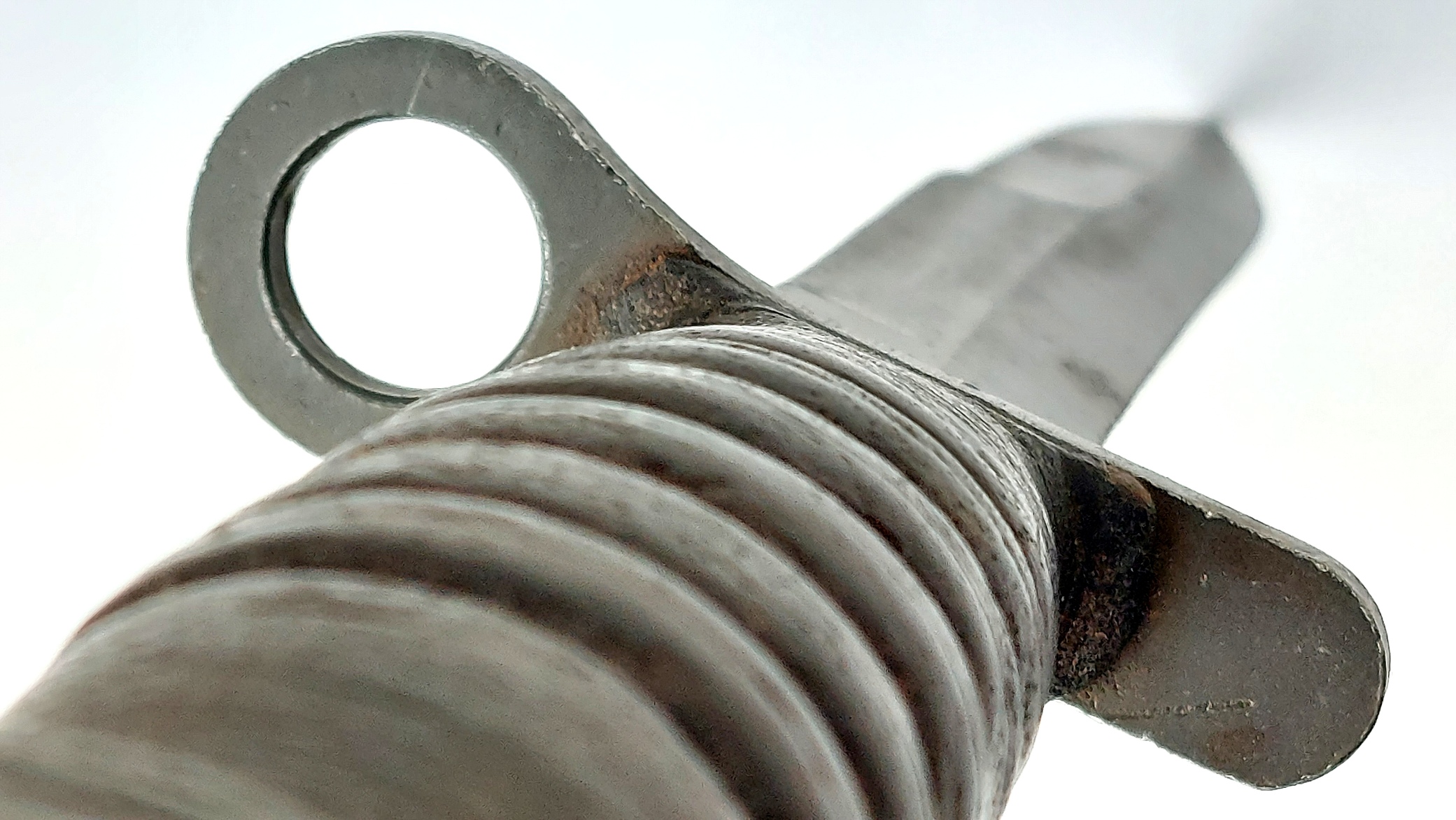
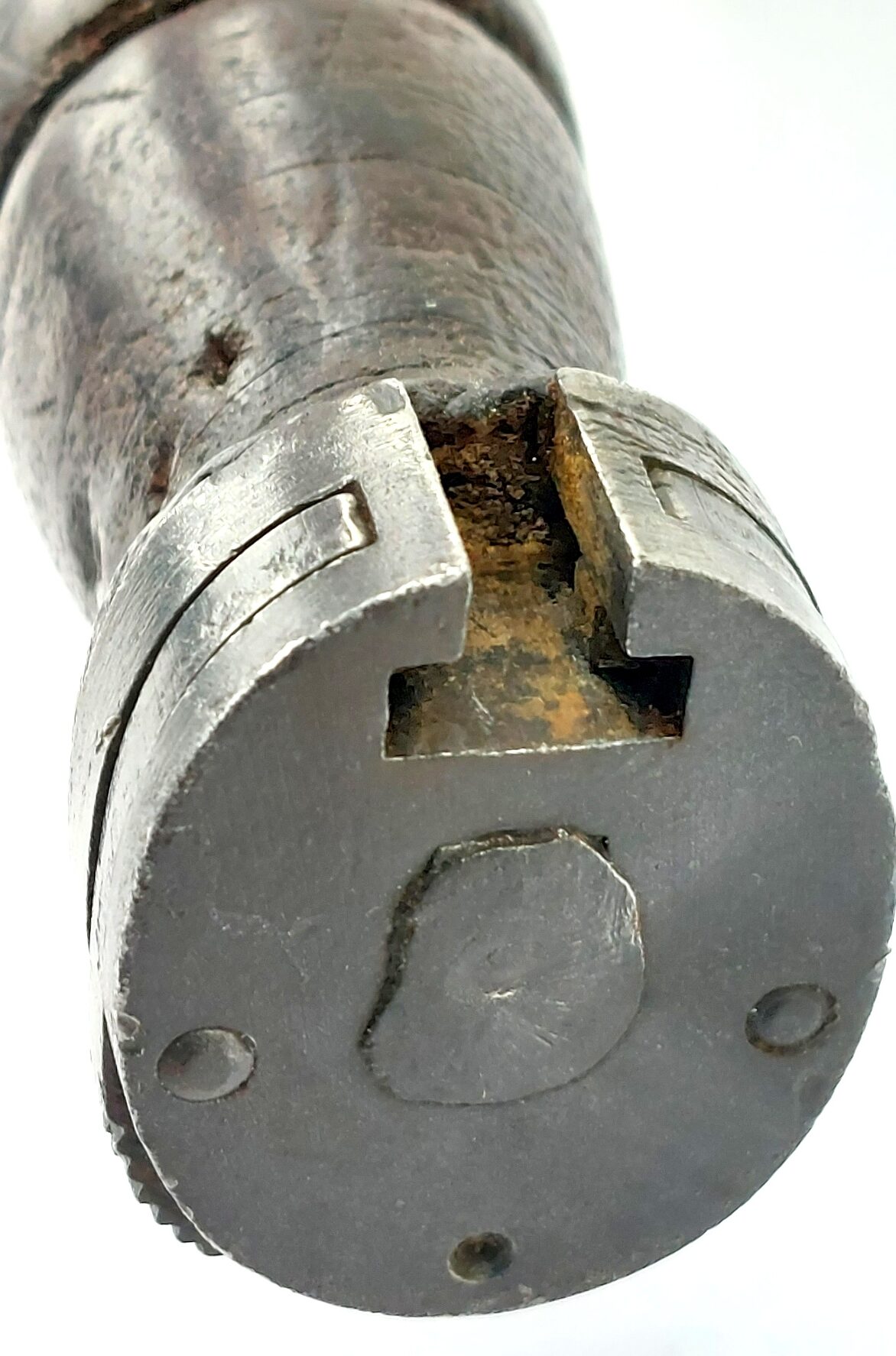
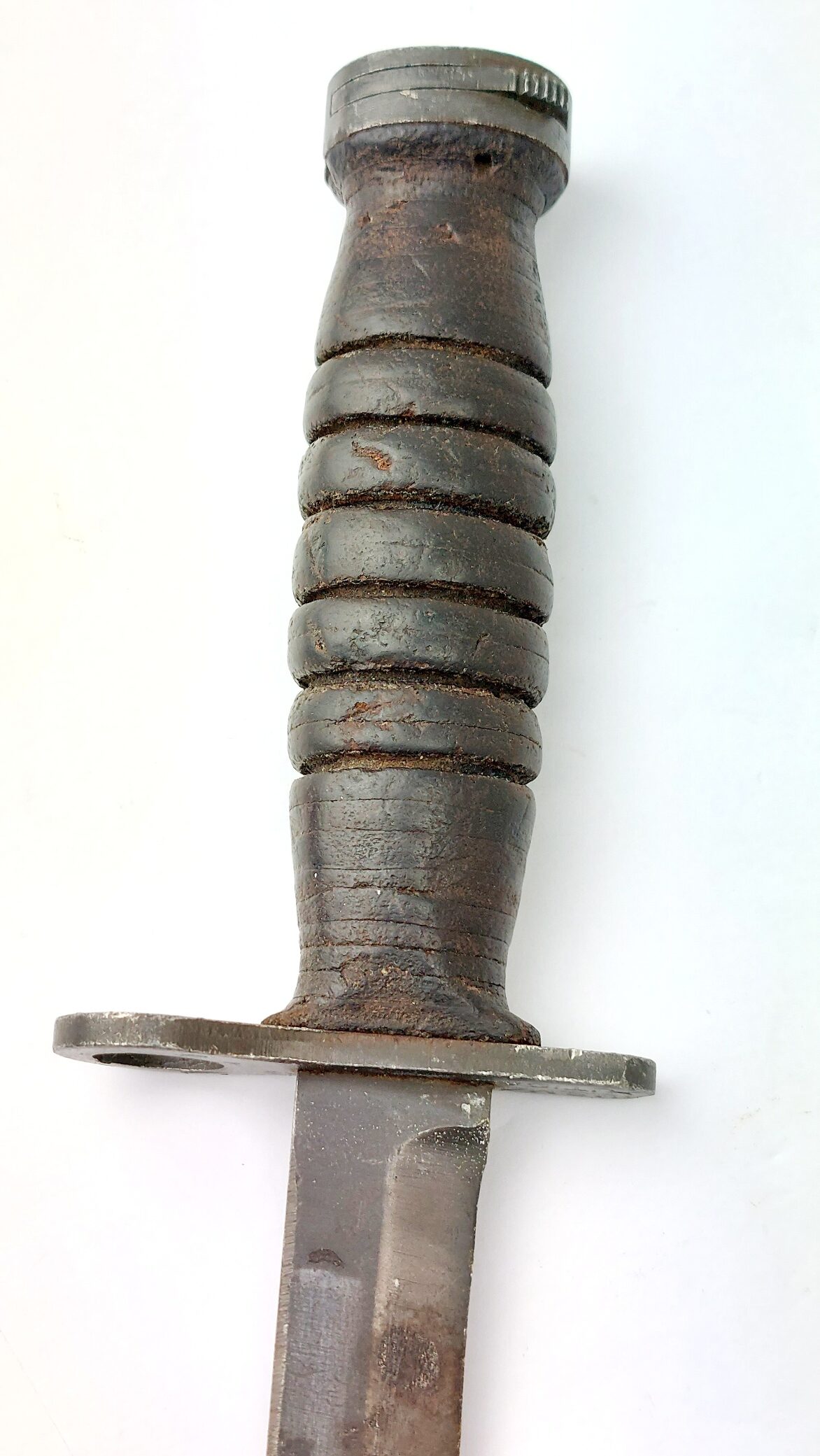
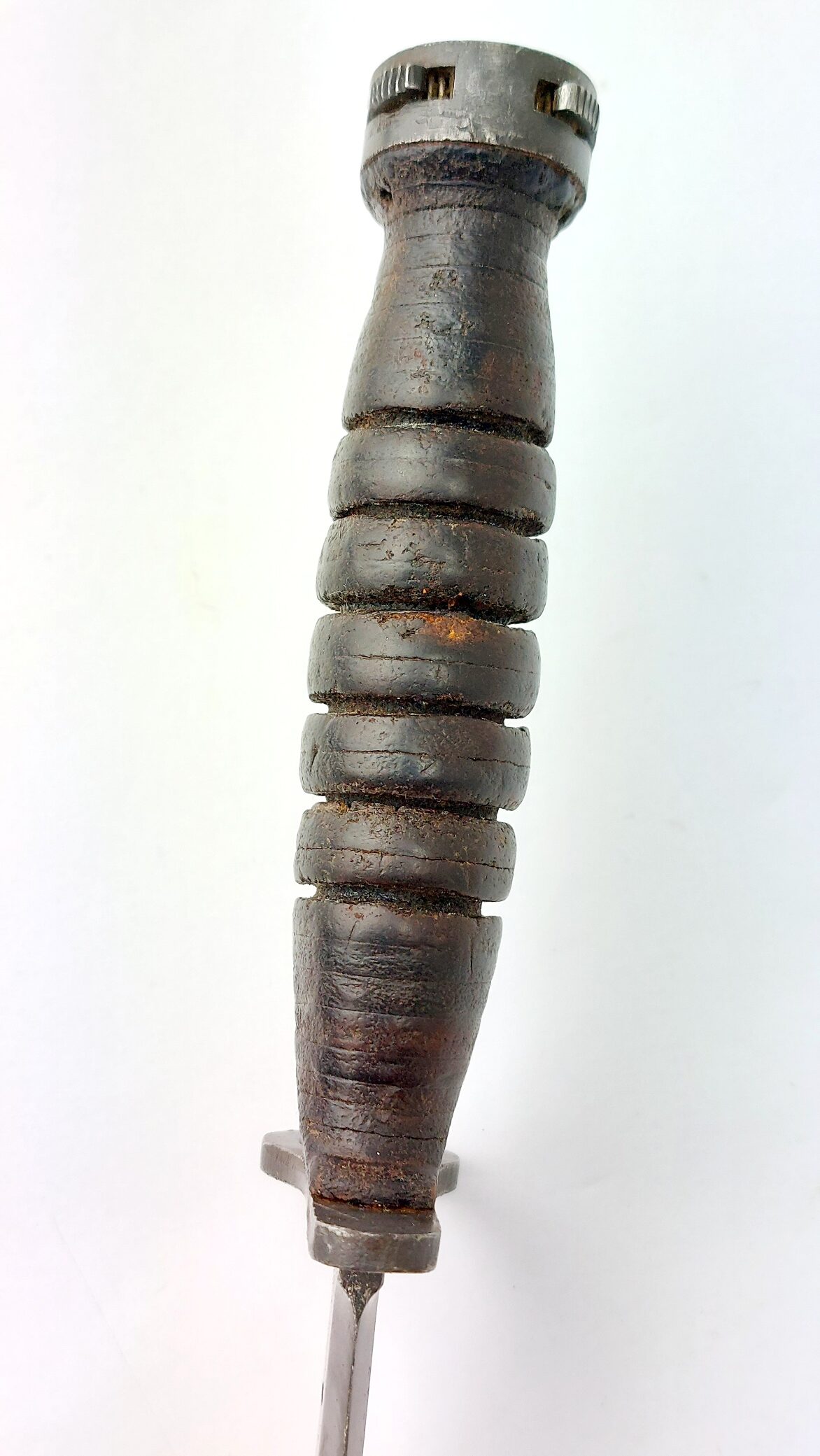
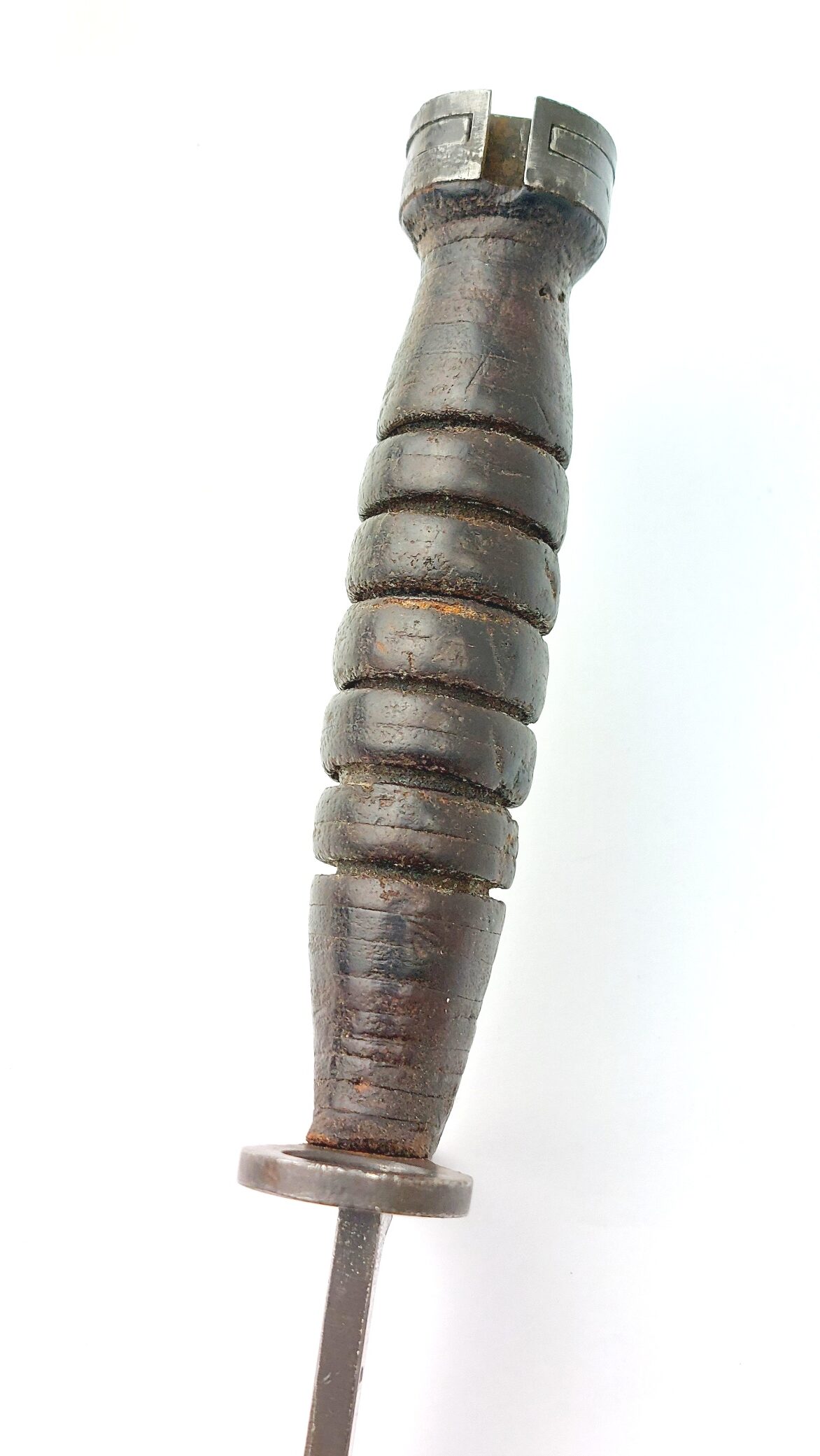
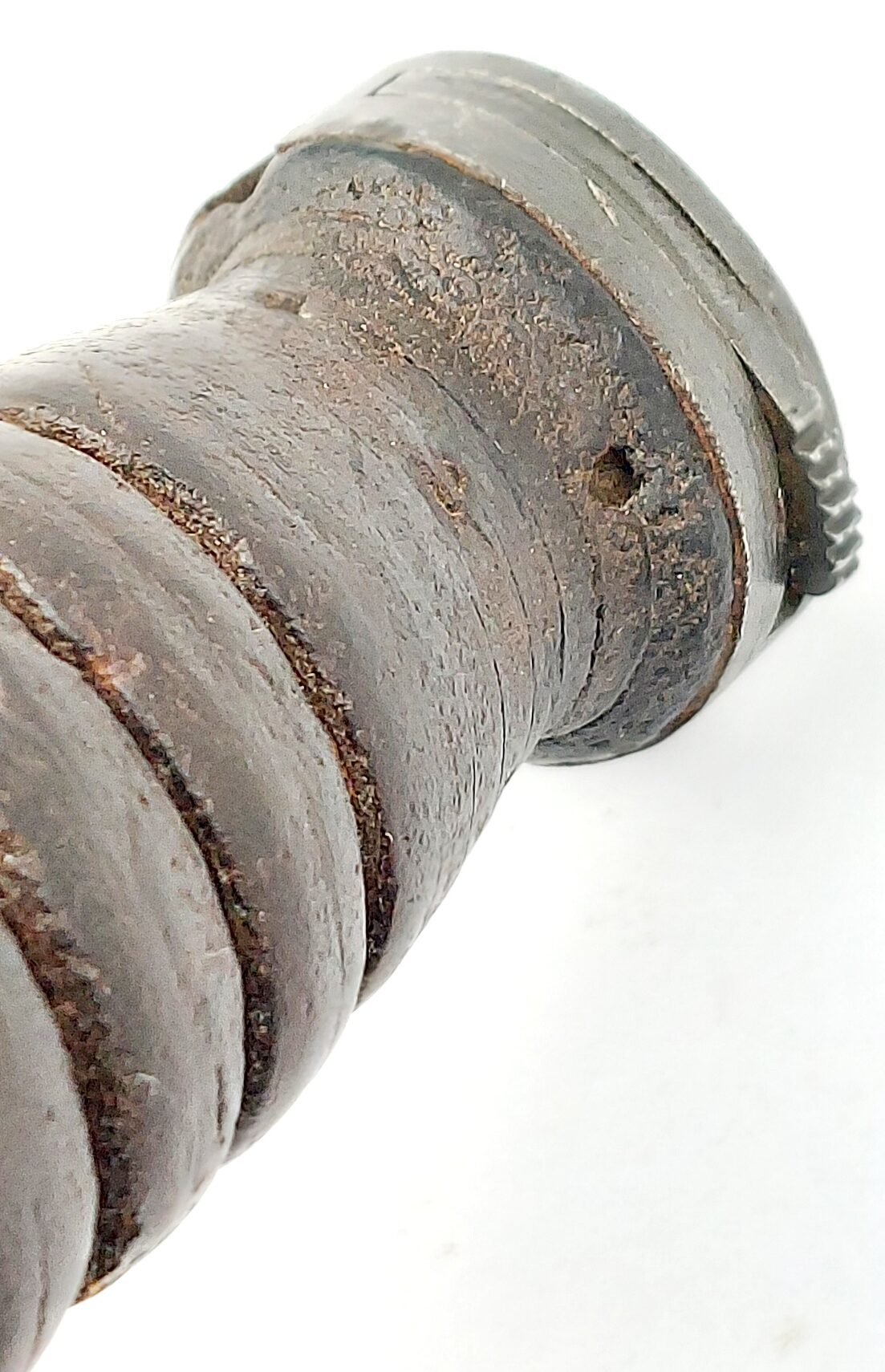
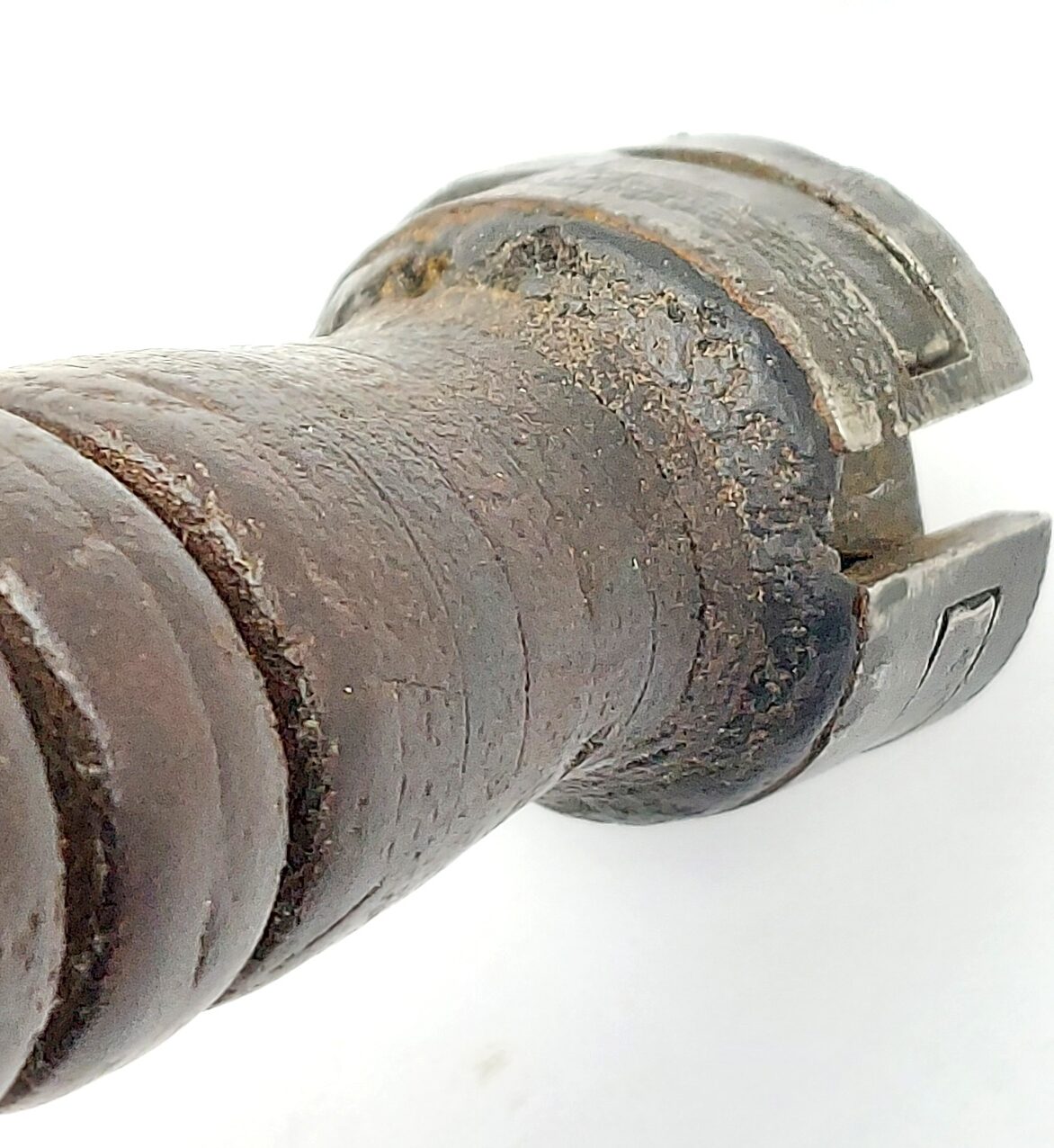
The crossguard is crisply stamped: "U.S. M4 UTICA" and bears the Frankford Arsenal flaming bomb mark, confirming official wartime production in 1944–45. The bayonet retains its correct ribbed leather washer grip, showing honest service compression and natural age patina. The steel pommel incorporates the M1 Carbine locking mechanism, which remains present and intact. Guard and pommel display typical service wear consistent with field use. The blade remains of correct M4 form with good profile and visible service patina.
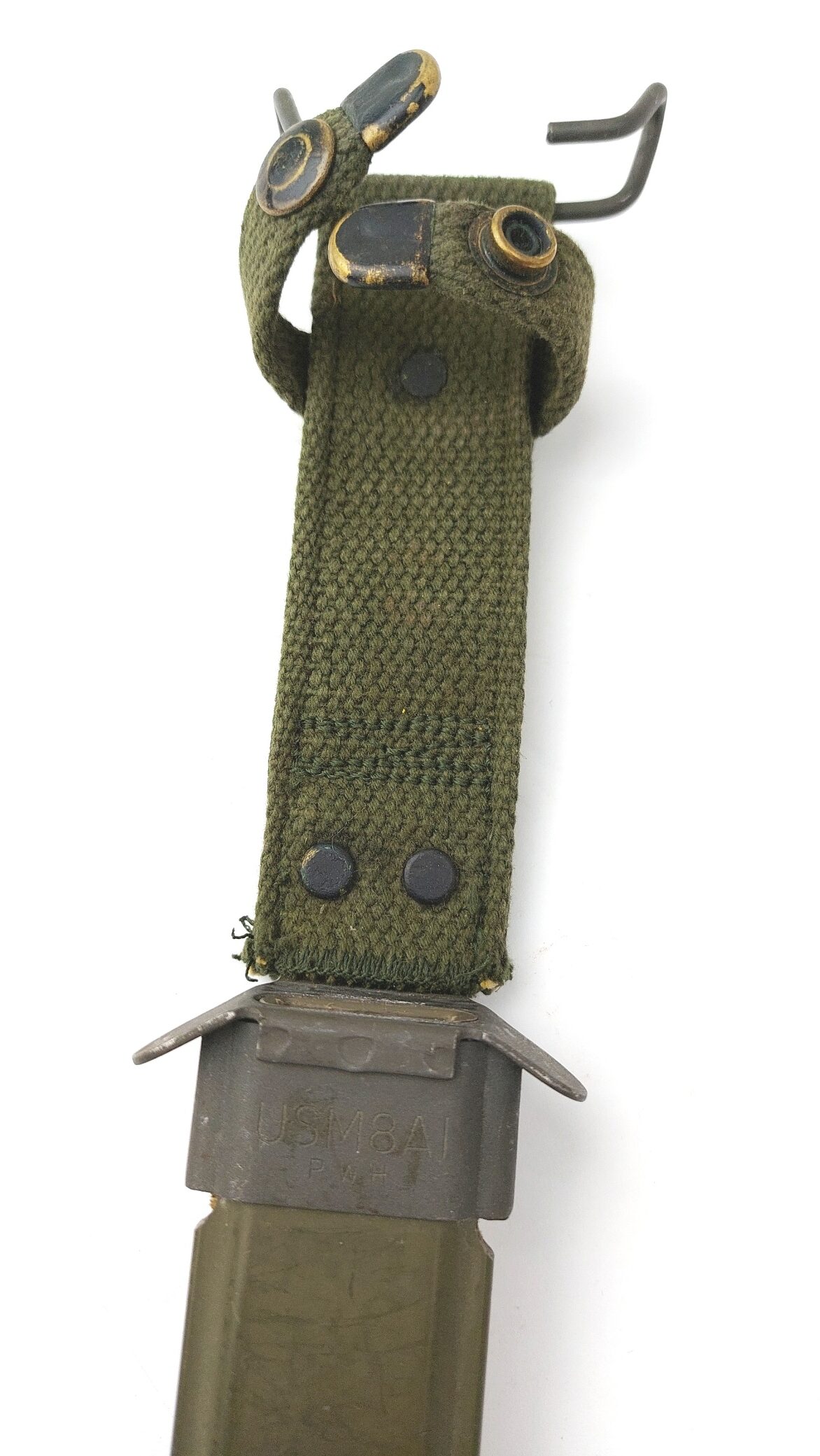
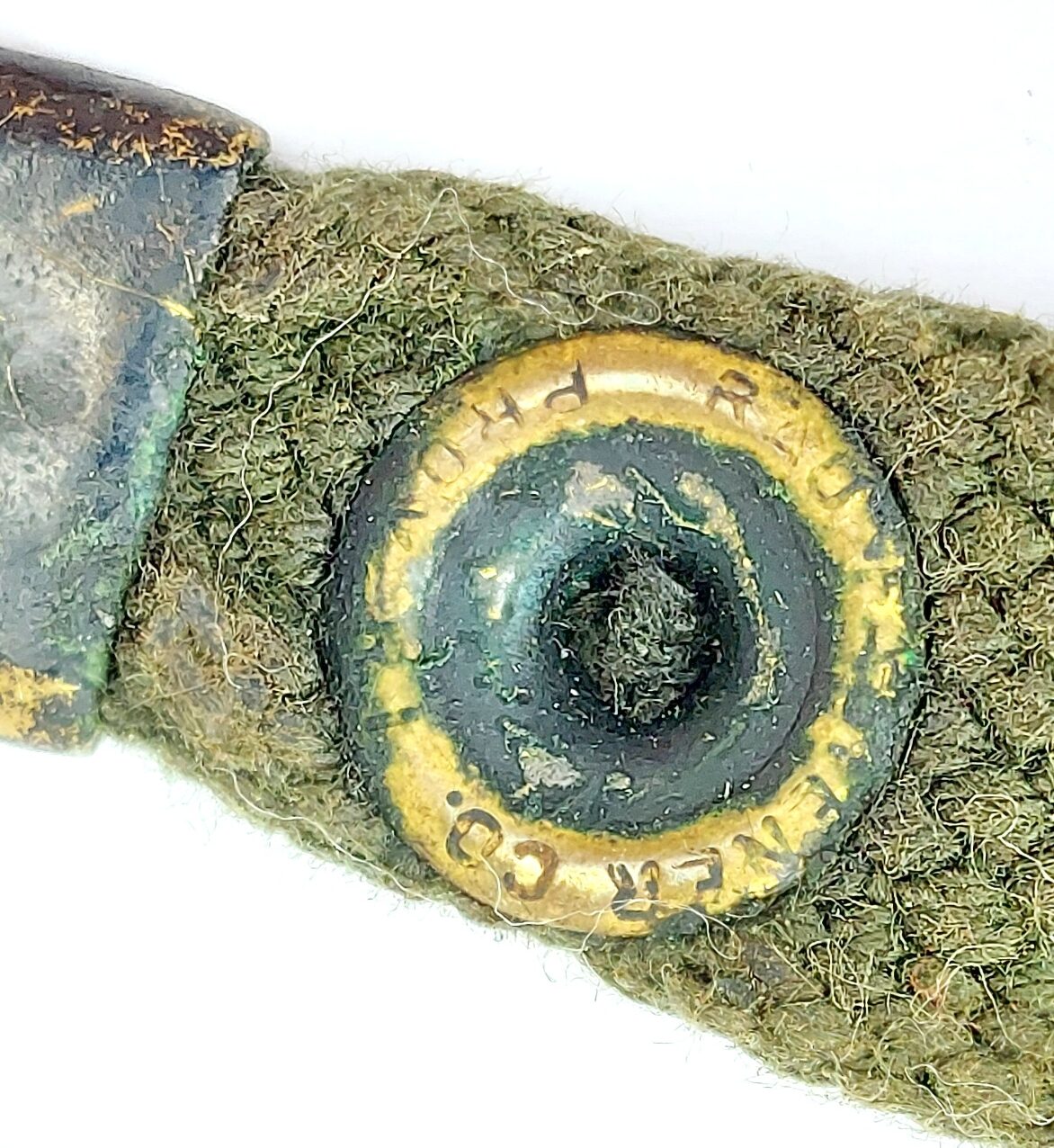
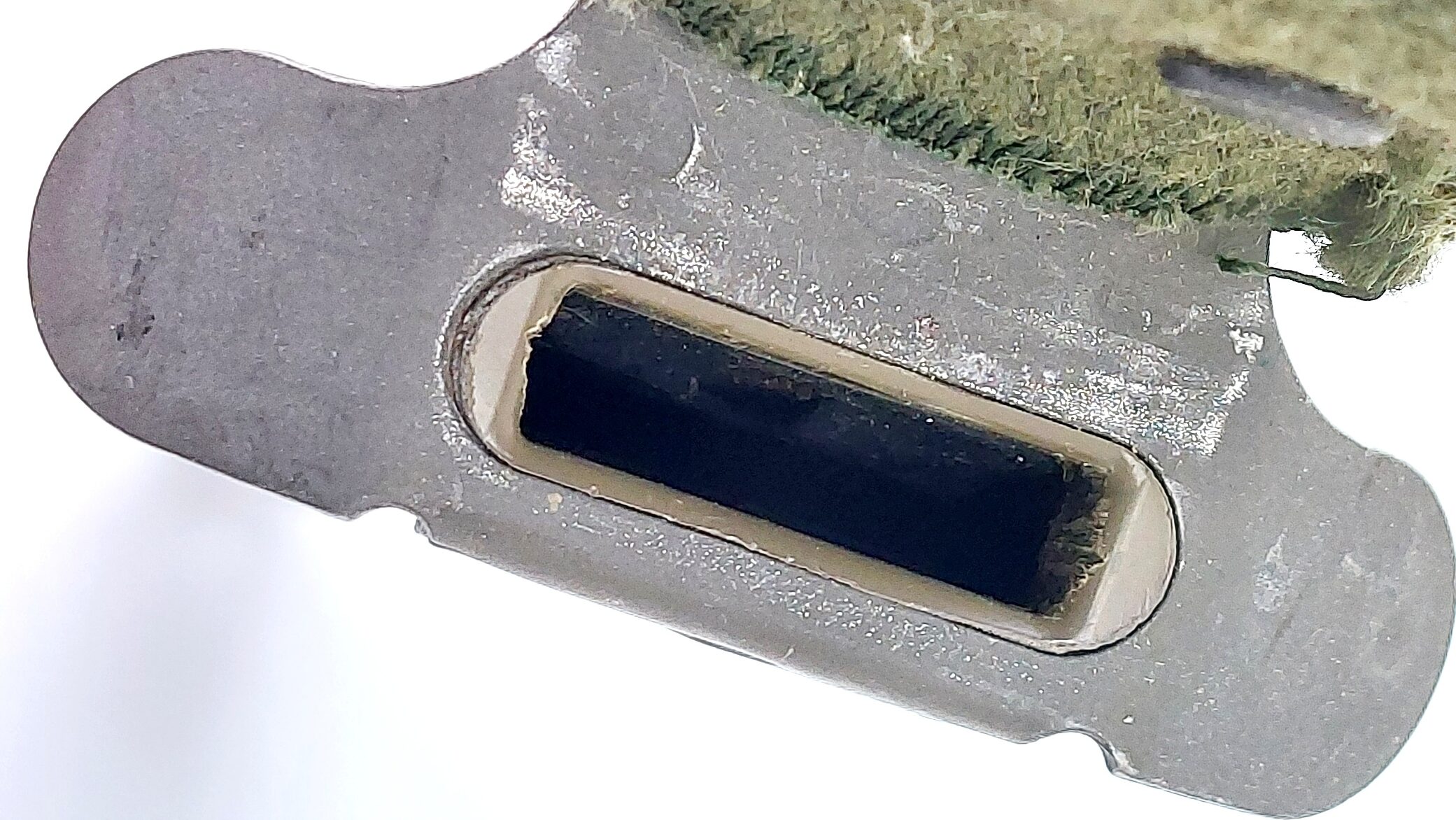
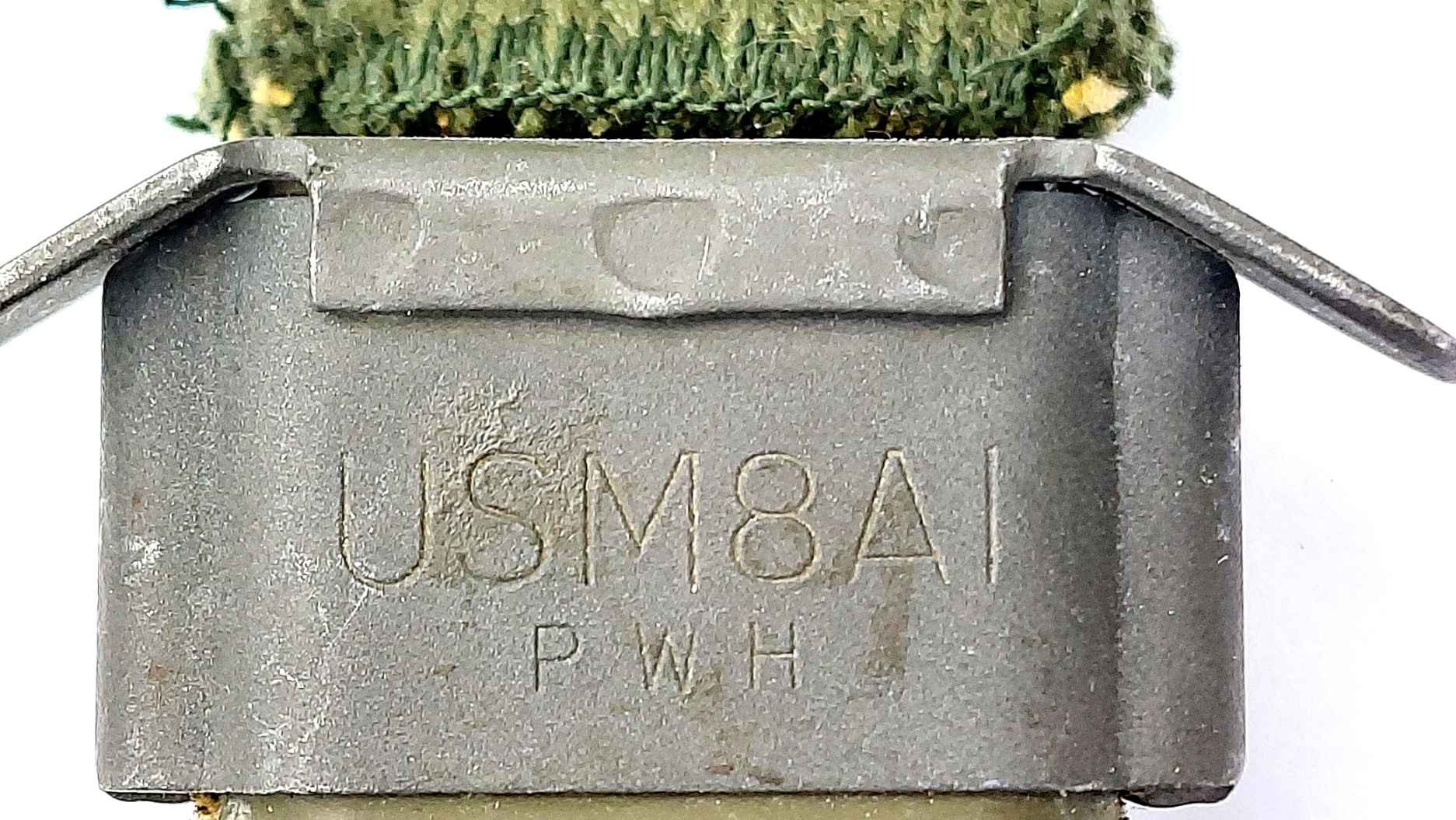
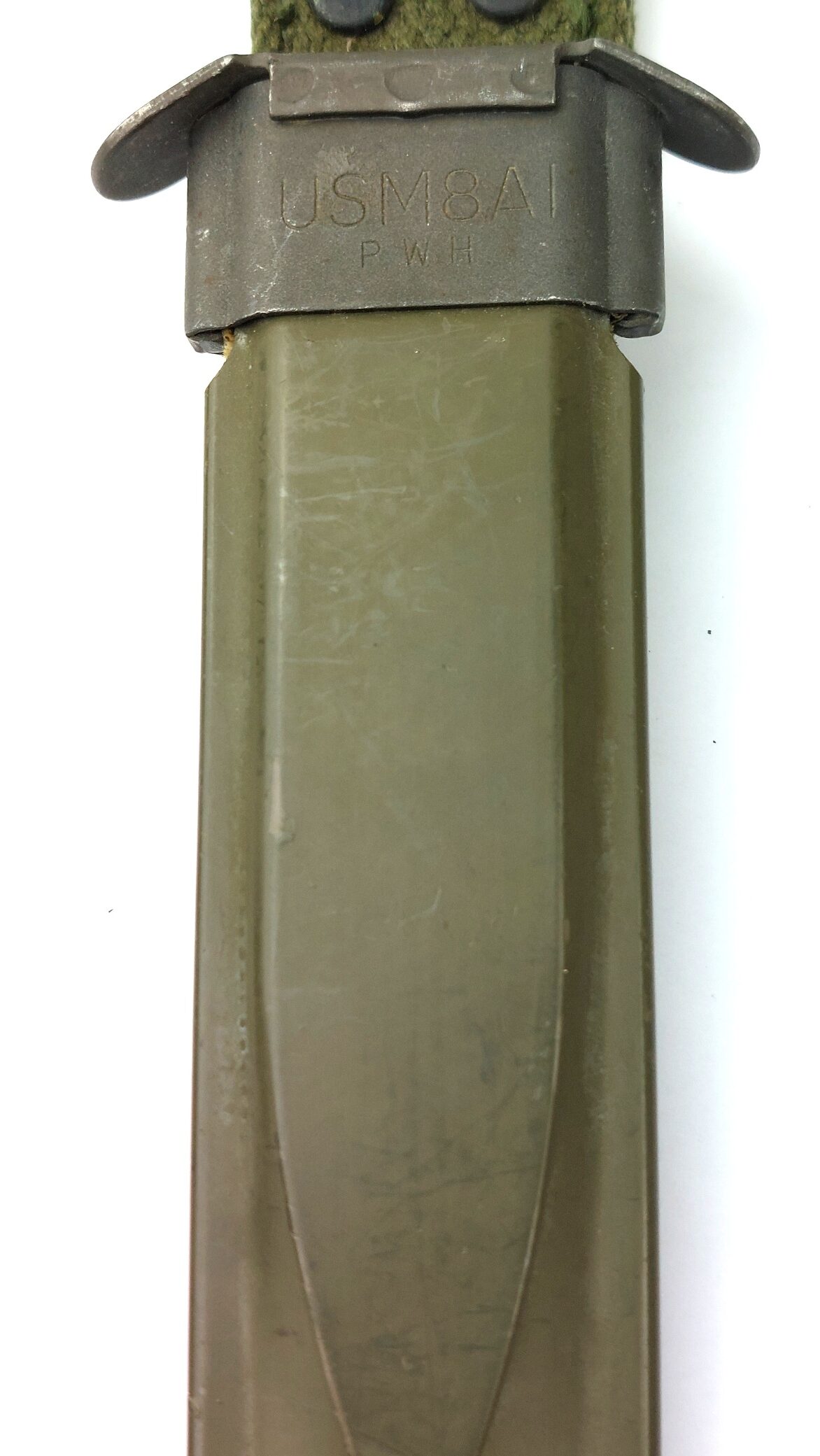
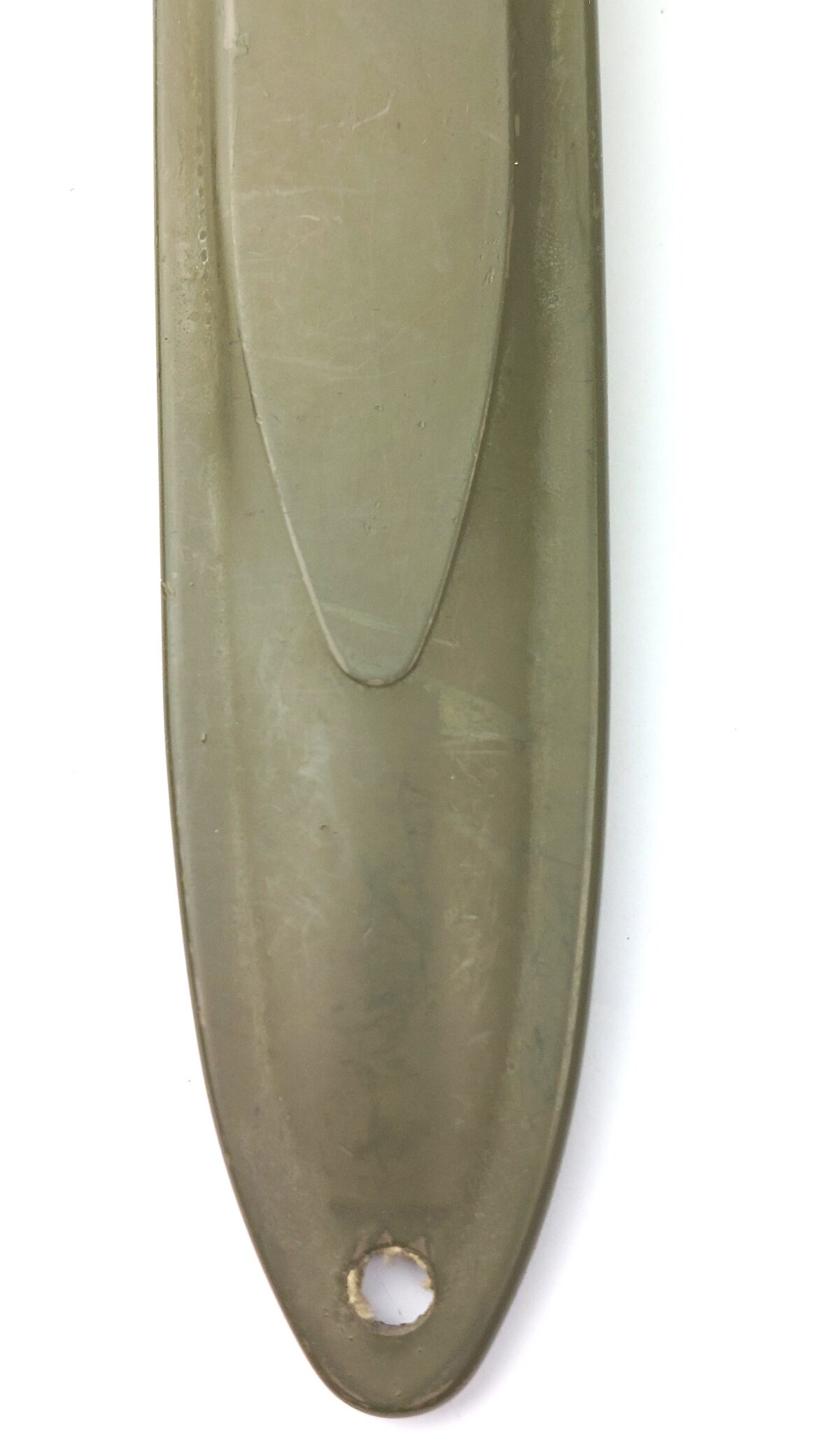
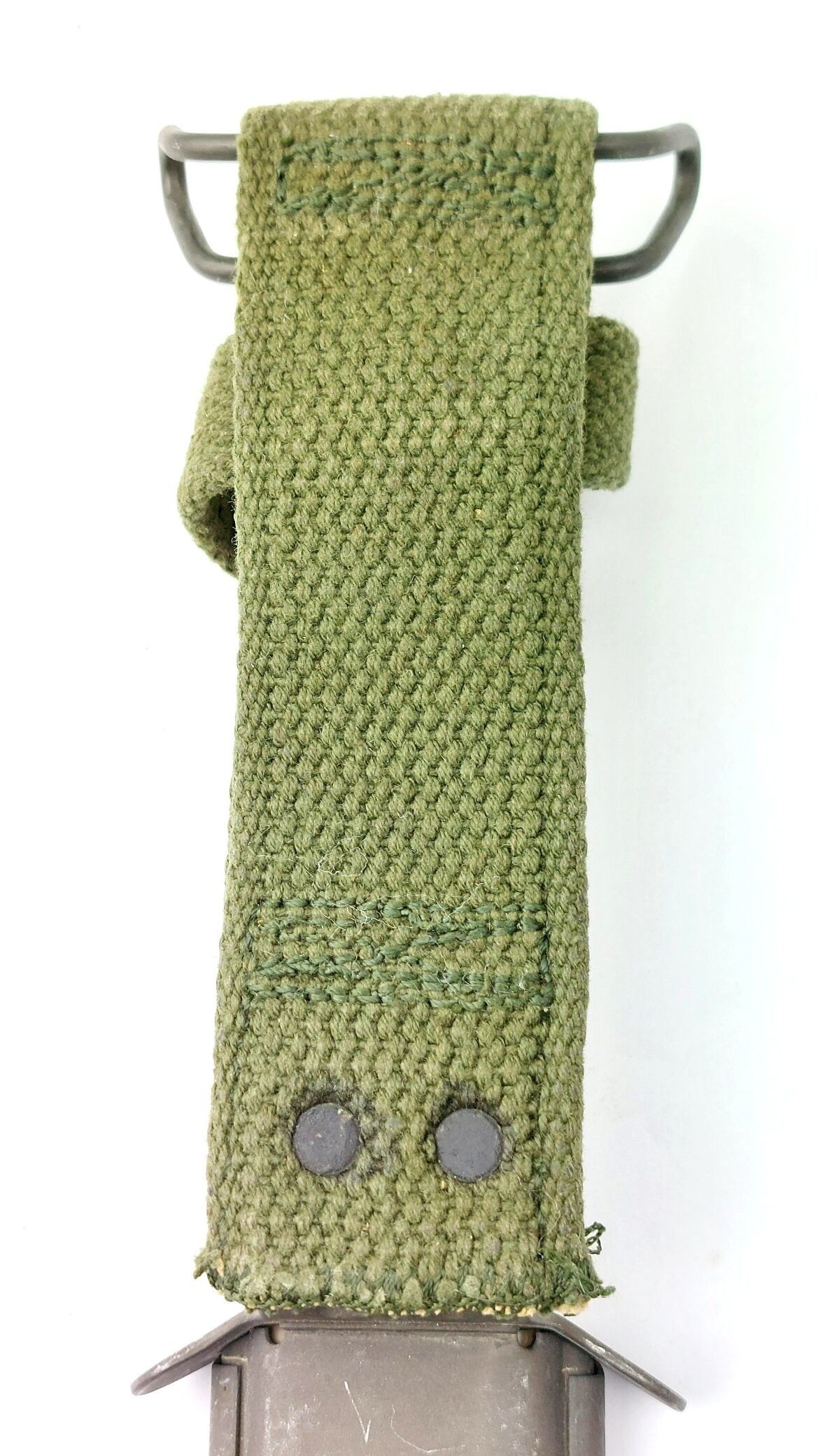
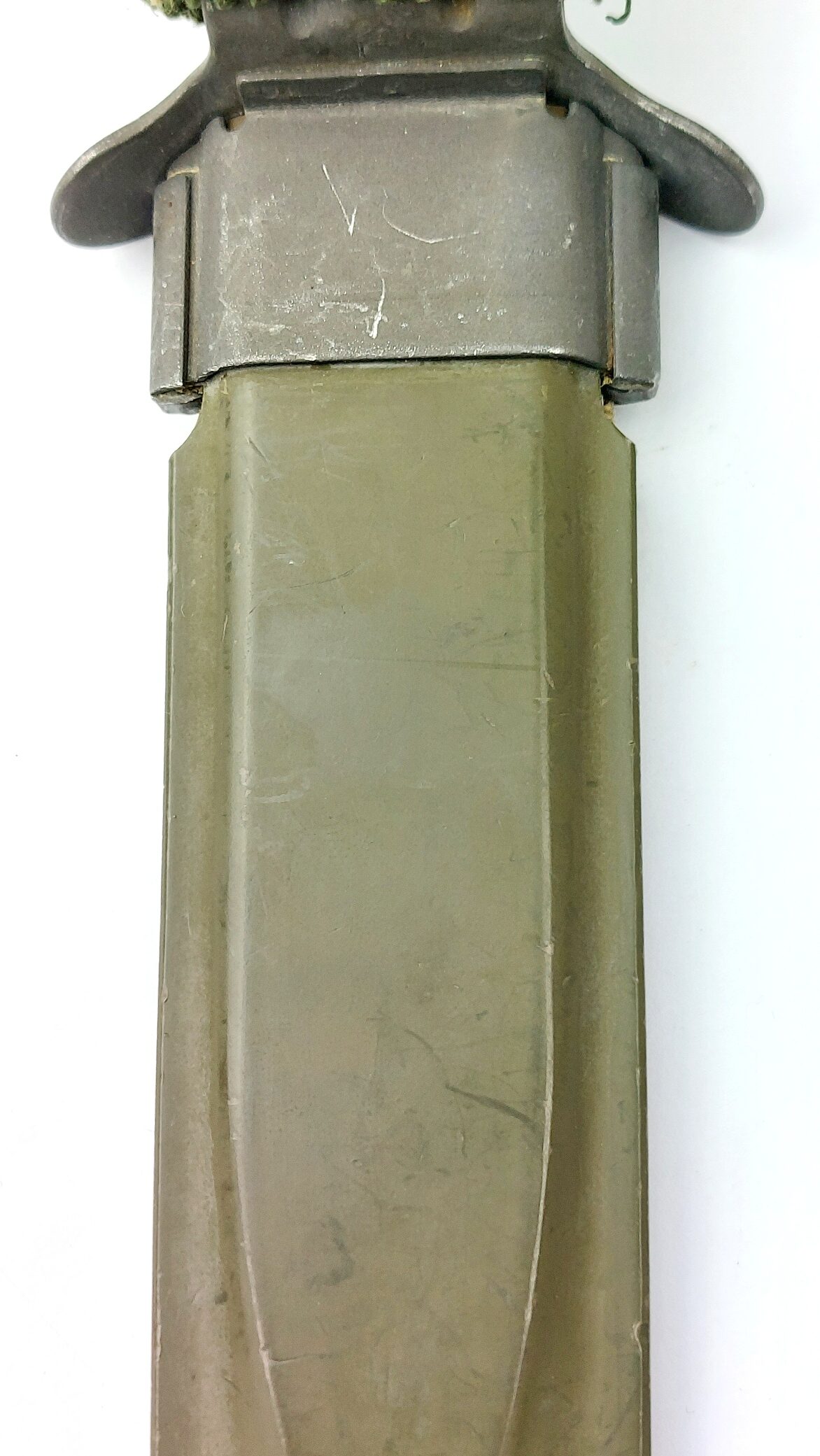
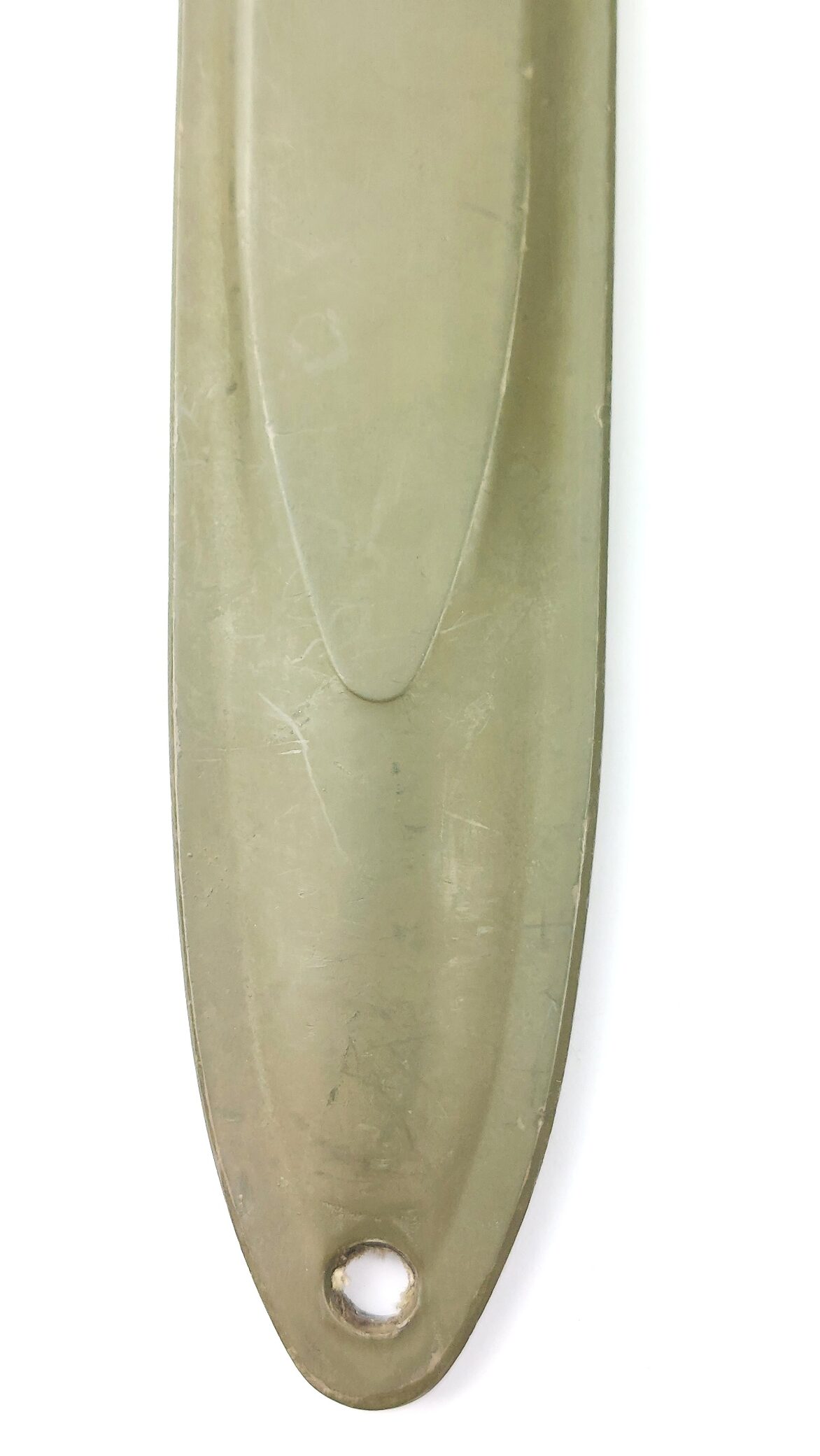
It is housed in an original U.S. M8A1 scabbard, the steel throat stamped: "U.S. M8A1 PWH". The web belt hanger retains its M1910 double wire belt hook and steel reinforcing tabs. The snap fastener (popper) to the belt strap is marked to "Rau Fastener Co., Providence, R.I.", a known U.S. military contractor active during the mid-1960s.
A correct and entirely authentic U.S. service pairing reflecting genuine military lifecycle use.
Approx. Measurements – Blade length: approx. 17 cm. Overall length: approx. 29.5 cm.
Historical Note: The M4 bayonet was introduced in 1944 for use with the calibre .30 U.S. M1 Carbine. Earlier carbines were not originally designed to accept a bayonet; beginning in June 1944, new production carbines were fitted with a barrel band incorporating a bayonet lug. The M4 was developed from the earlier M3 fighting knife. While retaining a similar blade, the guard and pommel were redesigned to incorporate a mounting system capable of withstanding the stresses of bayonet use. Wartime production occurred primarily during 1944–45, with just under 2.5 million manufactured by contractors including Utica, Camillus, Imperial, Kinfolks, PAL, Case, and Aerial. Utica Cutlery Company of Utica, New York, was one of the principal wartime producers under U.S. Ordnance contracts.
The scabbard represents later service life. The defining feature of the M8A1 pattern is the addition of the M1910 double wire belt hook, distinguishing it from the earlier M8 scabbard, which lacked this attachment system. The M8A1 was introduced in early 1944 during WWII, with initial production undertaken by Beckwith Manufacturing Co. (marked B.M. Co.), later continued by Victory Plastics Co., which remained the sole producer through 1961. During the Vietnam War procurement period, production expanded to additional government contractors identified by Department of Defense manufacturer symbols. These included VIZ (1962–63), WD / VIZ-WD (1964–65), and PWH (Pennsylvania Working Home for the Blind, 1965–68), followed by TWB (1969–70). The present example is marked PWH, confirming manufacture between 1965 and 1968 under documented U.S. Army contracts. M8A1 scabbards of this period are commonly encountered paired with earlier WWII M4 bayonets, reflecting continued U.S. military service use through the post-war, Korean, and Vietnam eras. The Pennsylvania Working Home for the Blind, founded in 1874 in Philadelphia, was a sheltered workshop that received substantial U.S. government contracts during the Vietnam period, including weapons-programme awards for M8A1 scabbard production.
This combination therefore represents a historically correct U.S. military service lifecycle pairing rather than a later civilian assembly.
*Condition* The blade shows honest service wear with scattered staining and light pitting consistent with age and use. Edge profile remains correct without evidence of aggressive sharpening. Crossguard markings remain clear and legible. The leather washer grip shows expected age compression and surface wear but remains structurally sound and complete. Pommel and locking mechanism intact. The M8A1 scabbard body is solid with expected age toning. Throat markings are clear and well struck. Webbing shows service wear and minor fraying consistent with use. Wire belt hook intact. Snap fastener functional. A genuine service-used example retaining strong originality. Please see photographs as part of the condition report.
*In order to complete the online purchase we will require a picture/scan of a photo ID (Driving Licence, Passport or an official document with a recent picture). If you don't posses any such document please call to buy. If we consider that the proof of ID is incorect or insuficient, we reserve the right to cancel the transaction.
*We also reserve the right to cancel the transaction with a full refund if there is any suspicion that the provided item will be used in any way contrary to the laws and legislation of UK.