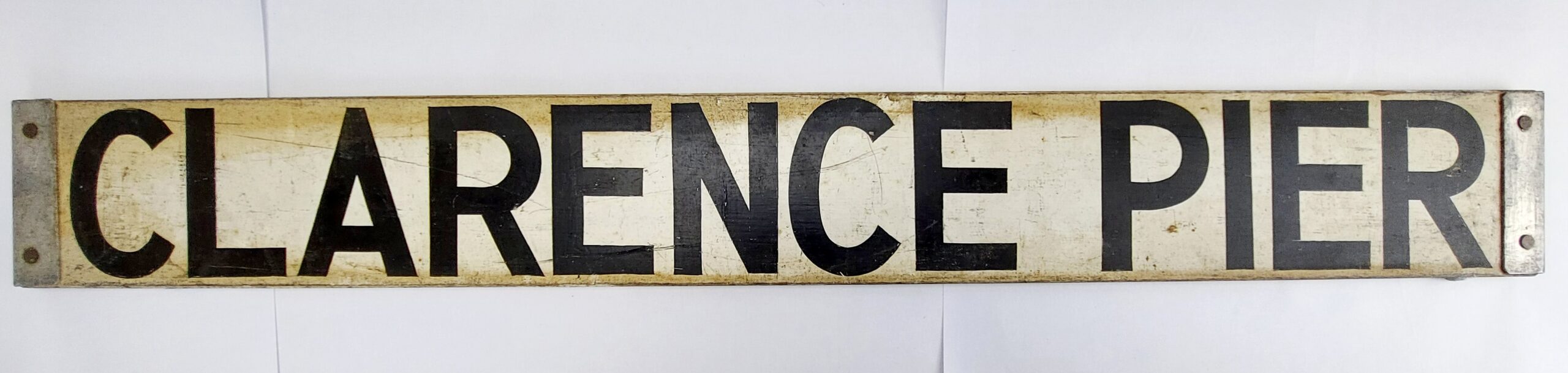
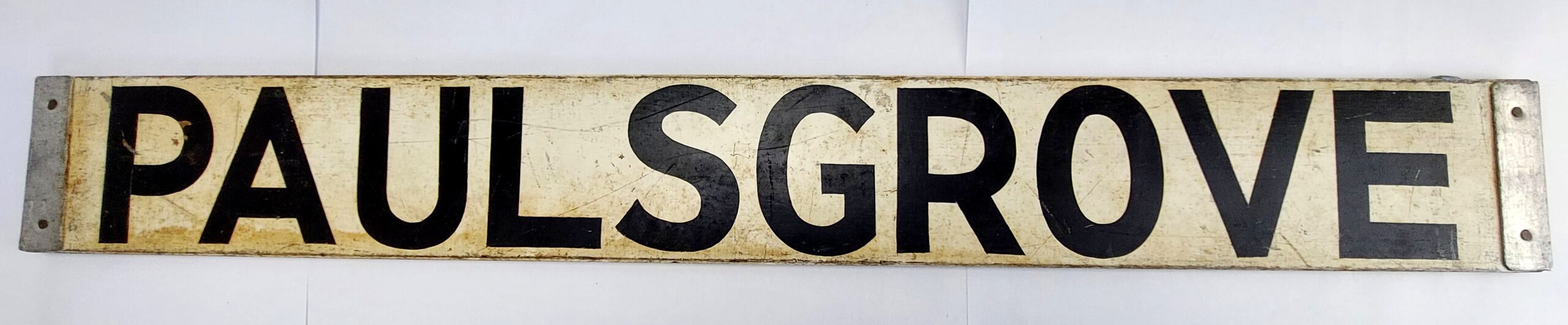
An original double-sided wooden bus destination board from Portsmouth, displaying CLARENCE PIER to one face and PAULSGROVE to the reverse. The sign is of classic mid-20th-century British Corporation Transport format, constructed from a painted wooden board with metal end plates drilled for mounting or insertion into external destination frames. The lettering is bold and clear in black on a cream ground, retaining strong visual impact and excellent legibility.
Measuring approximately 85 cm × 10.5 cm, with a depth of around 1 cm, the proportions and construction are entirely consistent with destination boards used on Portsmouth Corporation buses prior to the widespread adoption of roller blind displays. The pairing of a seafront leisure terminus with a major suburban estate is typical of Corporation route planning of the period.
Historical Note: Before the introduction of roller blind destination systems, British municipal bus operators commonly used interchangeable wooden destination boards, manually changed by depot staff or drivers to reflect route termini. In Portsmouth, Clarence Pier served as a prominent seafront terminus and tourist destination from the inter-war years onwards, while Paulsgrove expanded rapidly from the late 1930s as one of the city’s principal post-war housing estates. Signs such as this would have been in daily operational use on Corporation routes linking the city centre, suburbs, and the Southsea seafront, making them a tangible survivor of Portsmouth’s mid-20th-century public transport history.
*Condition* The sign is in good original condition, showing honest service wear throughout, including surface scuffing, paint wear, and age-toning consistent with prolonged operational use. Both destination names remain fully legible. The wooden body is sound, and the metal end plates are intact with original fixing holes present. No evidence of modern repainting or restoration is noted. Please see photographs as part of the condition report.