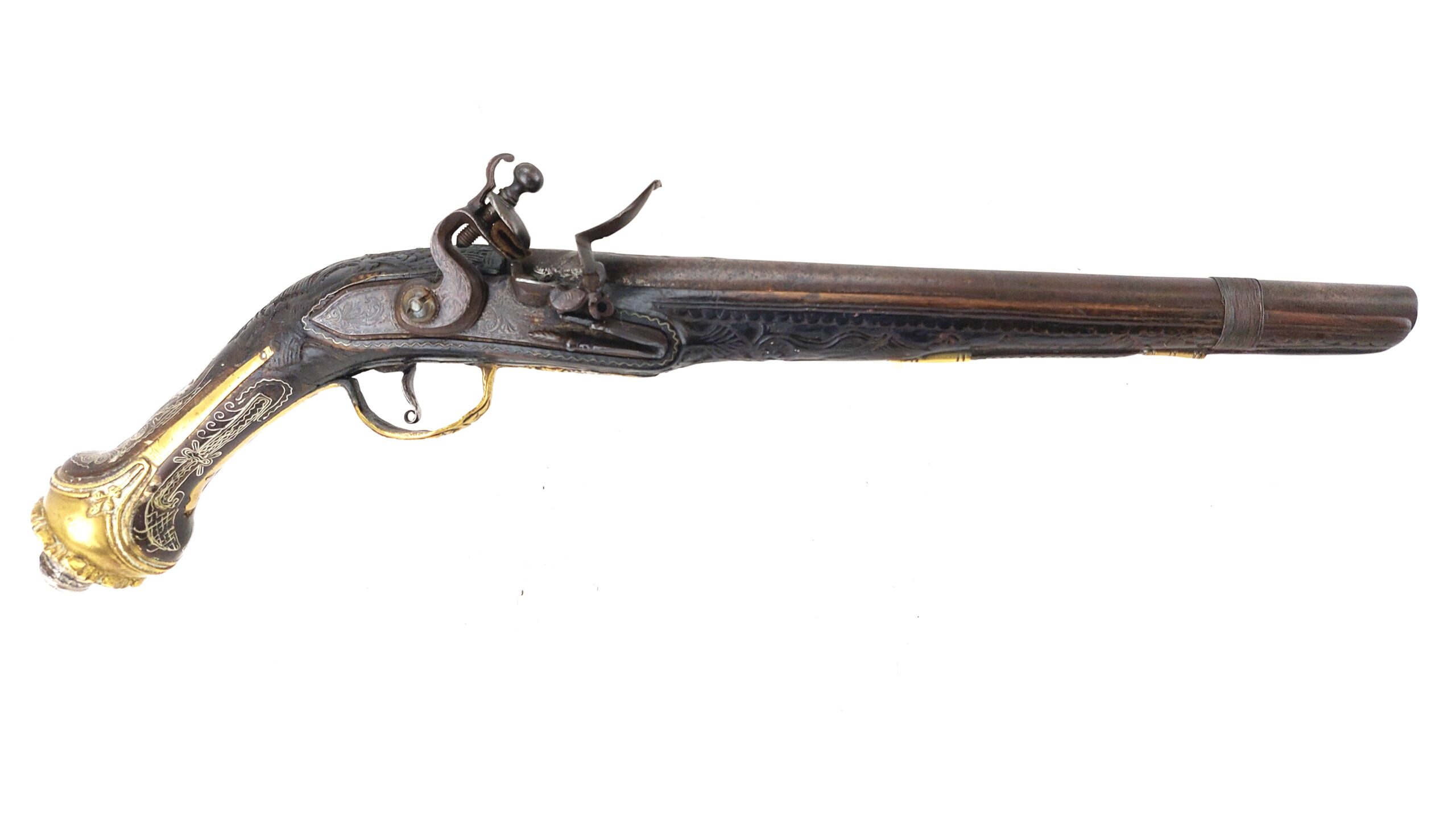
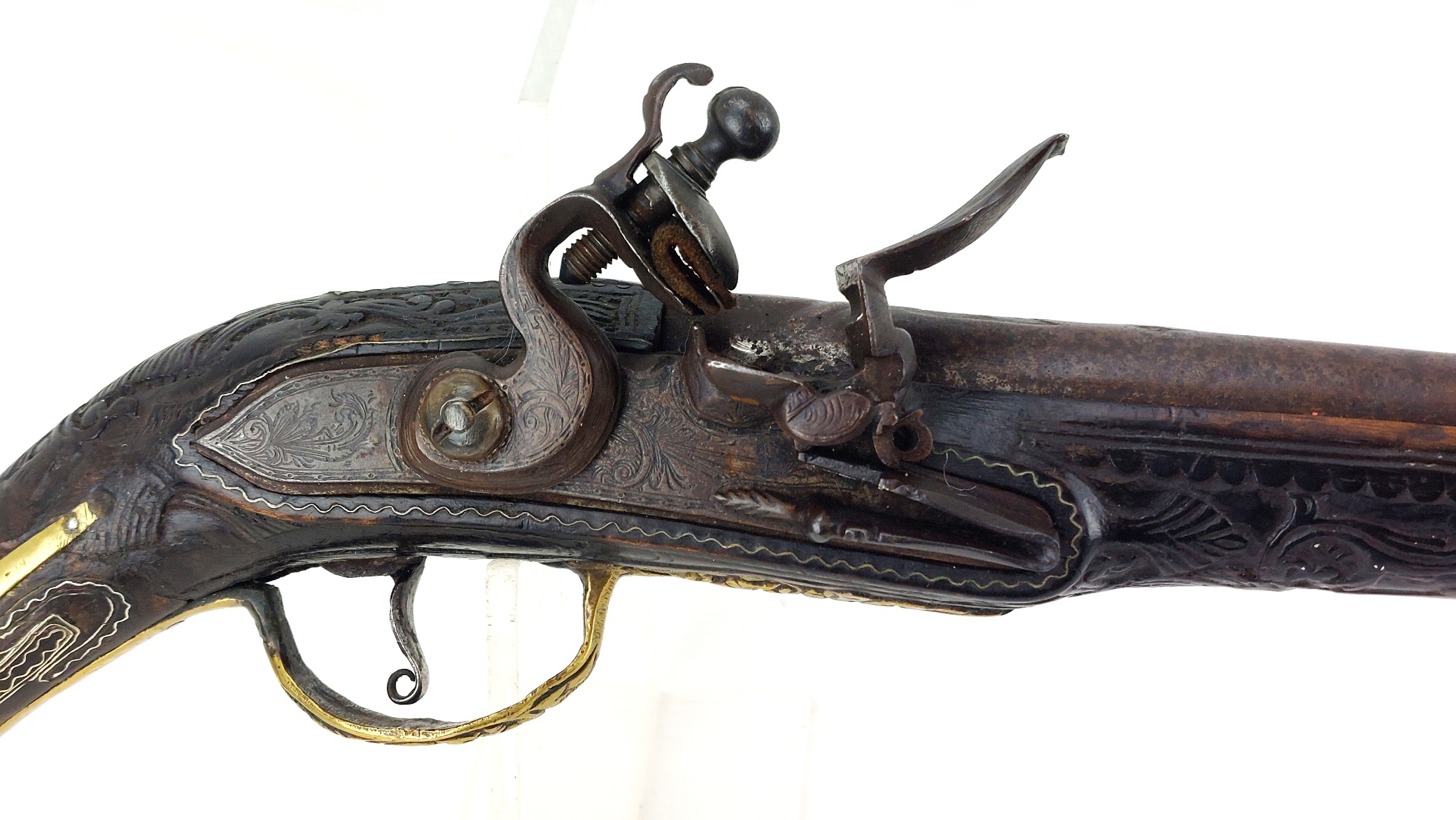
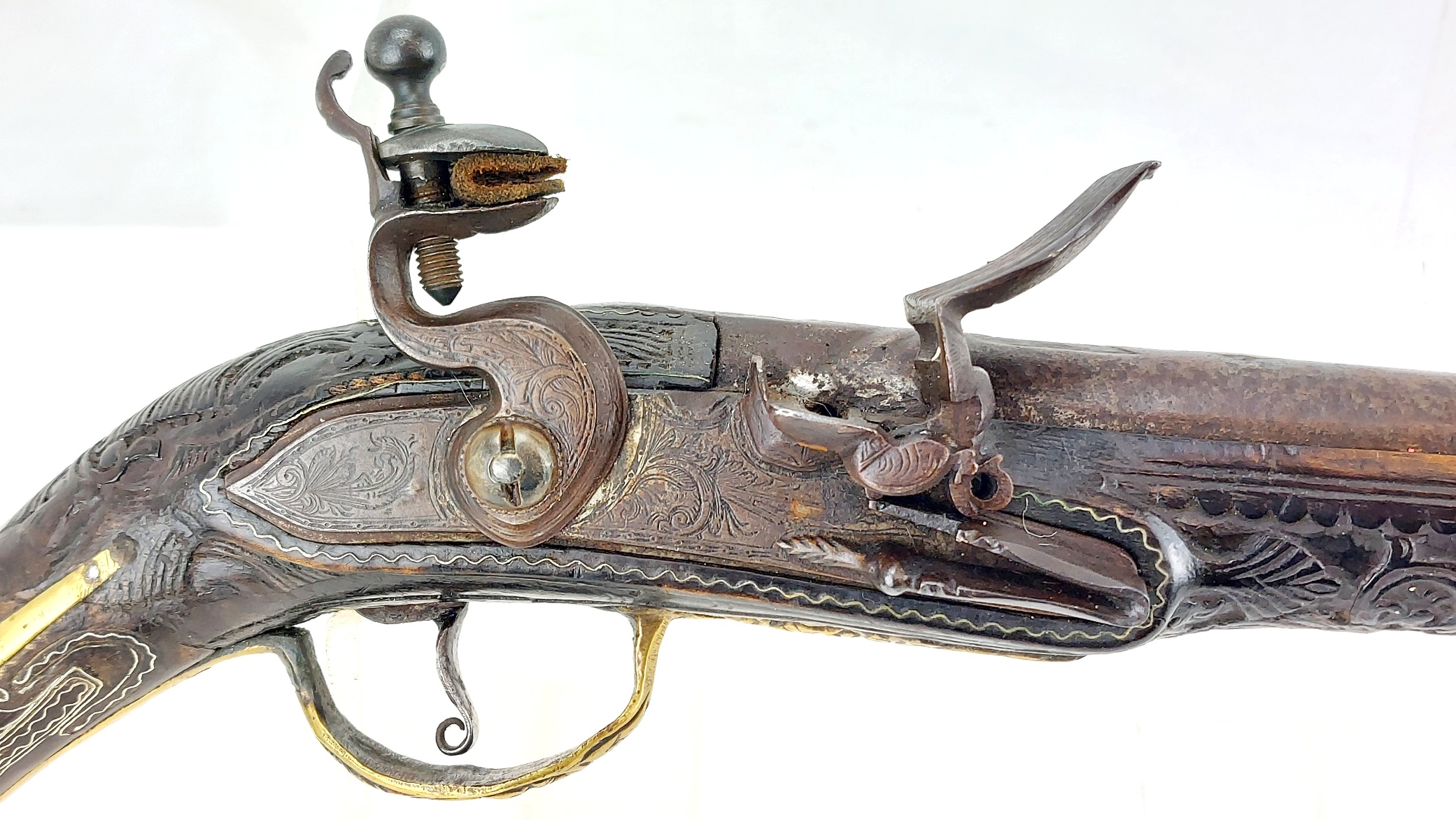
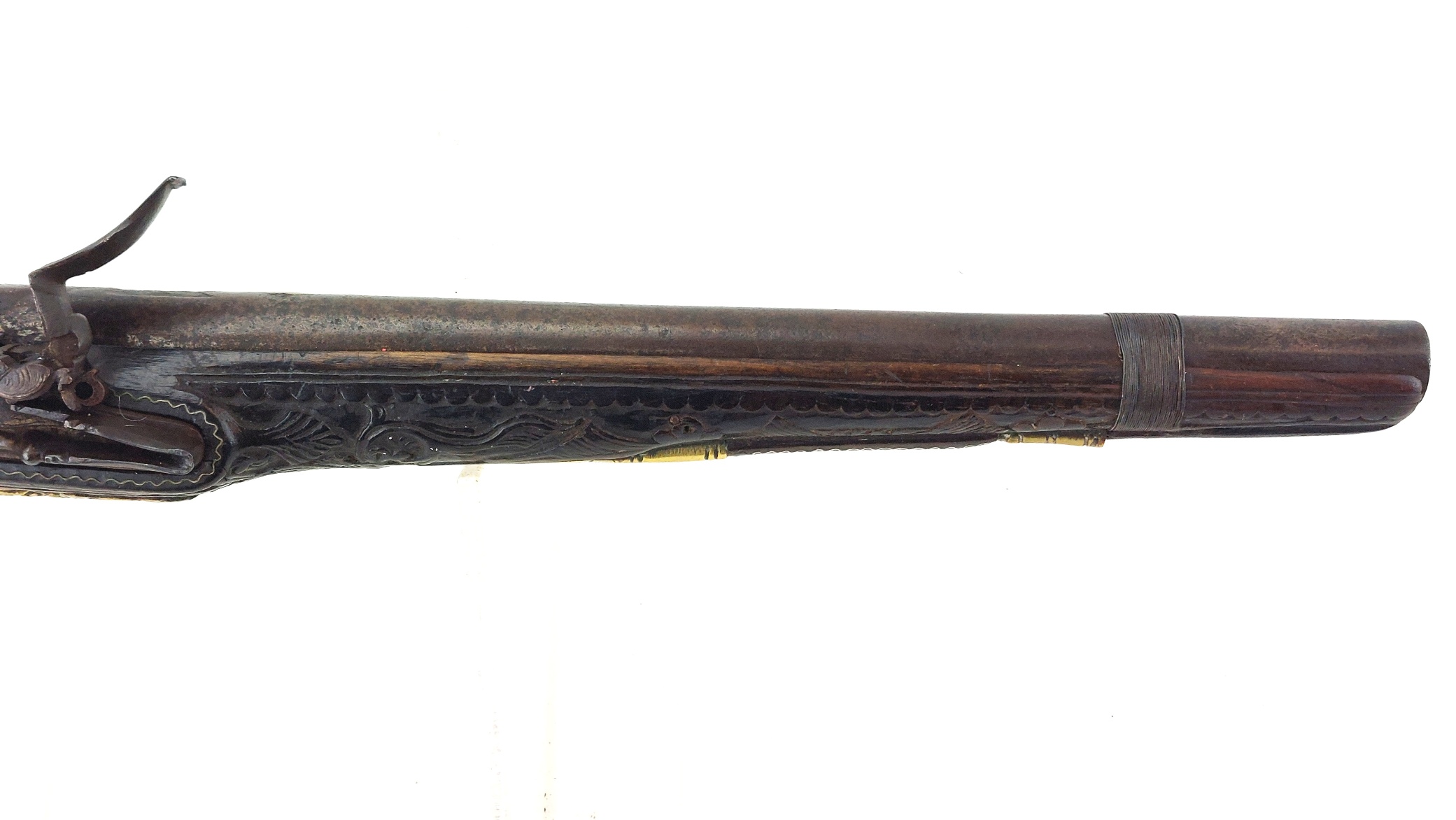
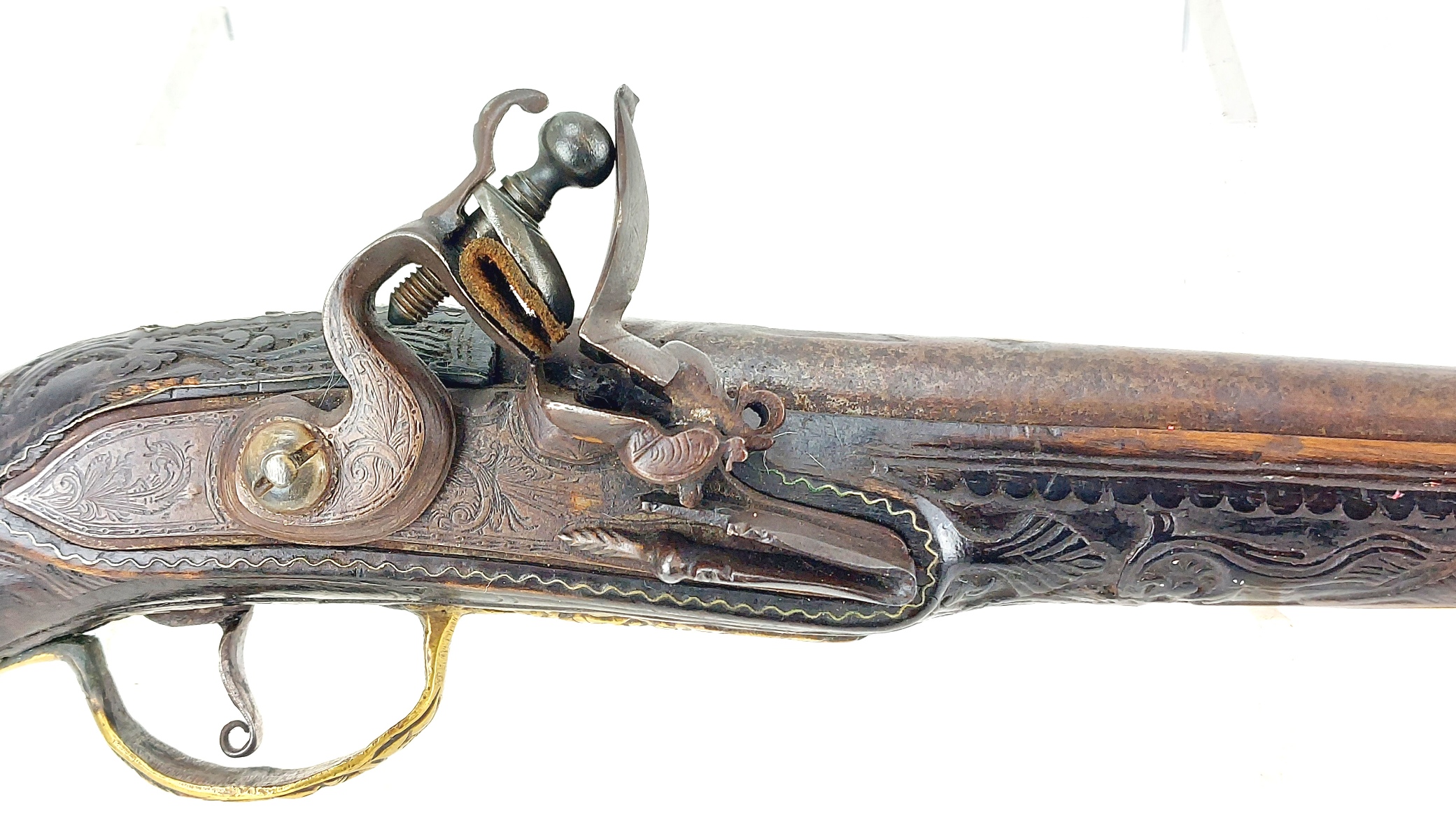
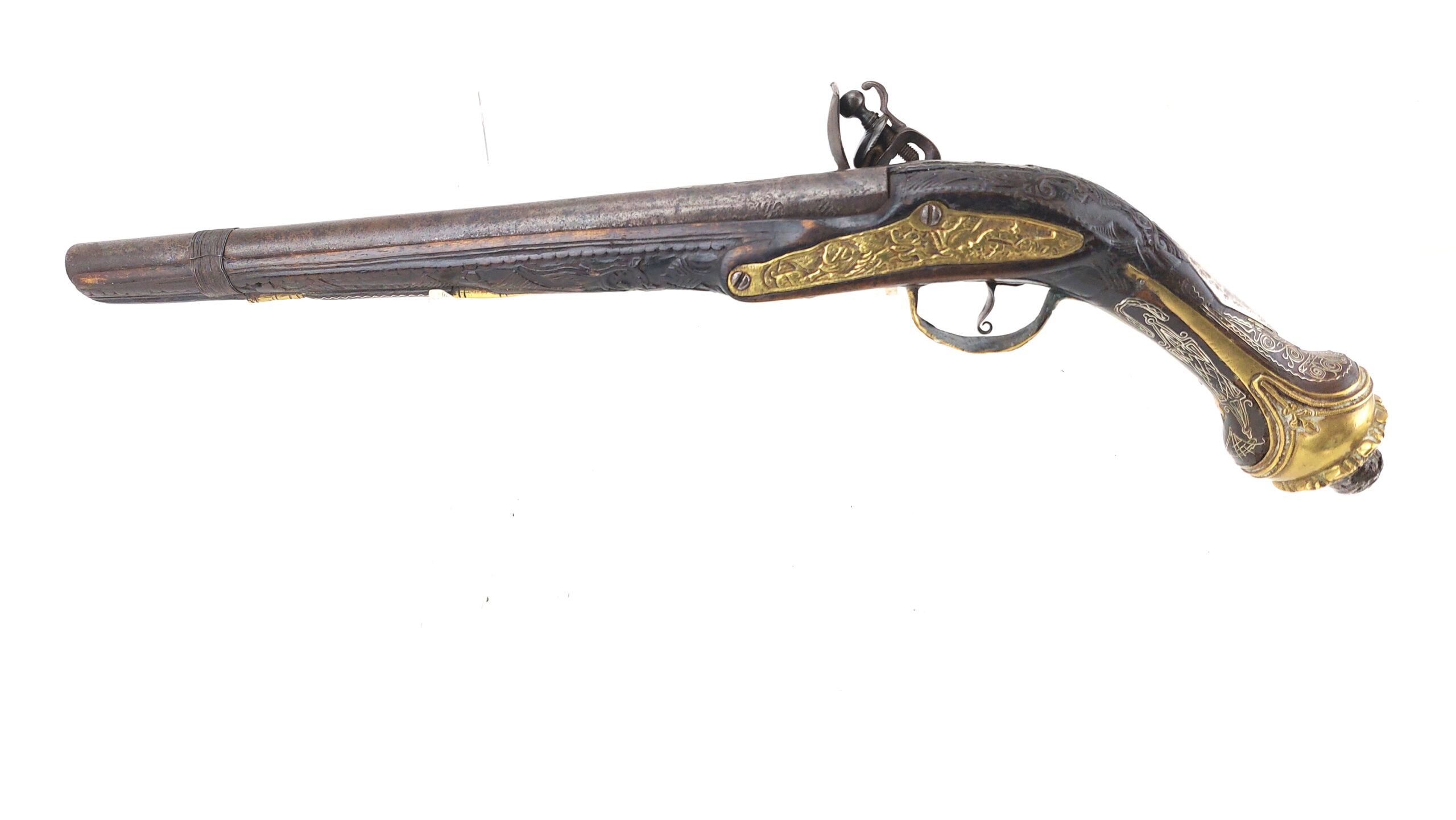
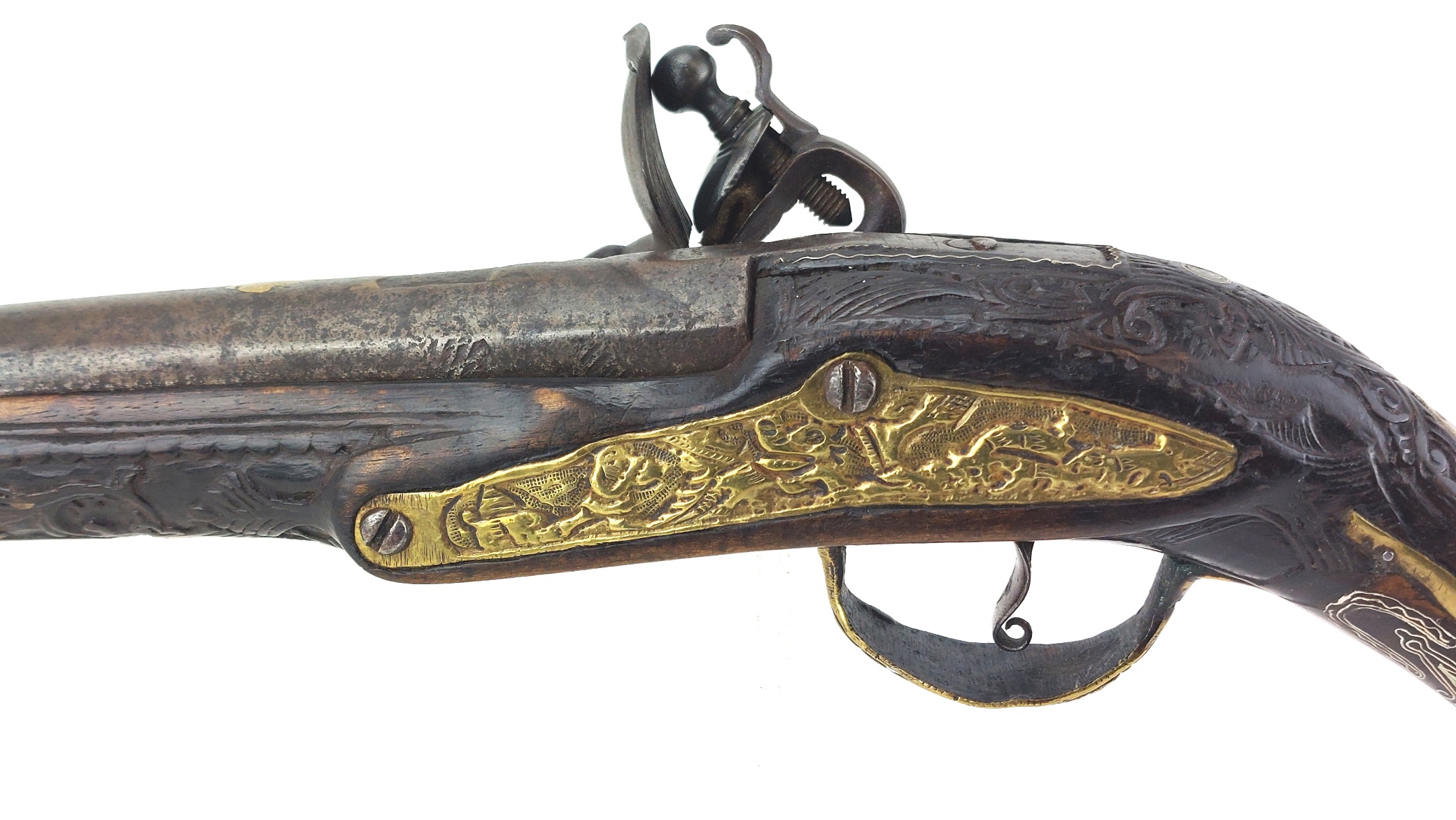
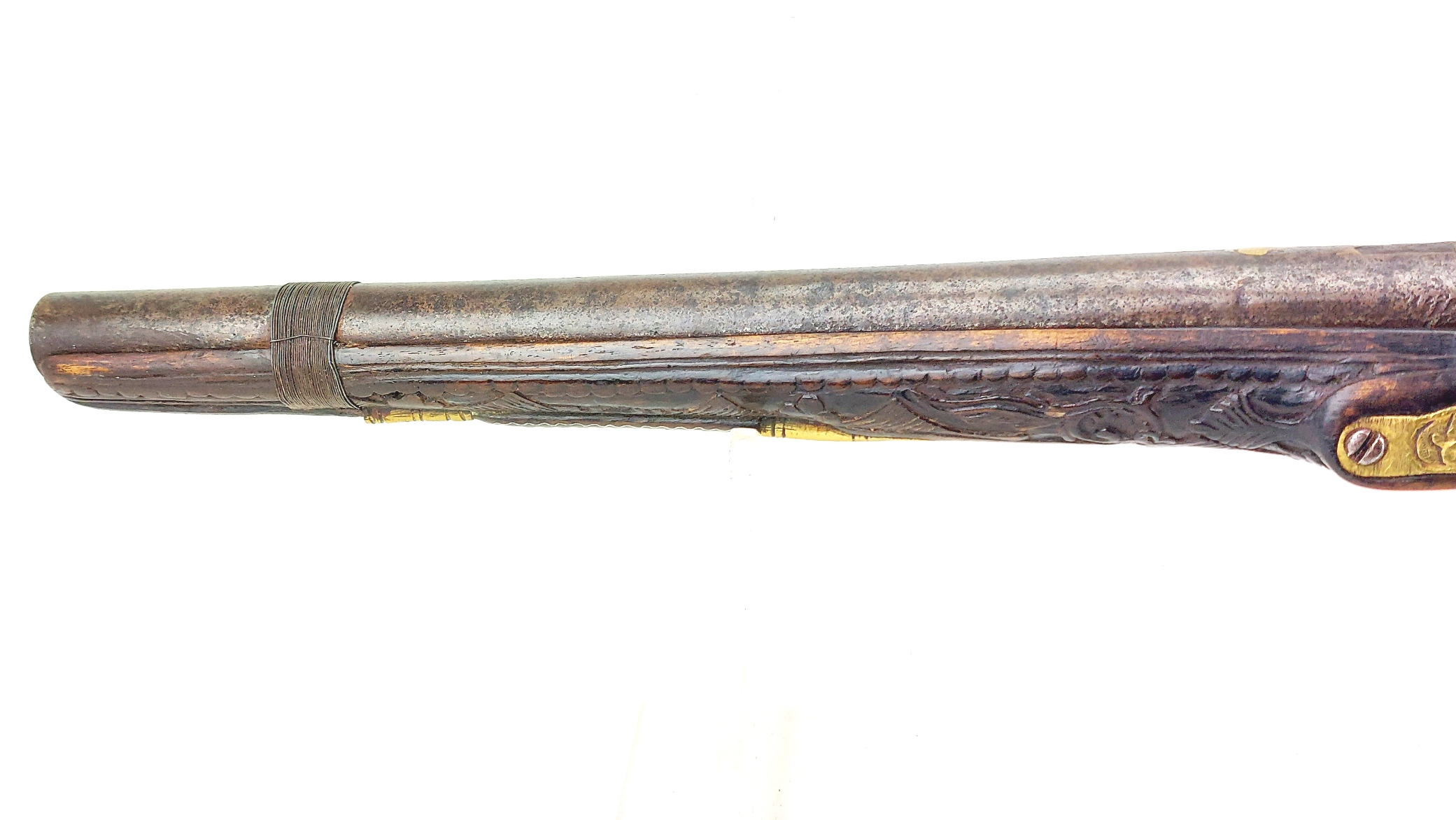
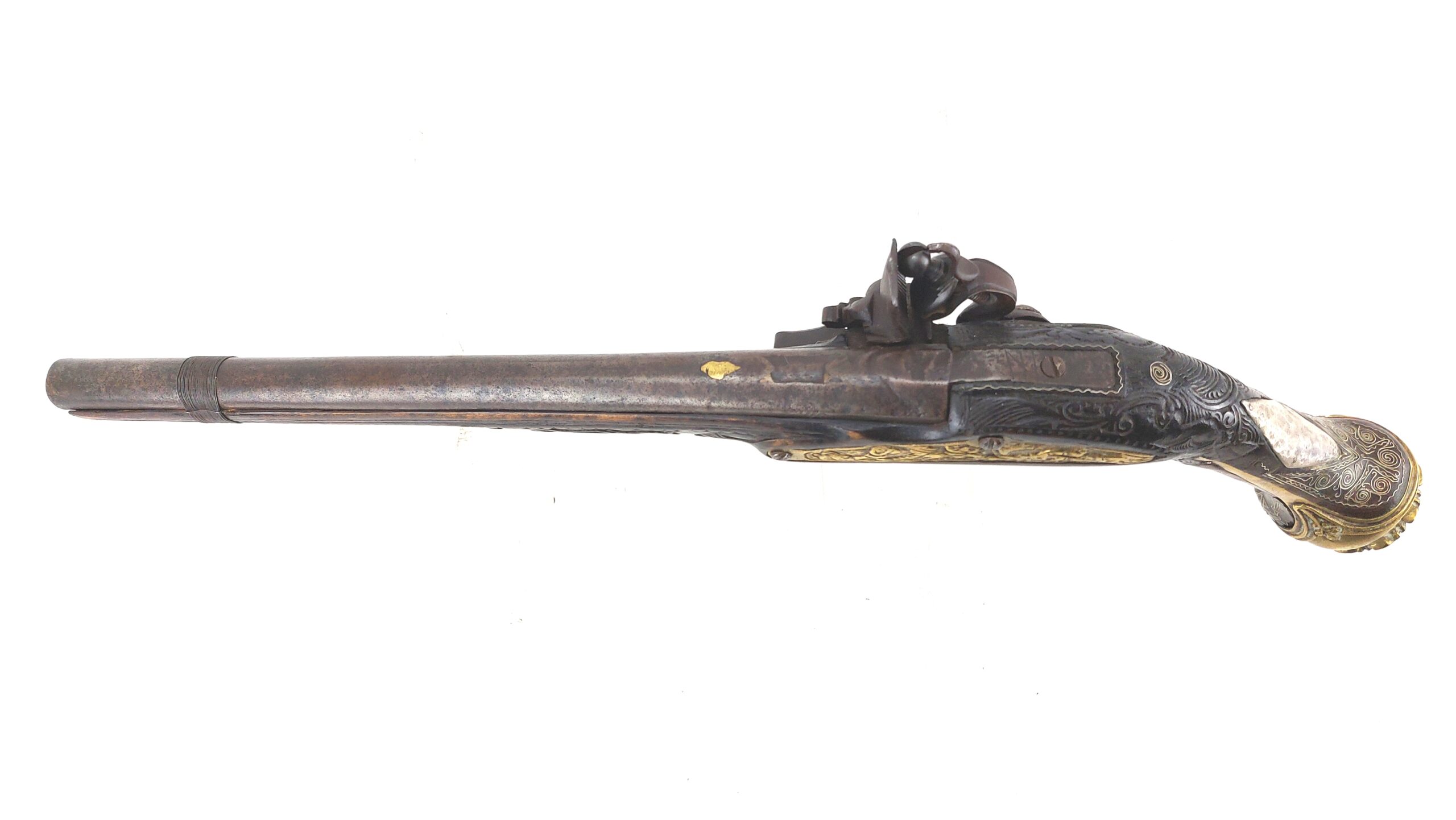
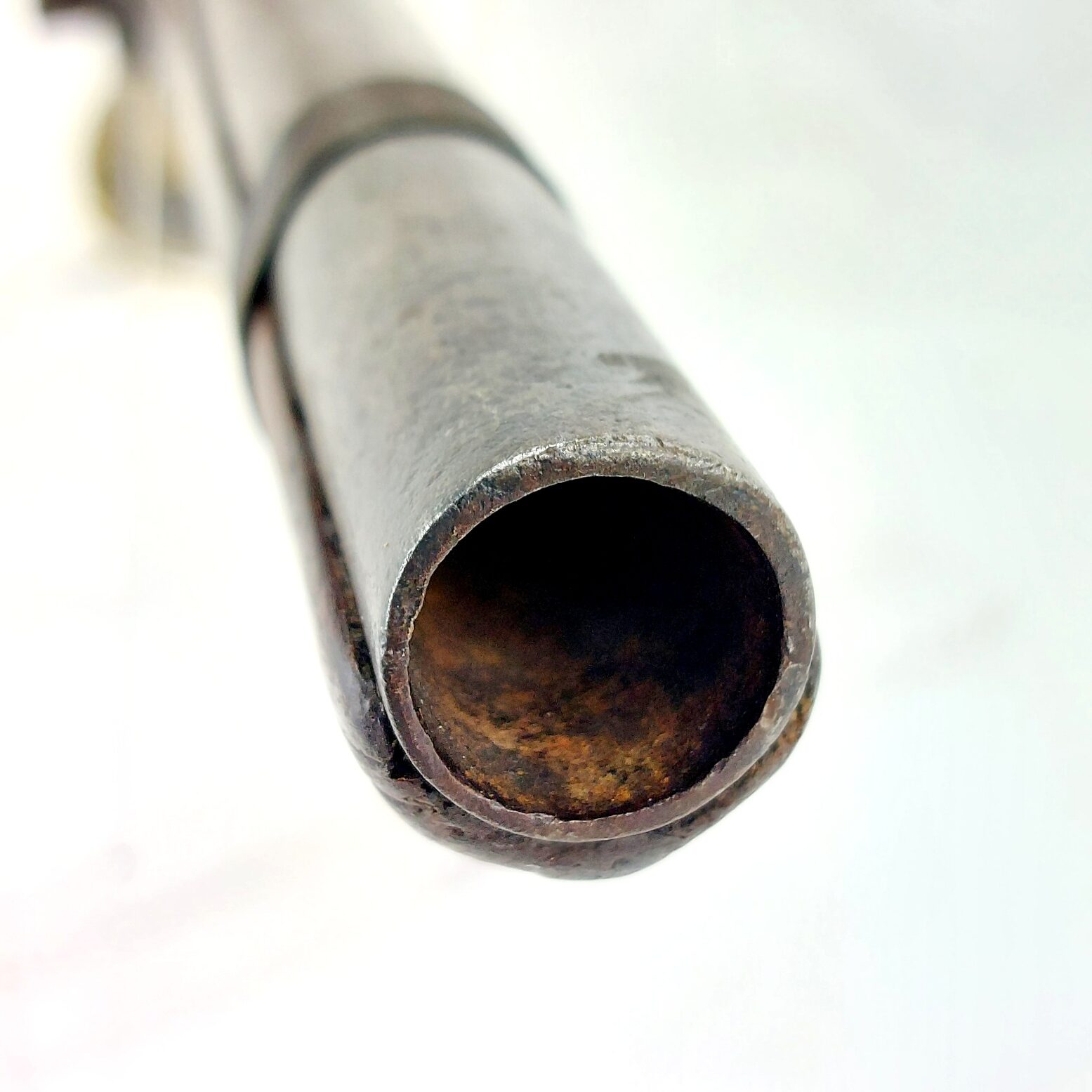
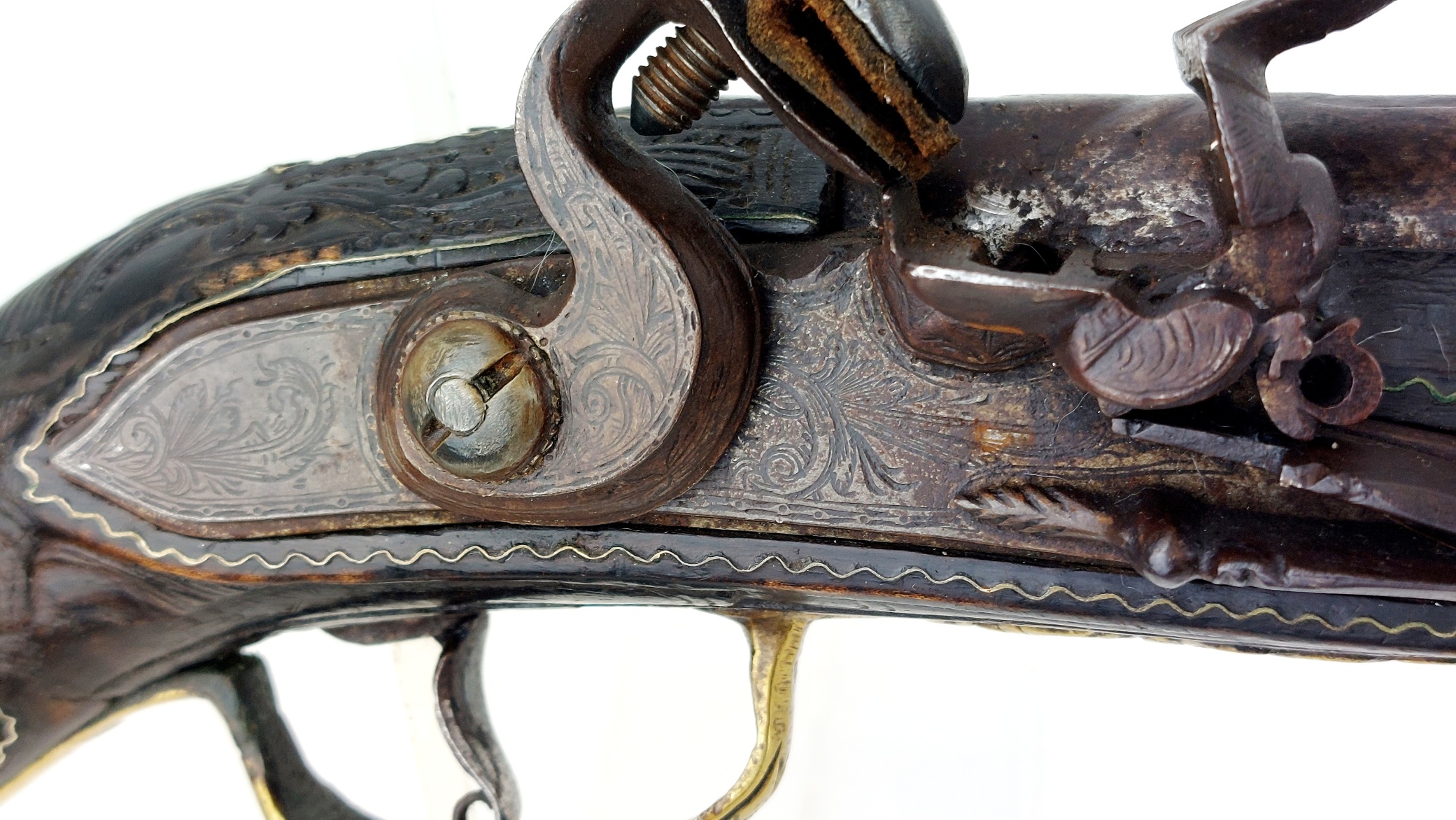
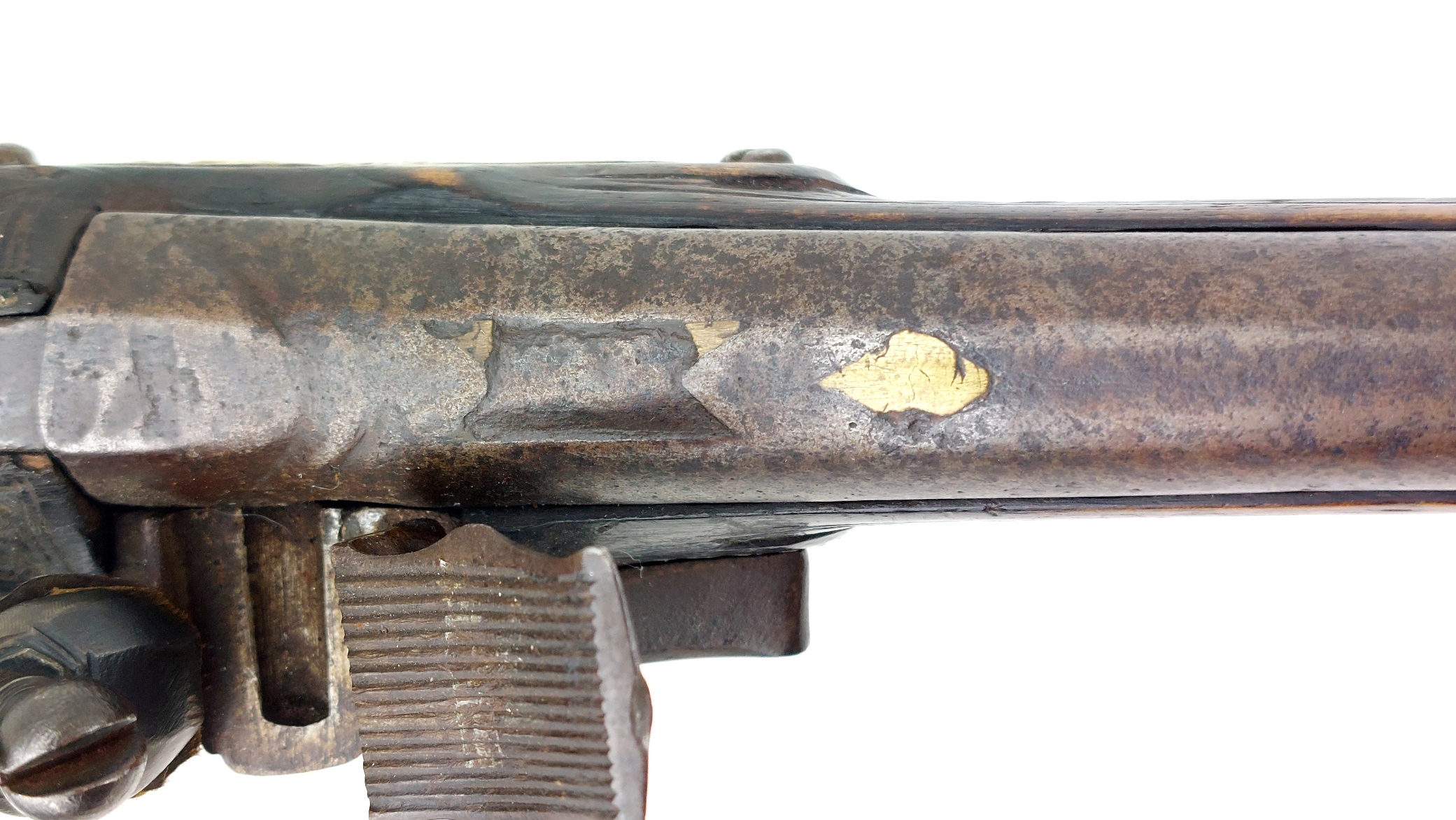
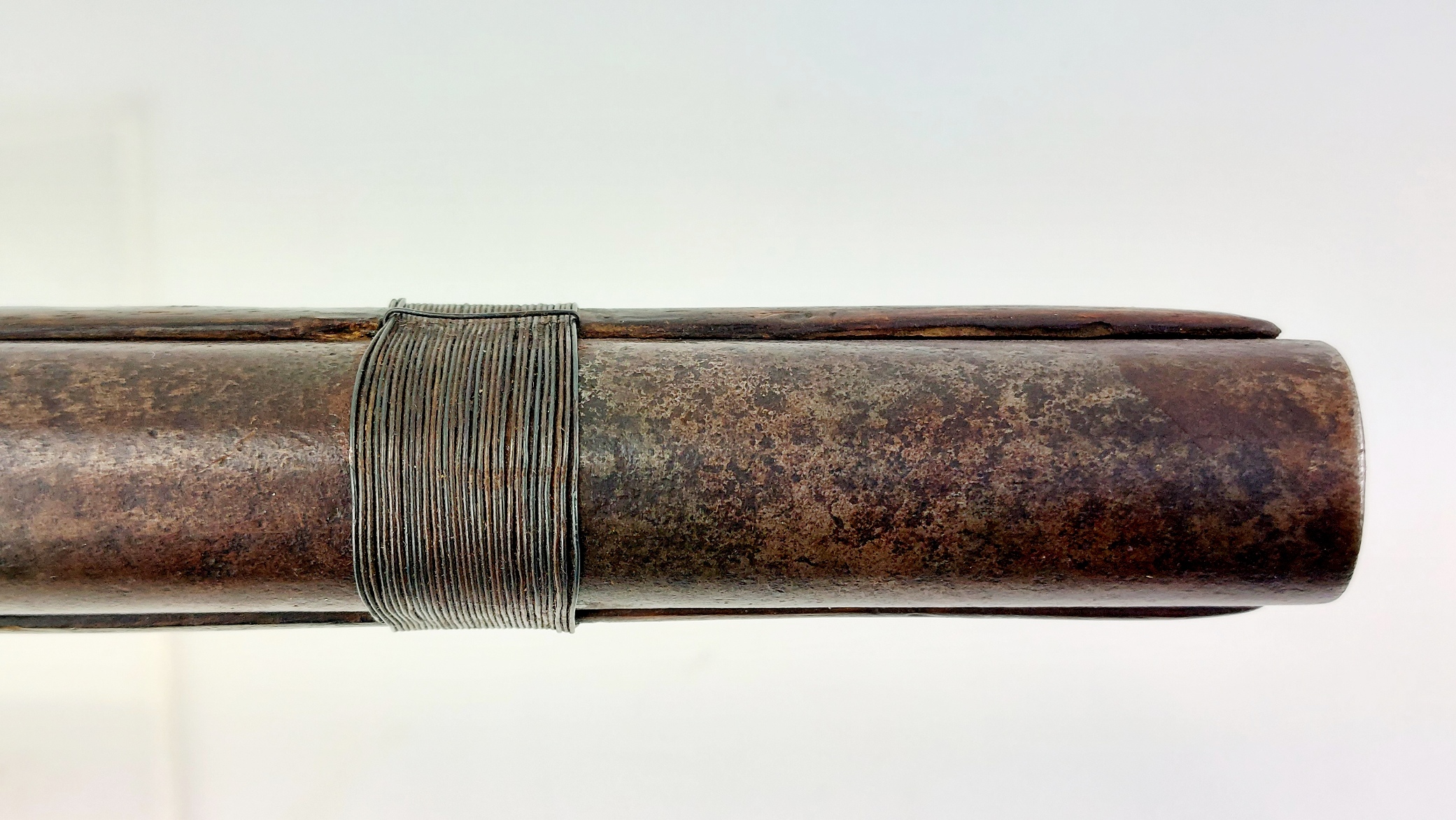
A fine and richly ornamented Albanian miquelet-lock flintlock pistol dating to the first half of the 19th century, measuring approximately 48.5 cm overall with a 31.7 cm barrel of round section, slightly flared muzzle, and decorative wire binding near the muzzle. The barrel shows traces of original gilt koftgari inlay and typical hand-engraved geometric motifs. The lock is of miquelet form with foliate engraving and all original components present.
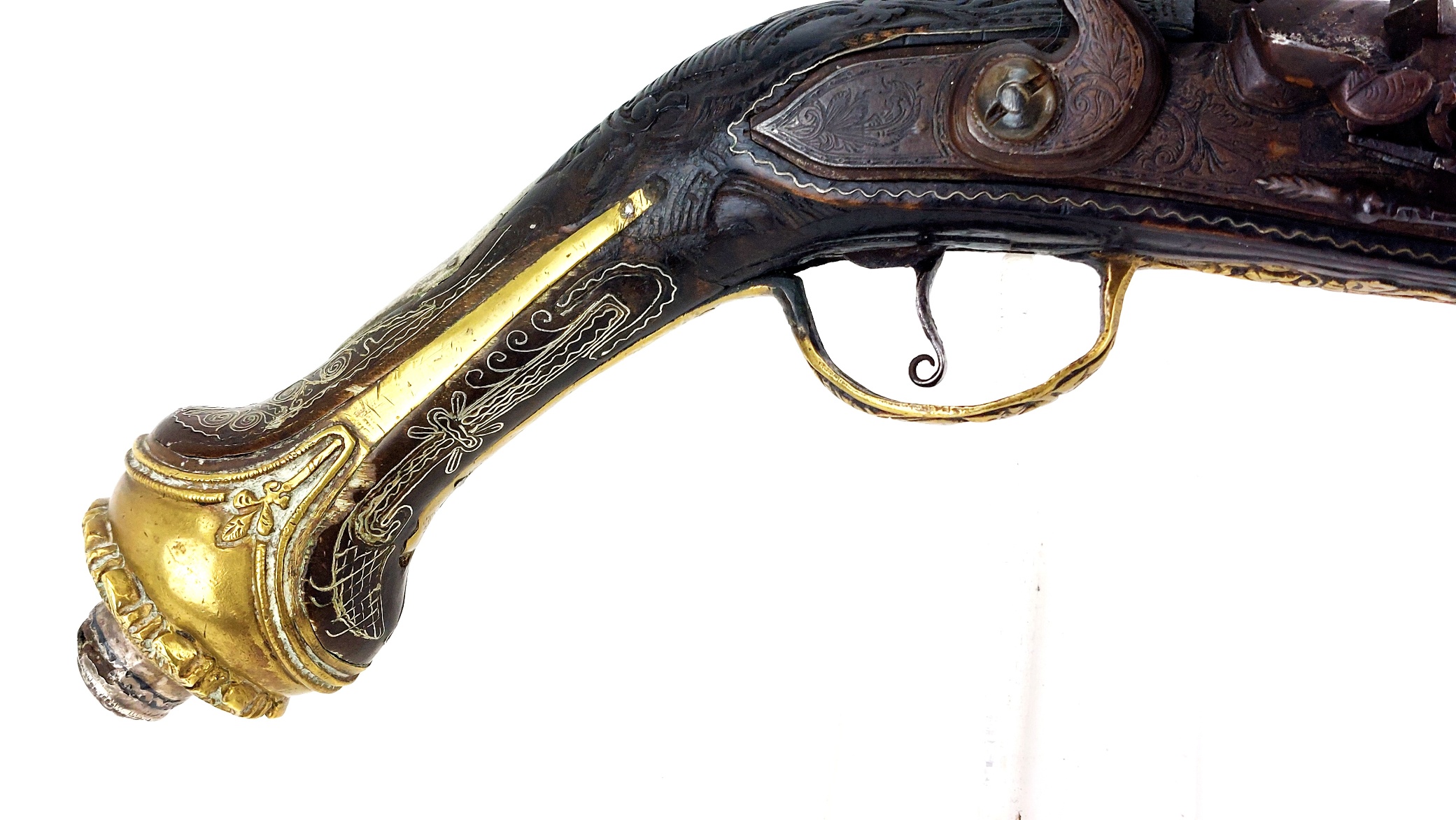
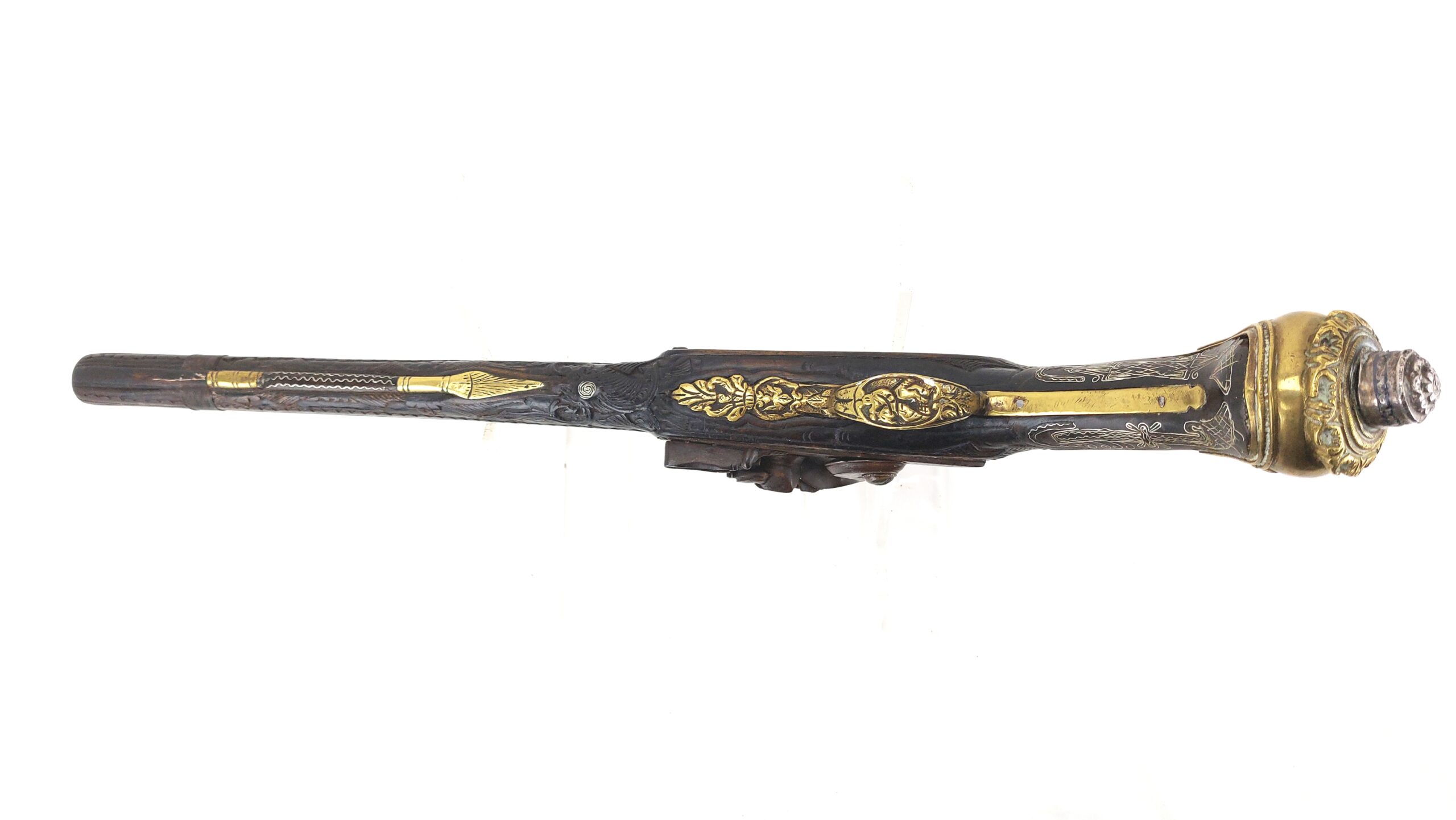
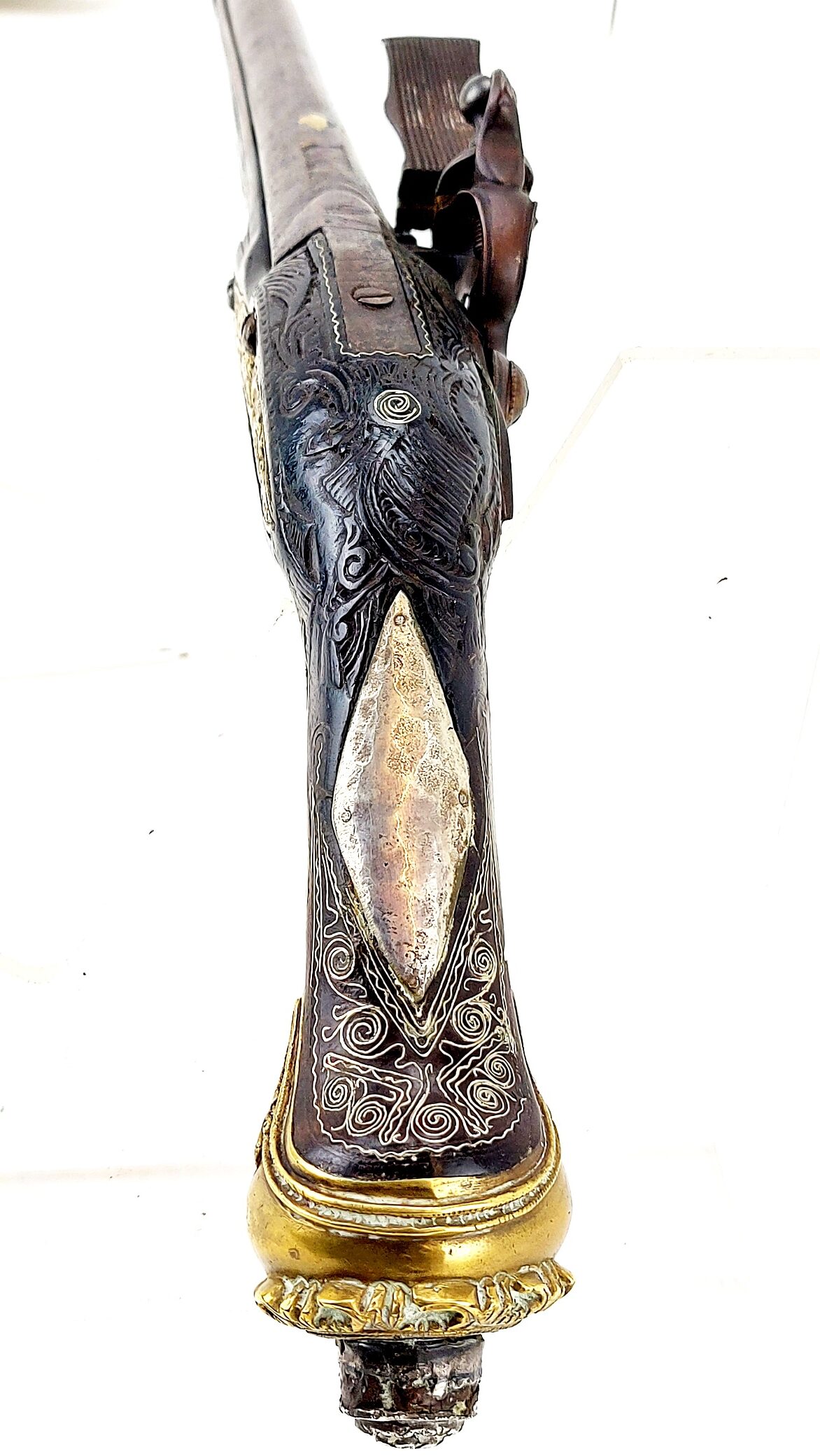
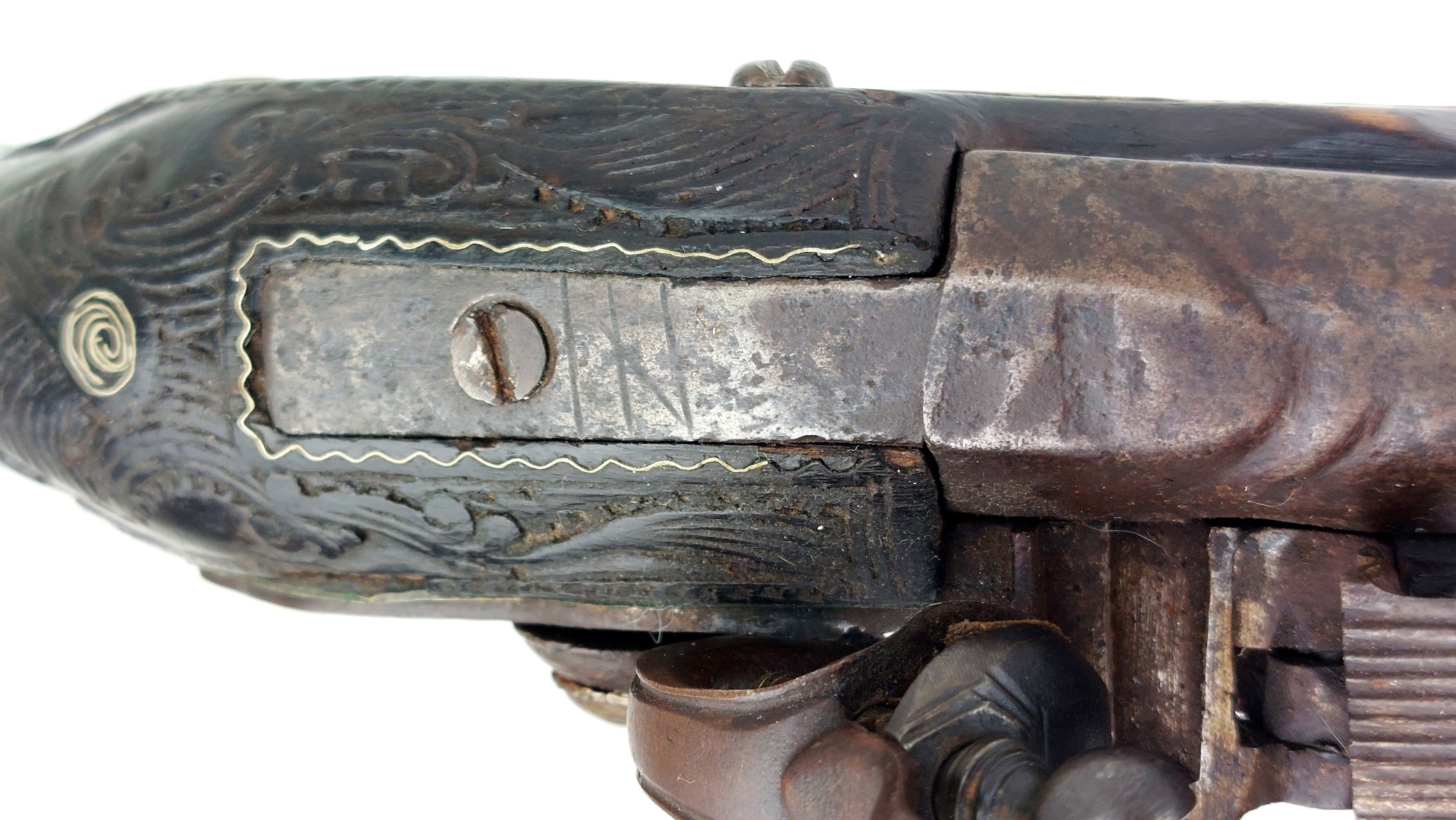
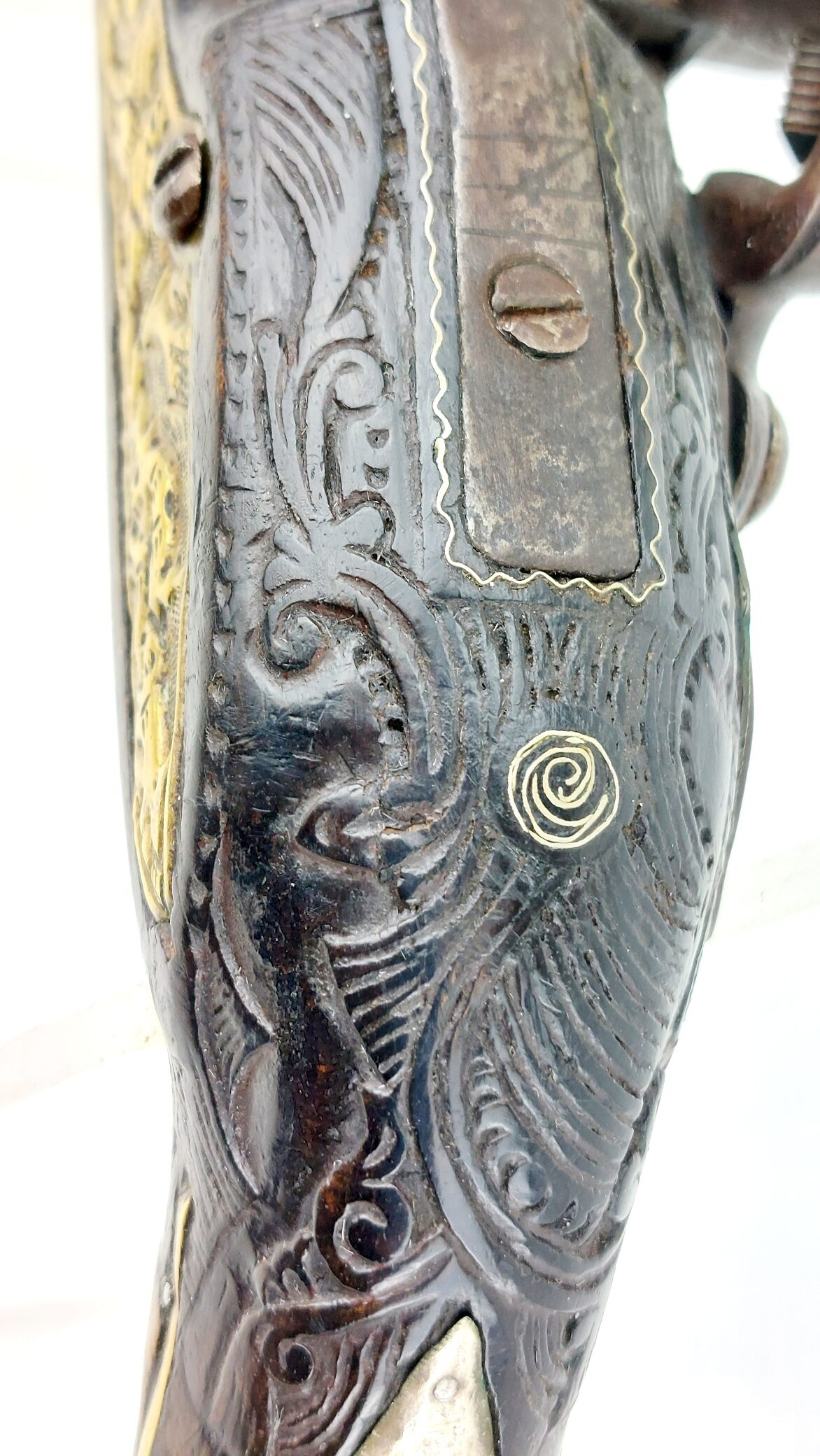
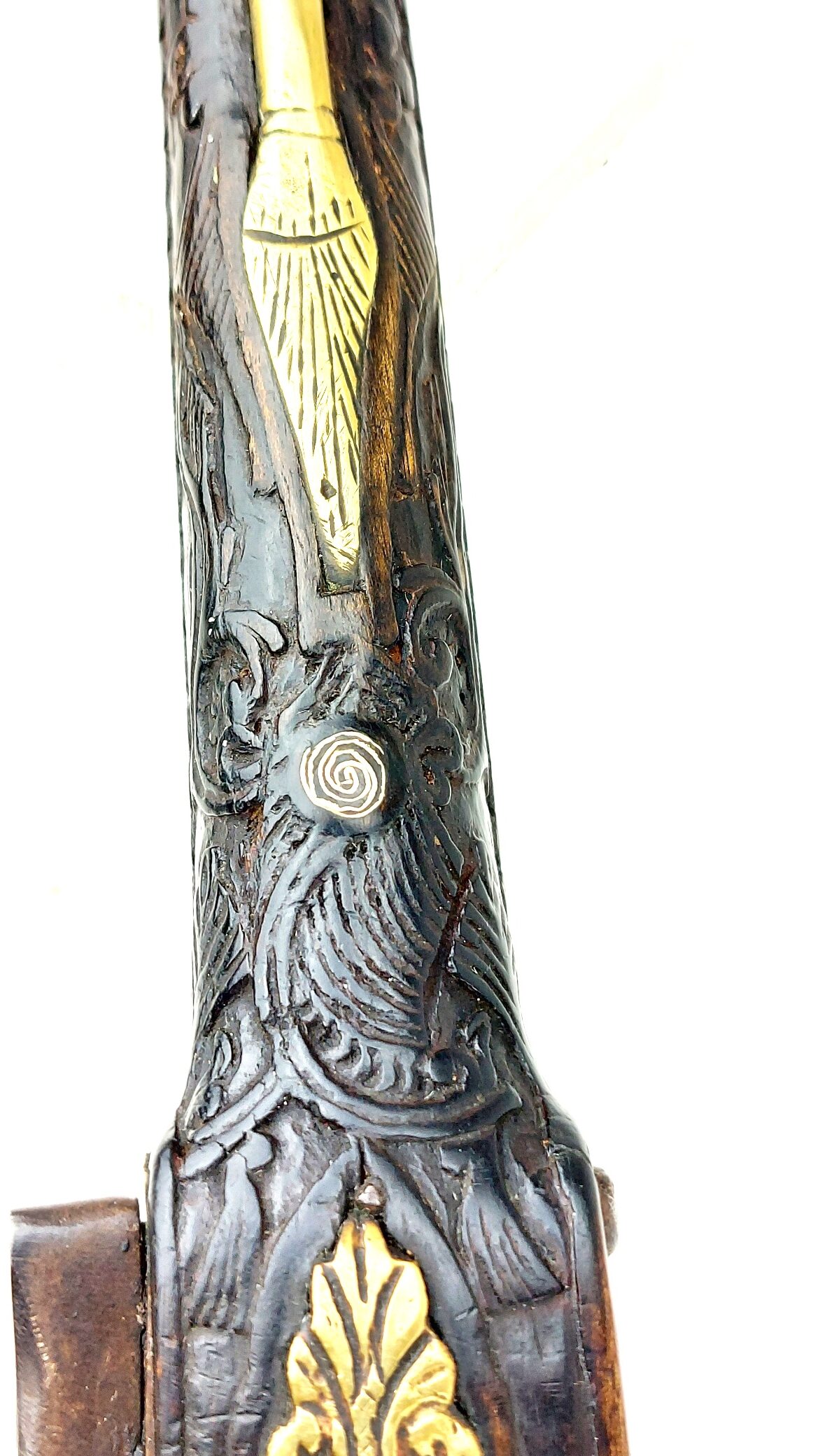
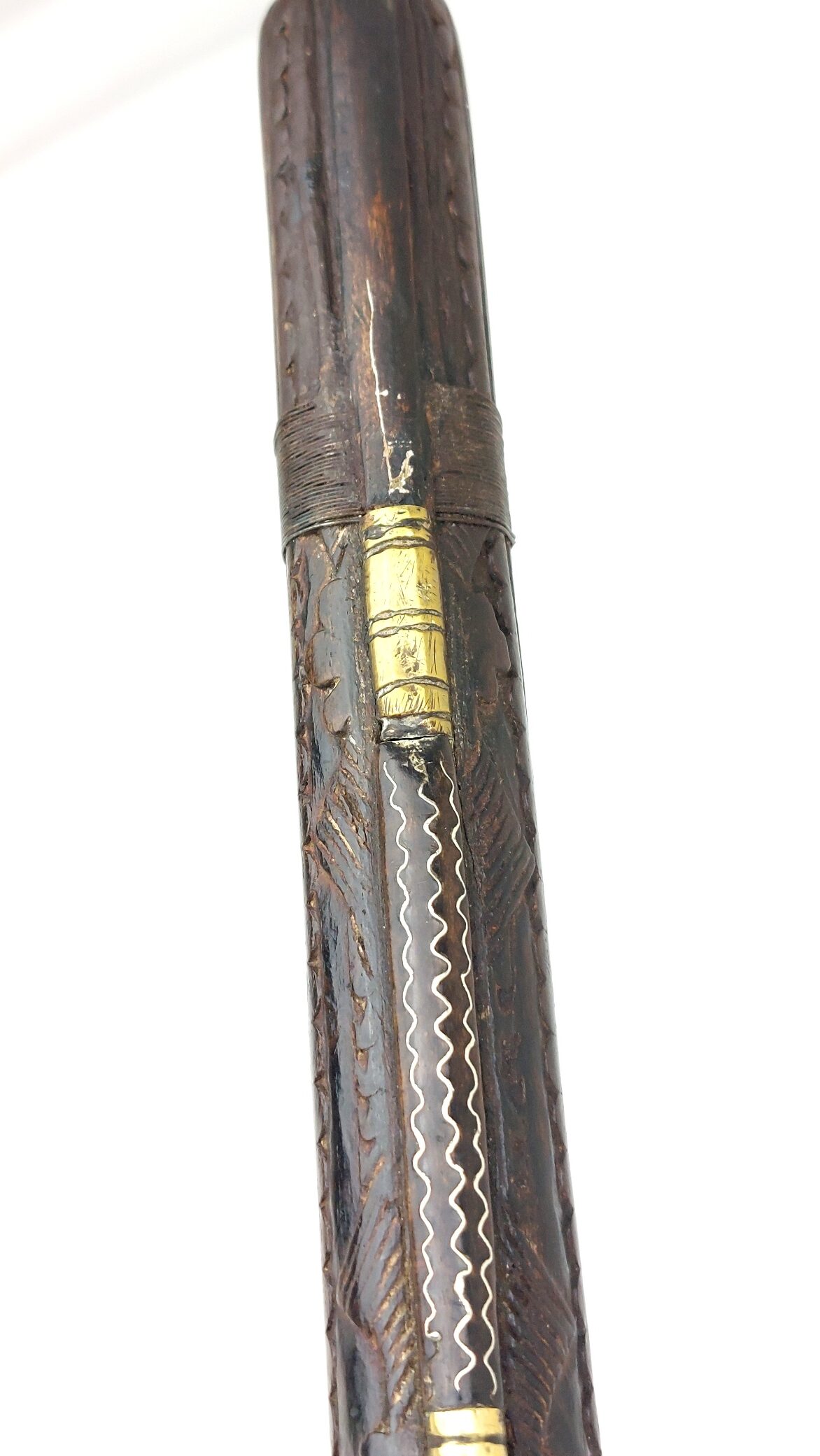
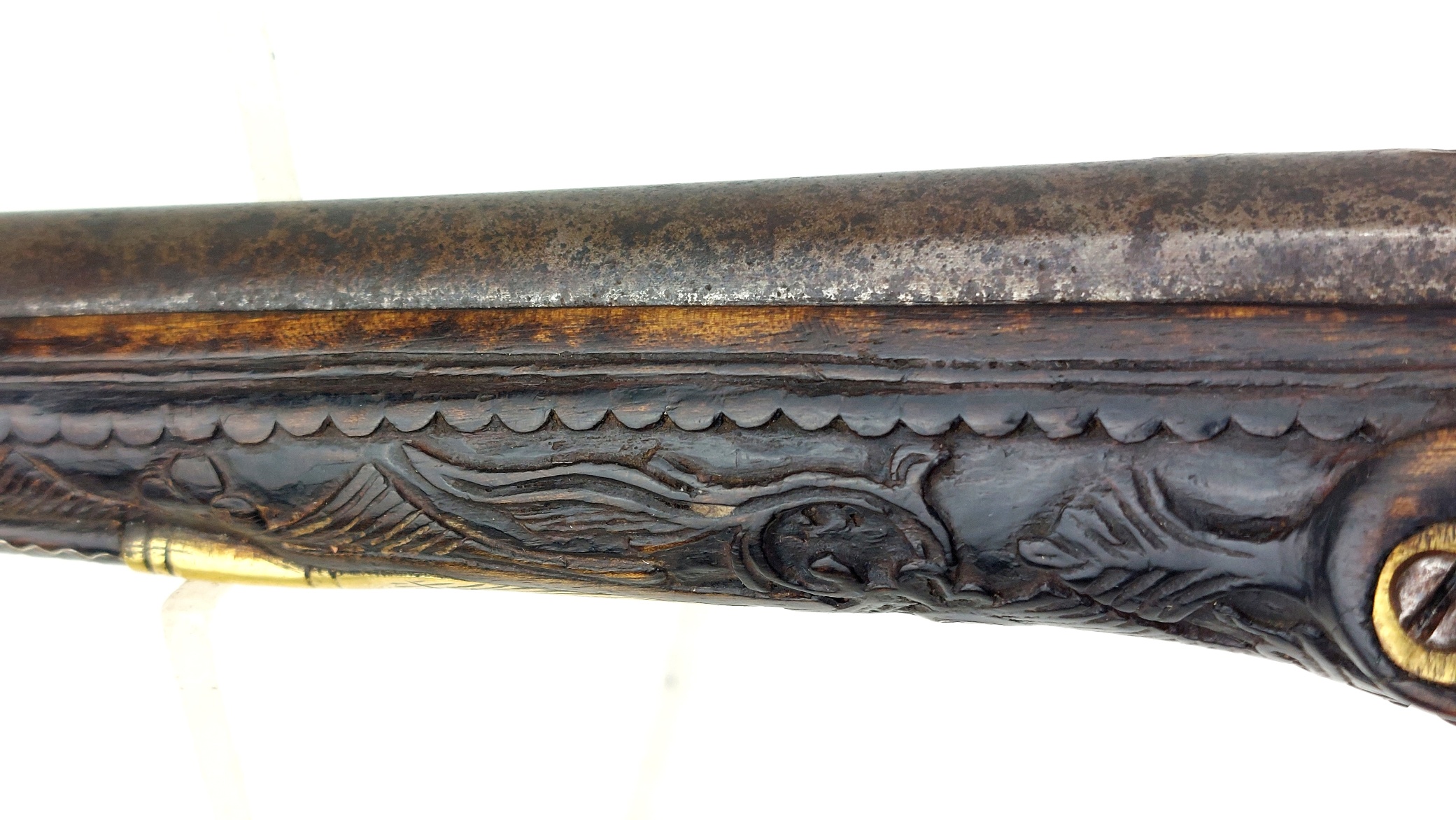
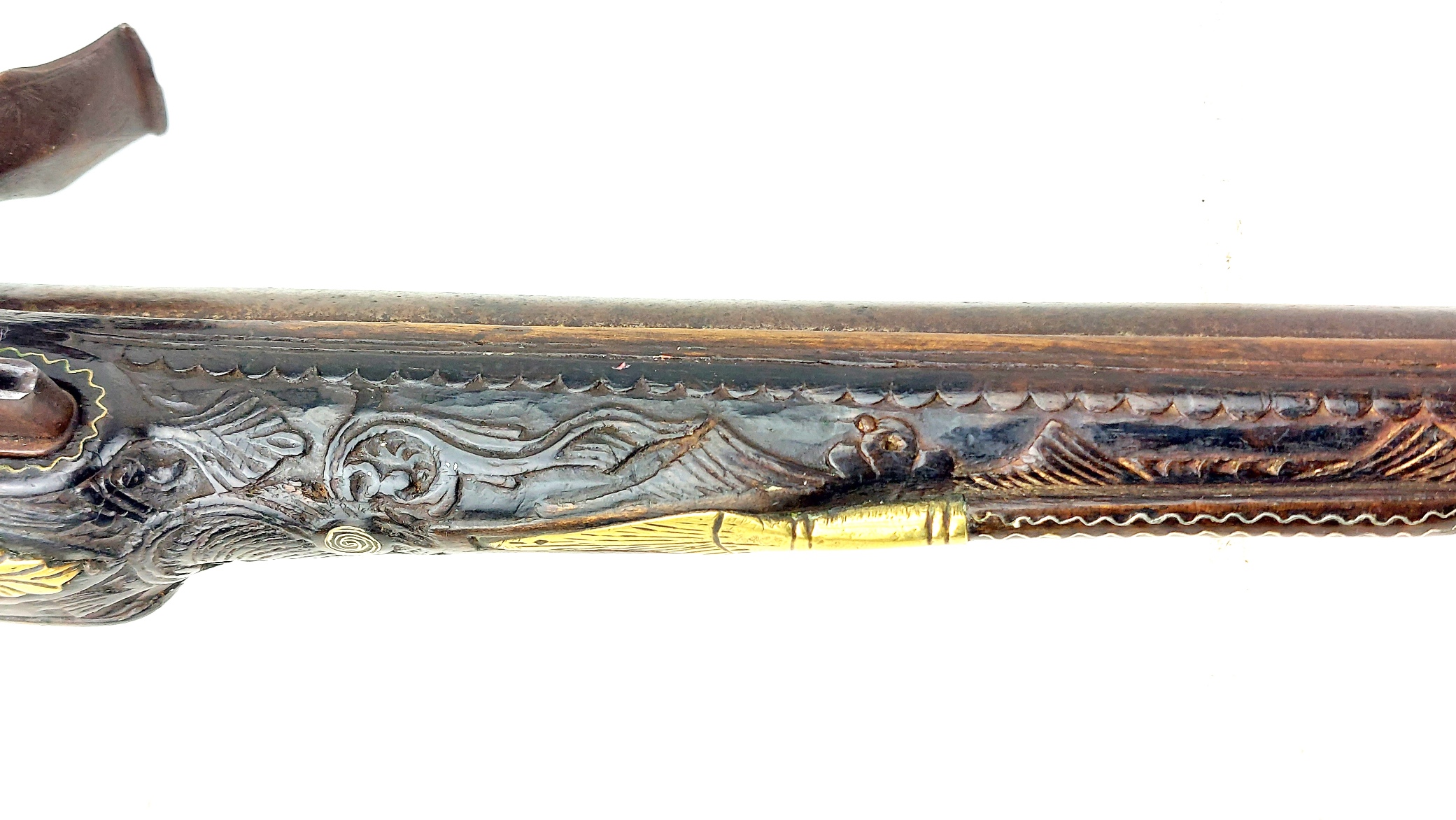
The walnut stock is finely carved throughout in deep relief with scrolling foliate and wave-pattern ornament, bordered by incised scalloped edging, and further enriched with silver and brass wire inlay. These “wave” motifs are characteristic of high-grade Shkodër workshop pistols, symbolising motion and protection within the Ottoman decorative canon.
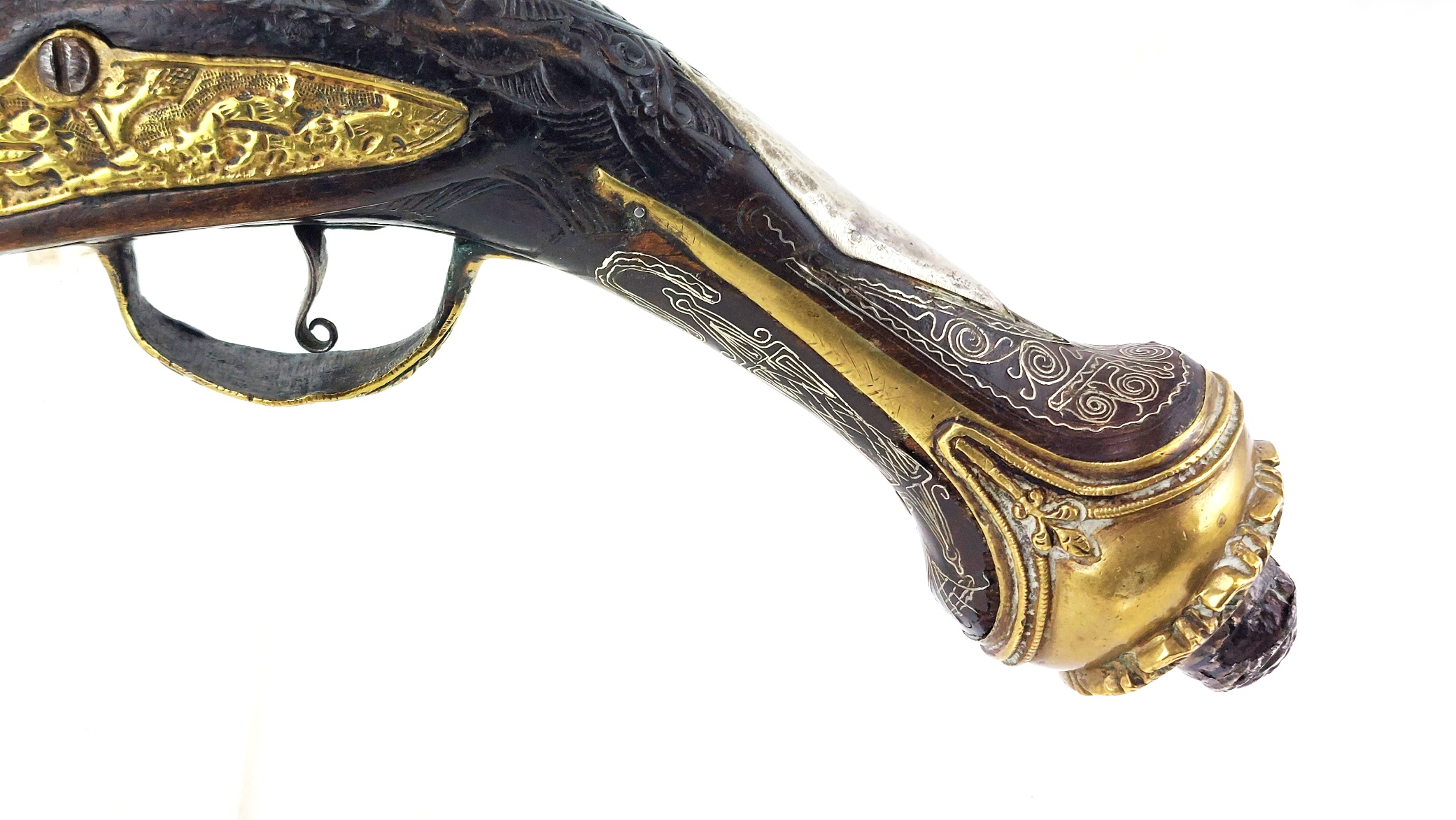
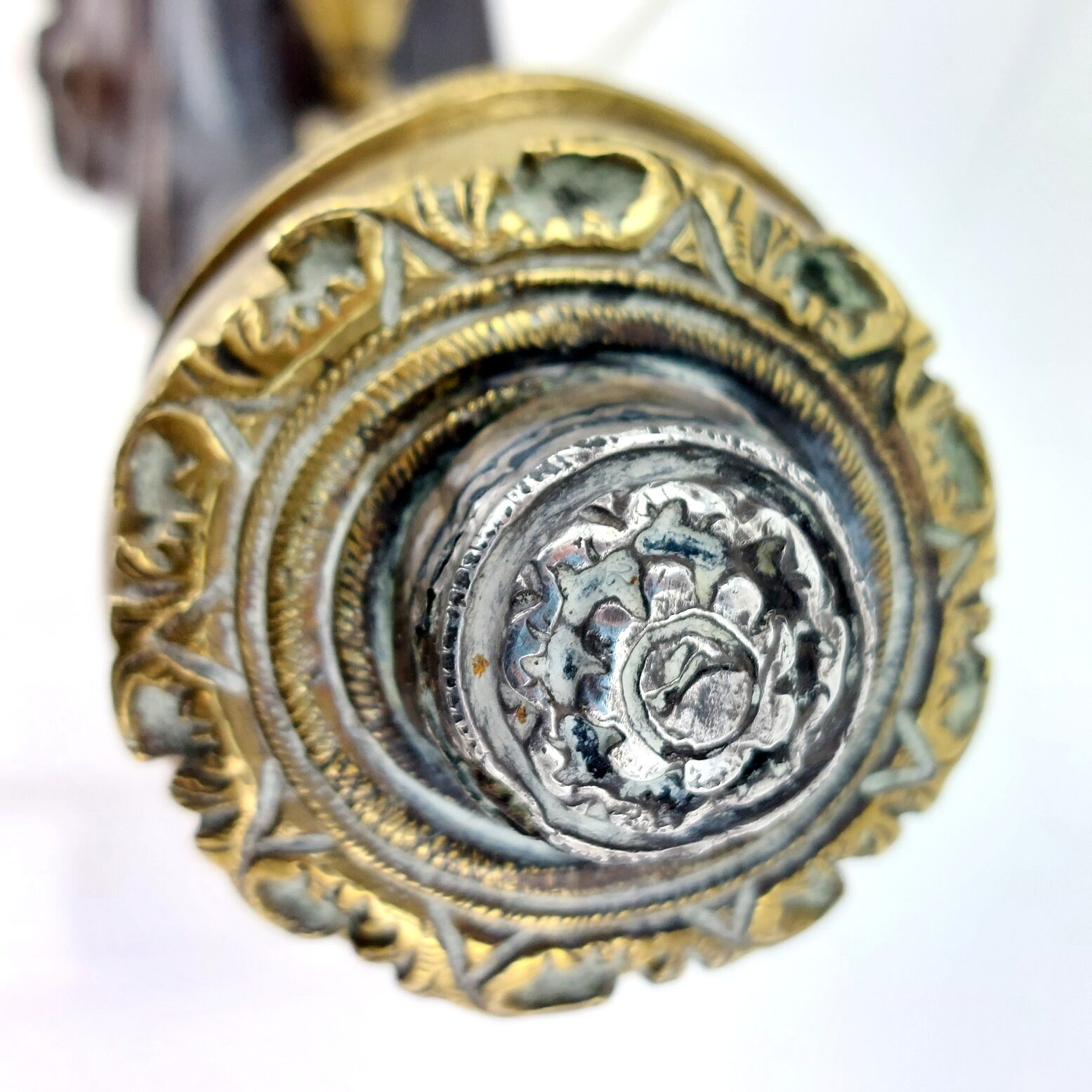
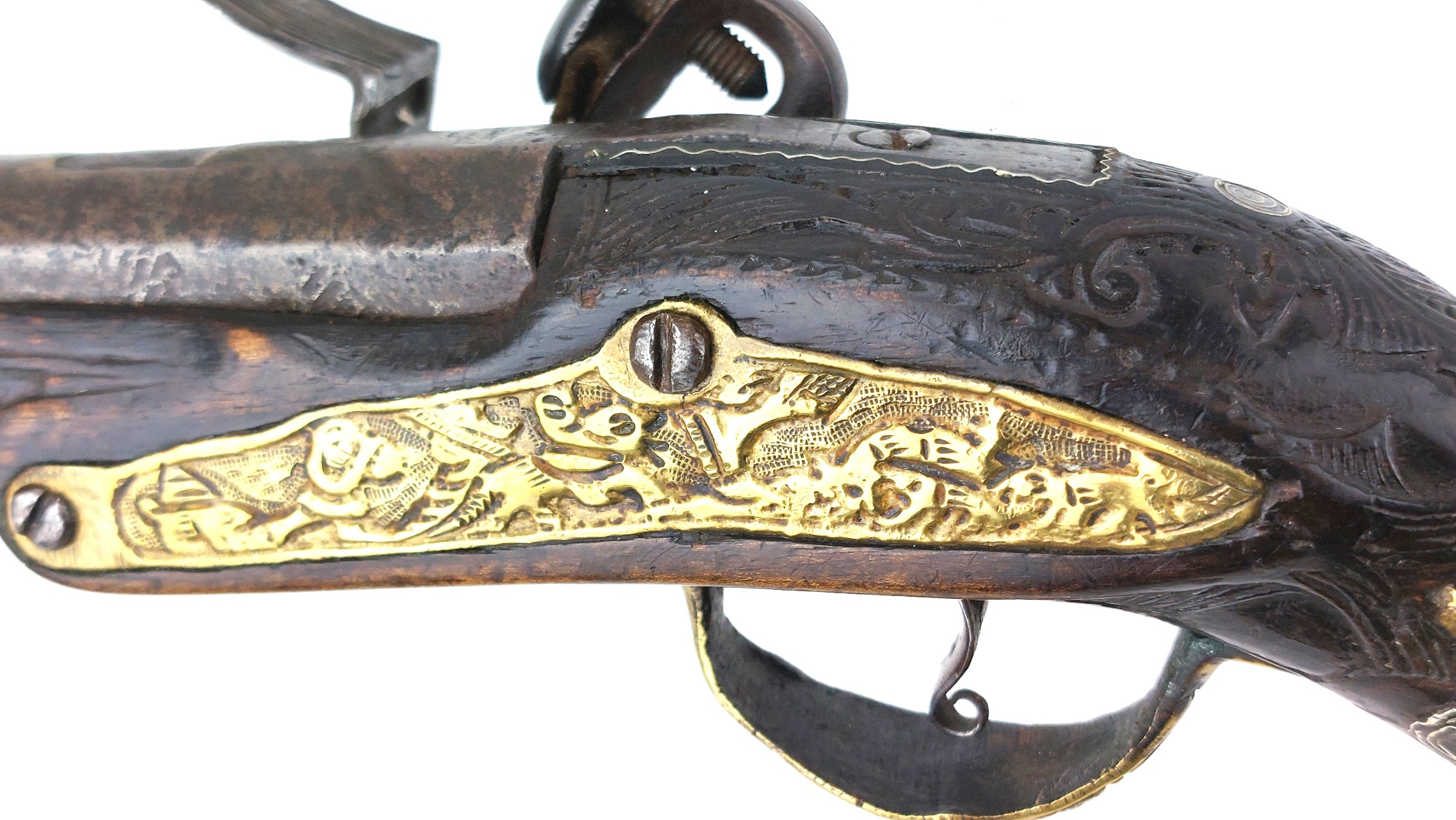
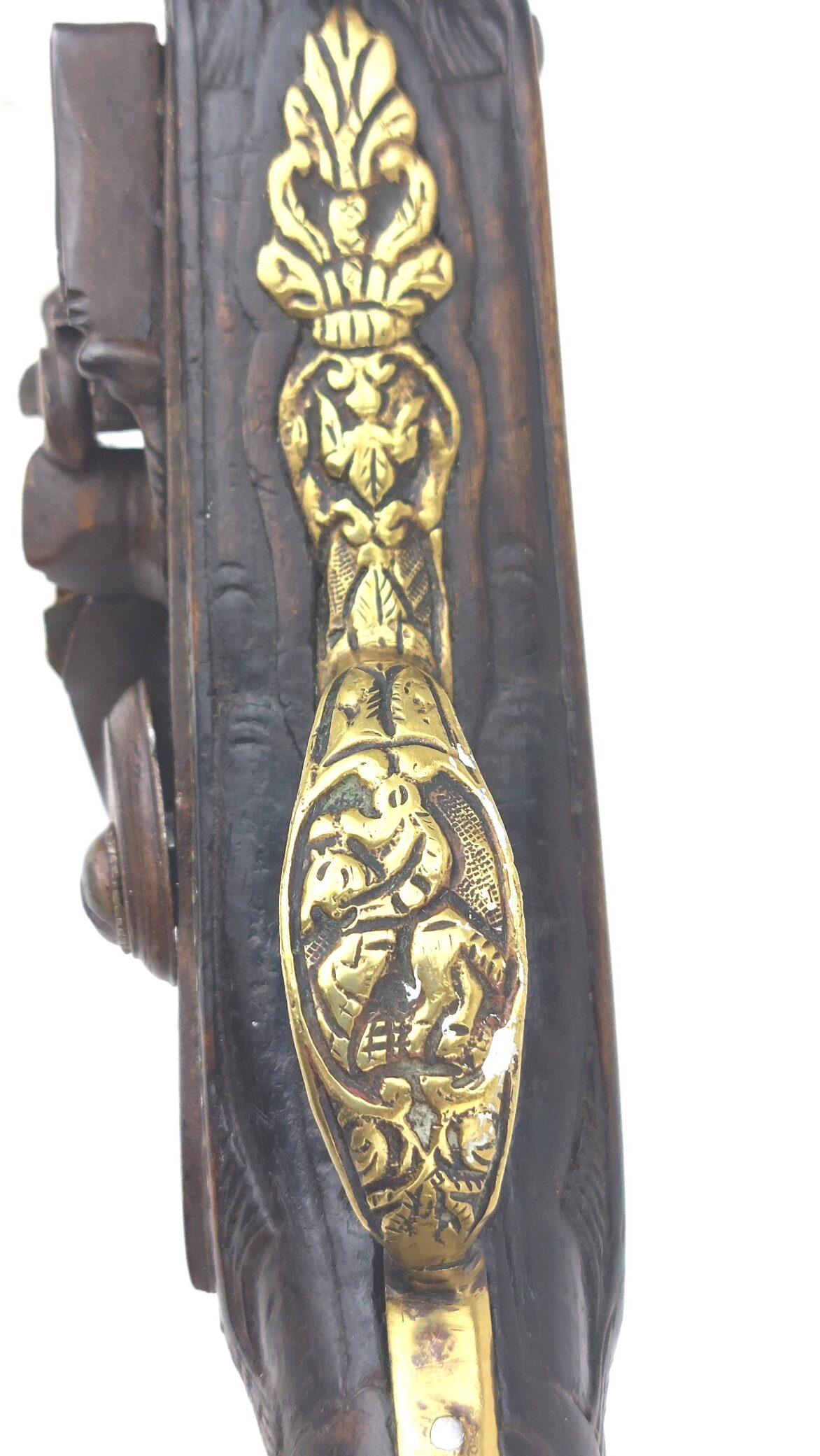
Furniture is of gilt brass, including an elaborately chased sideplate, possibly depicting a hunting scene, a floral trigger-guard finial, and an elegantly formed butt cap. The silver-topped butt cap bears a rosette and crescent-and-star motif — a clear nod to Ottoman imperial symbolism — within a gilt brass collar of embossed floral design. The ramrod channel is decorative only.
Historical Note: Pistols of this form were produced in northern Albania (Shkodër/Scutari region) and throughout Ottoman-controlled Epirus and Bosnia between circa 1800 and 1850.
The elaborate ornamentation reflects the fusion of Venetian, Ottoman, and Balkan craftsmanship, with carving and inlay executed by local artisans and locks either made locally or imported from Istanbul. The incorporation of naturalistic “wave” or flame motifs and animal symbolism was intended to convey vitality and martial virtue.
The pistol’s weighted and domed butt, strengthened by a through-tang and capped with heavy silver and gilt brass, also served a secondary purpose as a striking weapon. Once fired, it could be reversed in the hand and wielded effectively as a club in close combat — a practice commonly noted among 19th-century Albanian and Montenegrin warriors. This dual use made the pistol both a symbol of authority and a practical sidearm, equally suited to display or survival.
Comparable examples are held in the Topkapi Palace Armoury (Istanbul), the Tareq Rajab Museum (Kuwait), and the Royal Armouries (Leeds).
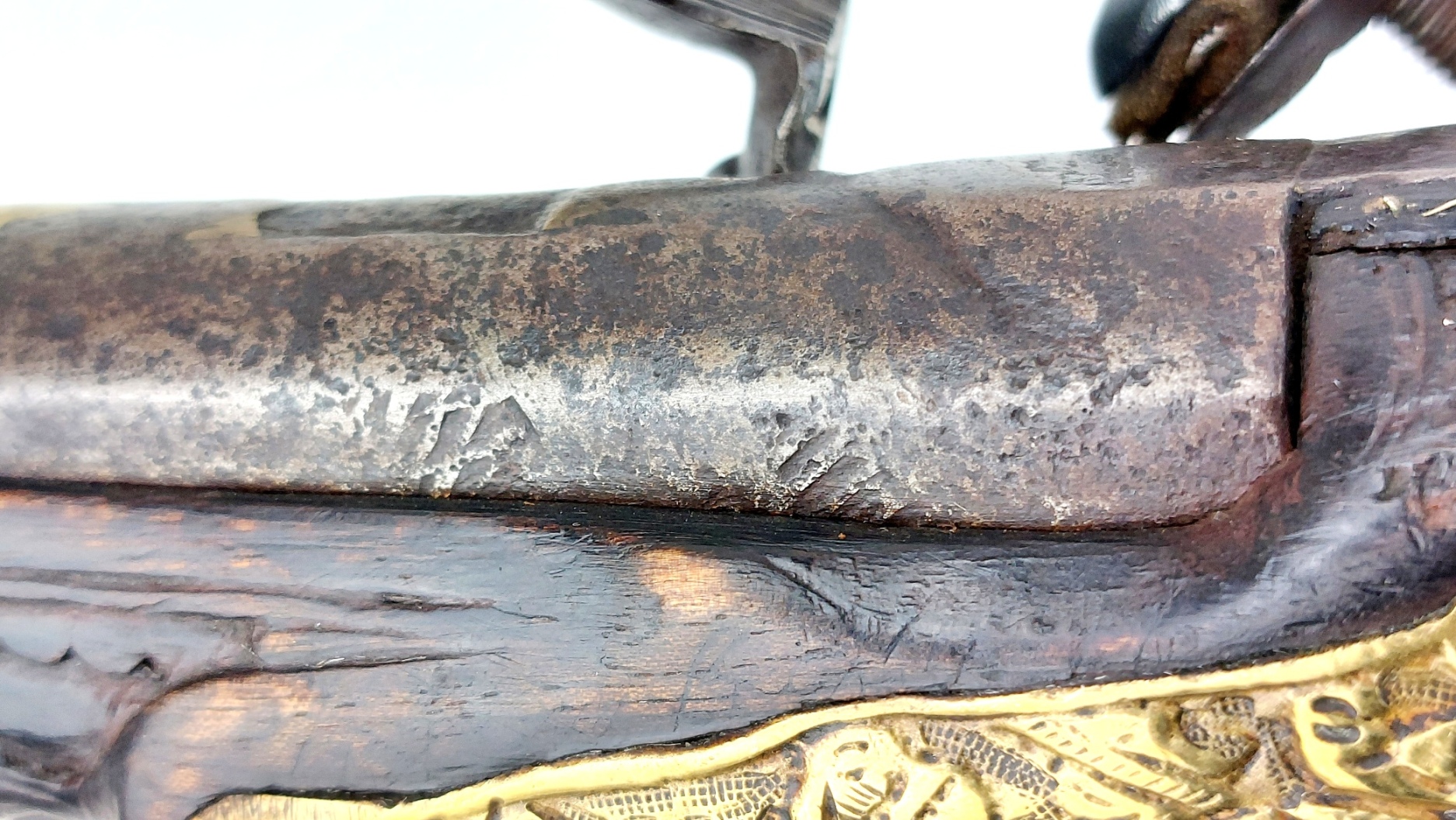
*Condition* Obsolete calibre. In very good, original, and untouched condition for its age. The barrel retains an even dark patina with isolated areas of surface pitting and remnants of gilt inlay. Lock complete but untested. Stock sound with minor age cracks, slight losses to wire inlay, and wear to high points of carving. Gilt brass furniture and silver mounts well preserved with light handling wear. Decorative ramrod absent. Please see photographs as part of the condition report.
*In order to complete the online purchase we will require a picture/scan of a photo ID (Driving Licence, Passport or an official document with a recent picture). If you don't posses any such document please call to buy. If we consider that the proof of ID is incorect or insuficient, we reserve the right to cancel the transaction.
*We also reserve the right to cancel the transaction with a full refund if there is any suspicion that the provided item will be used in any way contrary to the laws and legislation of UK.