~ Late Victorian Sarreguemines Majolica Serving Dish ~
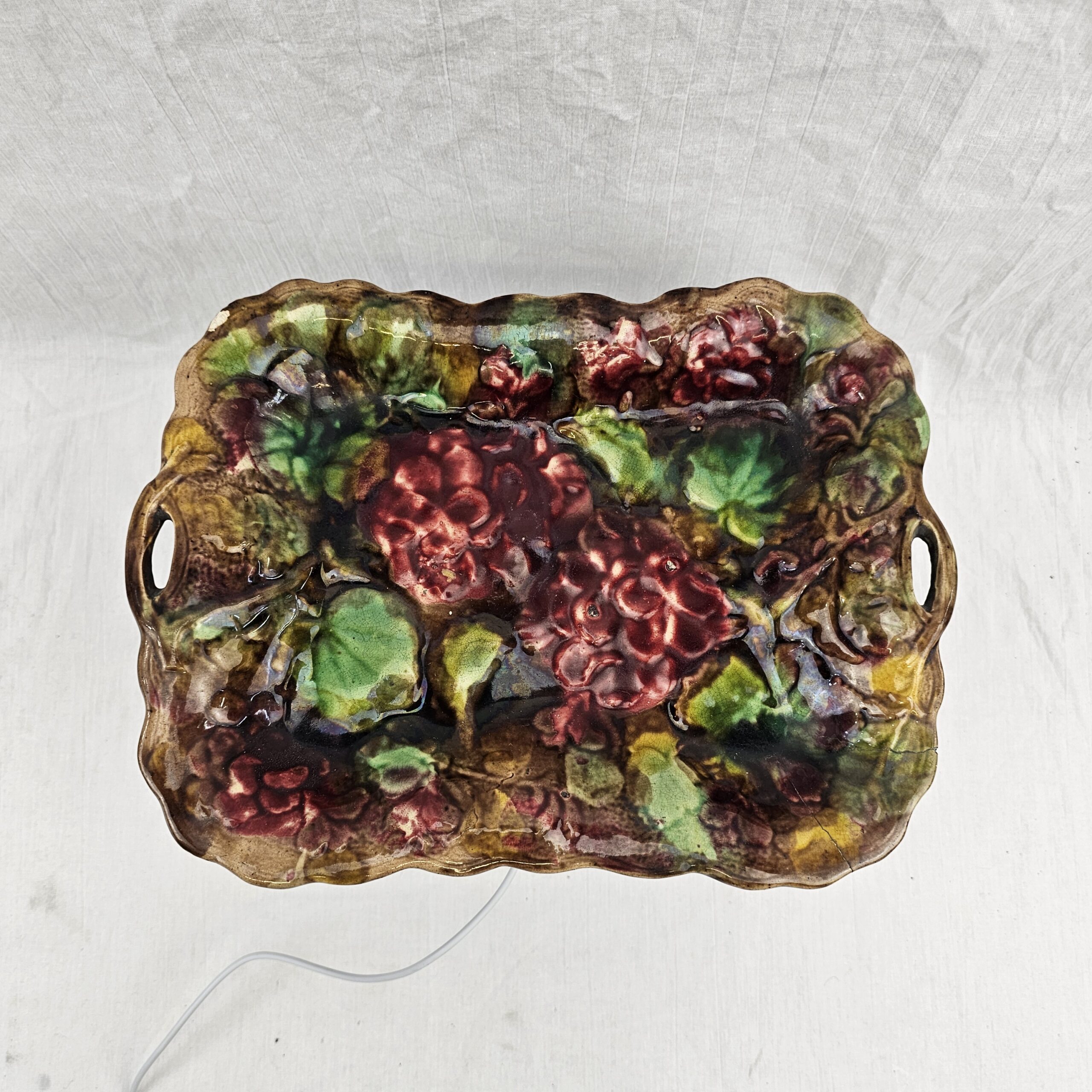
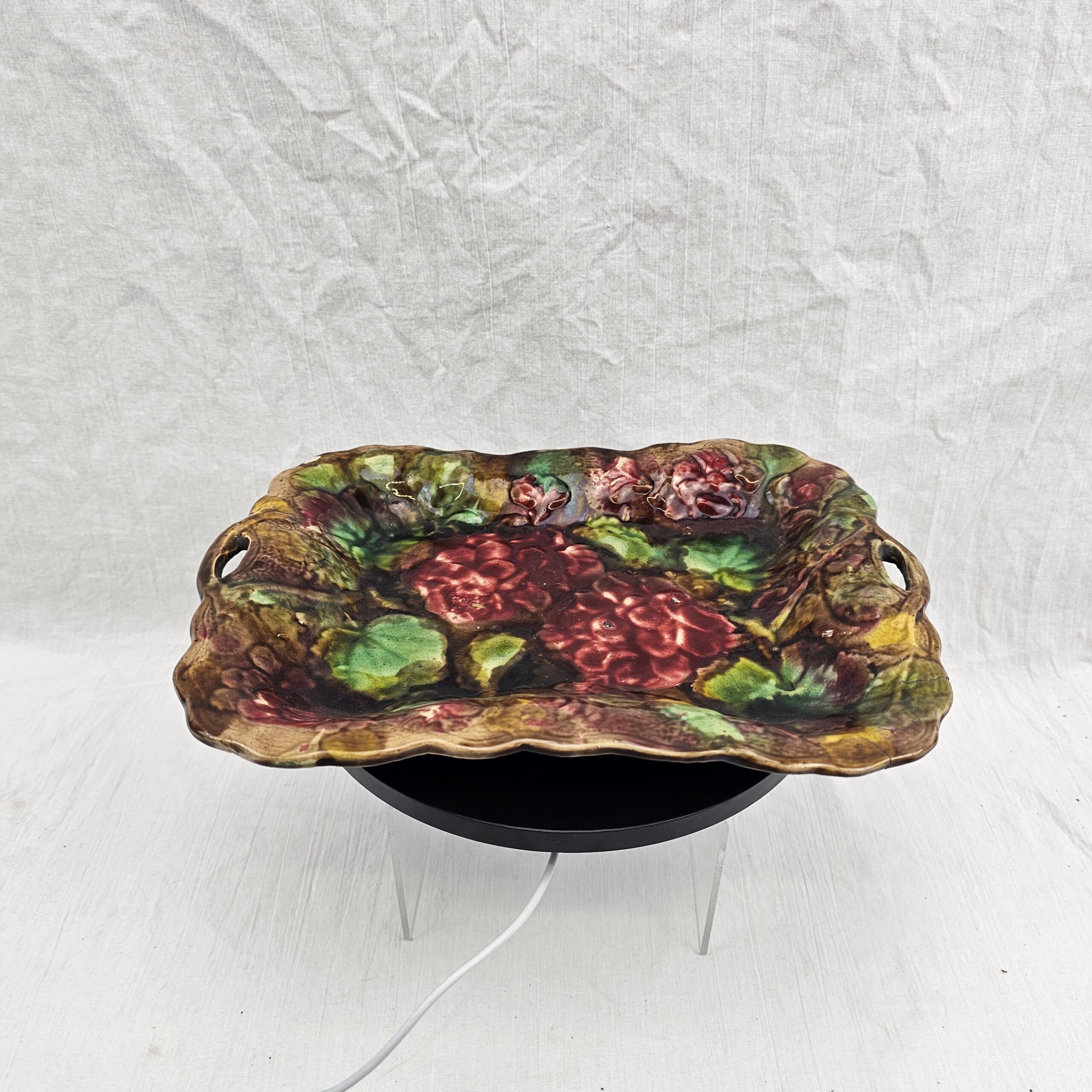
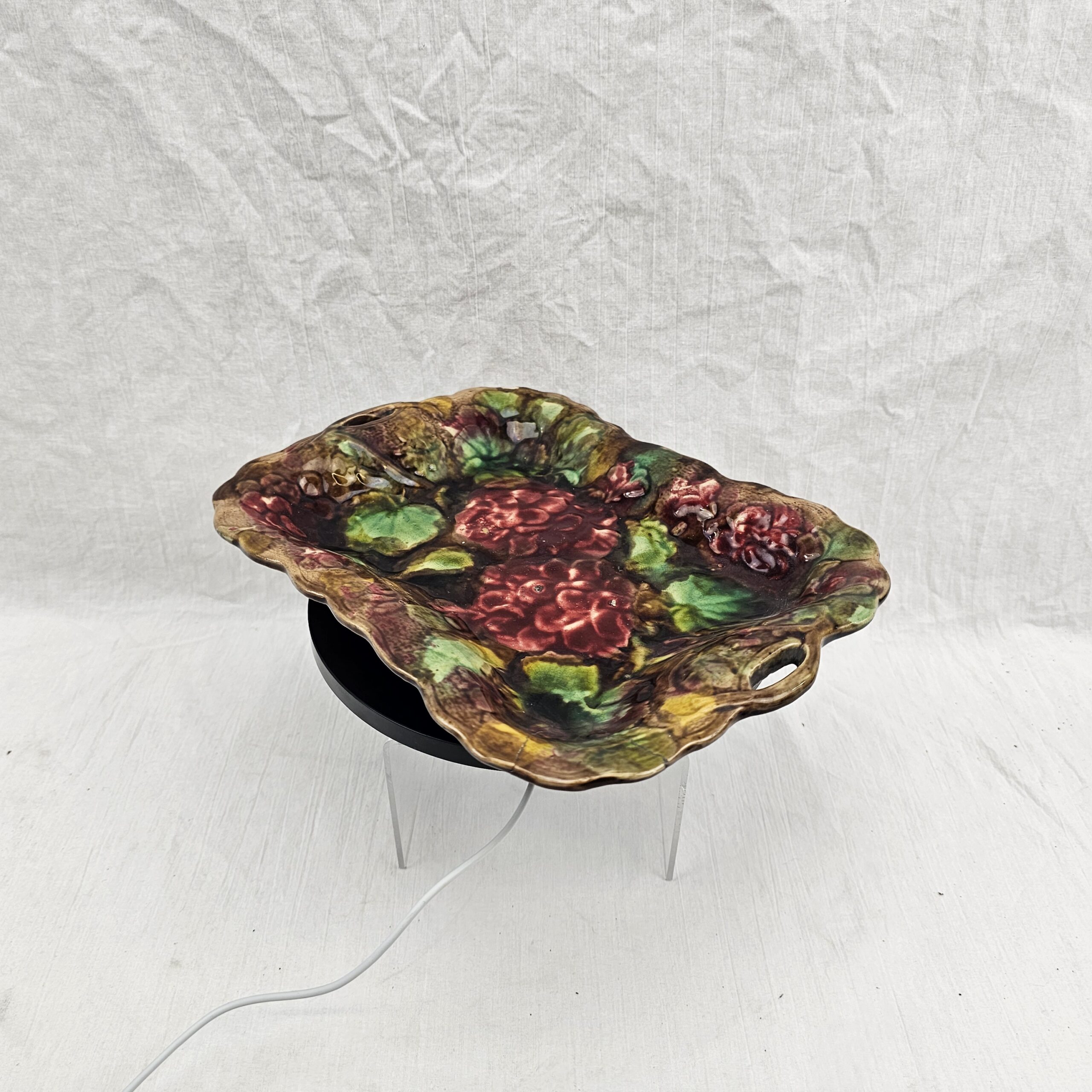
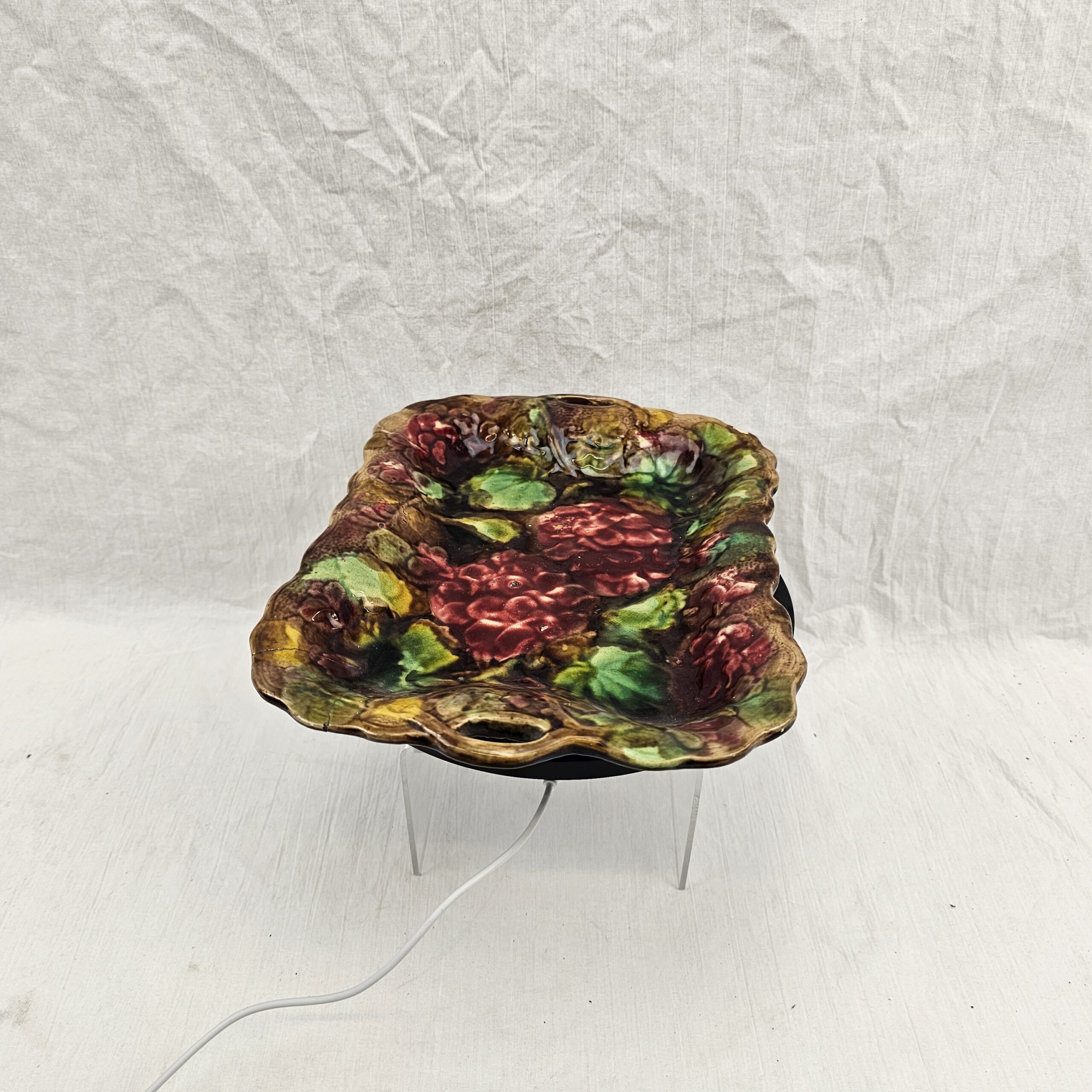
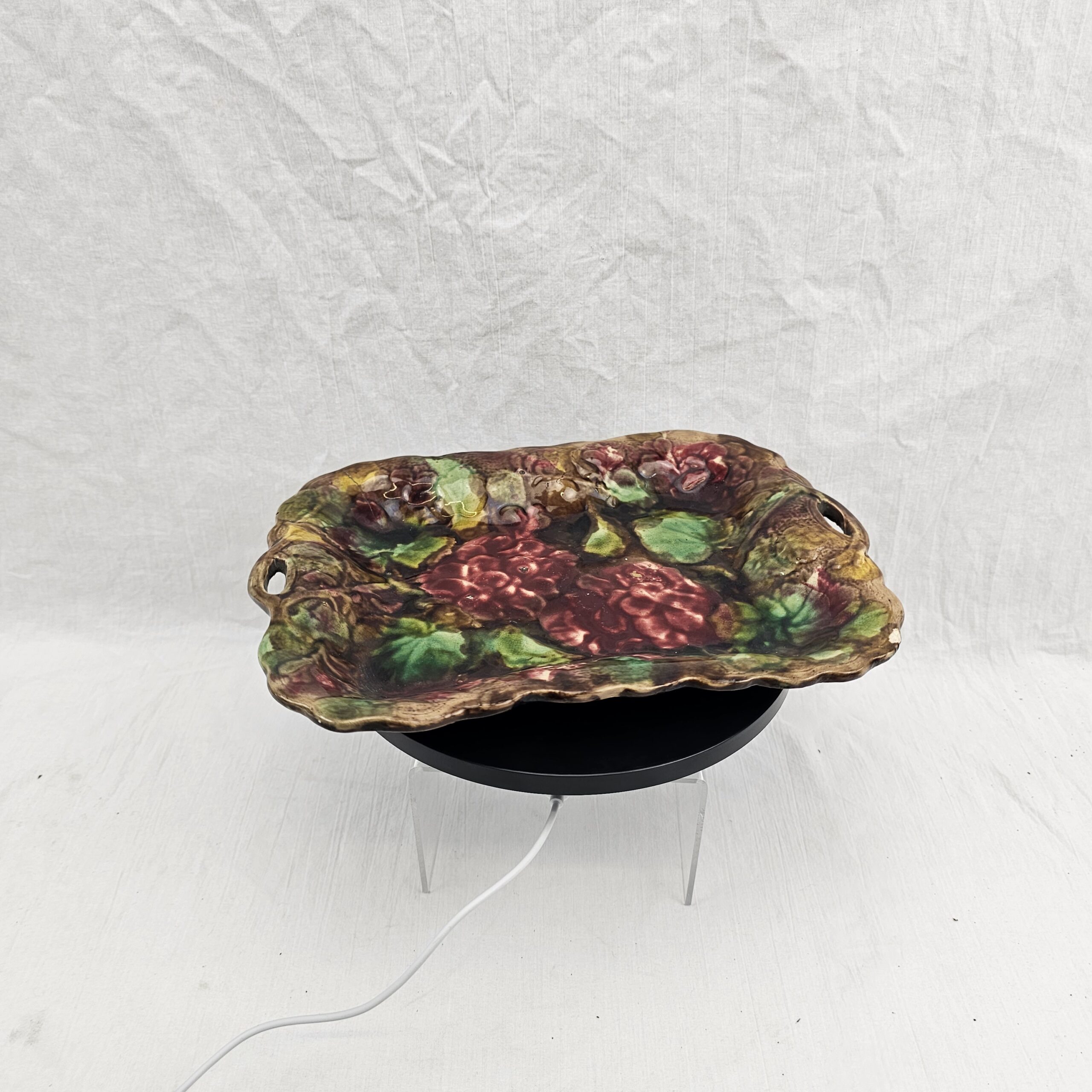
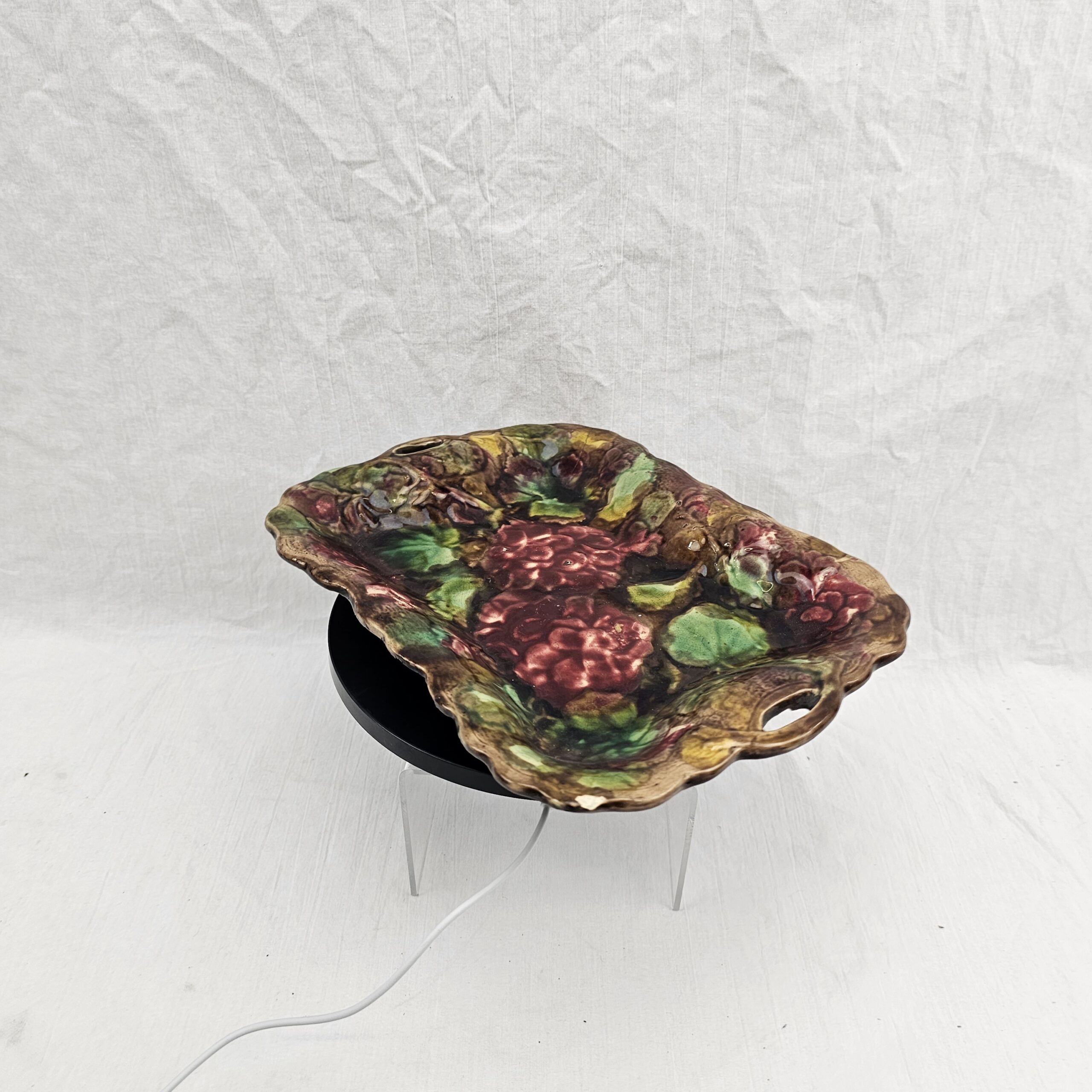
A richly decorative and substantial French majolica serving tray by the celebrated Sarreguemines pottery, modelled as a deep rectangular dish with a sinuous, scalloped rim and two integral loop side handles. The entire interior is encrusted in high-relief moulded decoration depicting abundant rounded blossoms — most likely geraniums or chrysanthemums — in deep crimson and burgundy, set among boldly moulded large green vine-like leaves and dark brown gnarled branches, all on a near-black ground. The moulded decoration is thick and sculptural in the manner typical of the French barbotine tradition, building up layers of coloured slip to create a densely three-dimensional surface of remarkable richness.
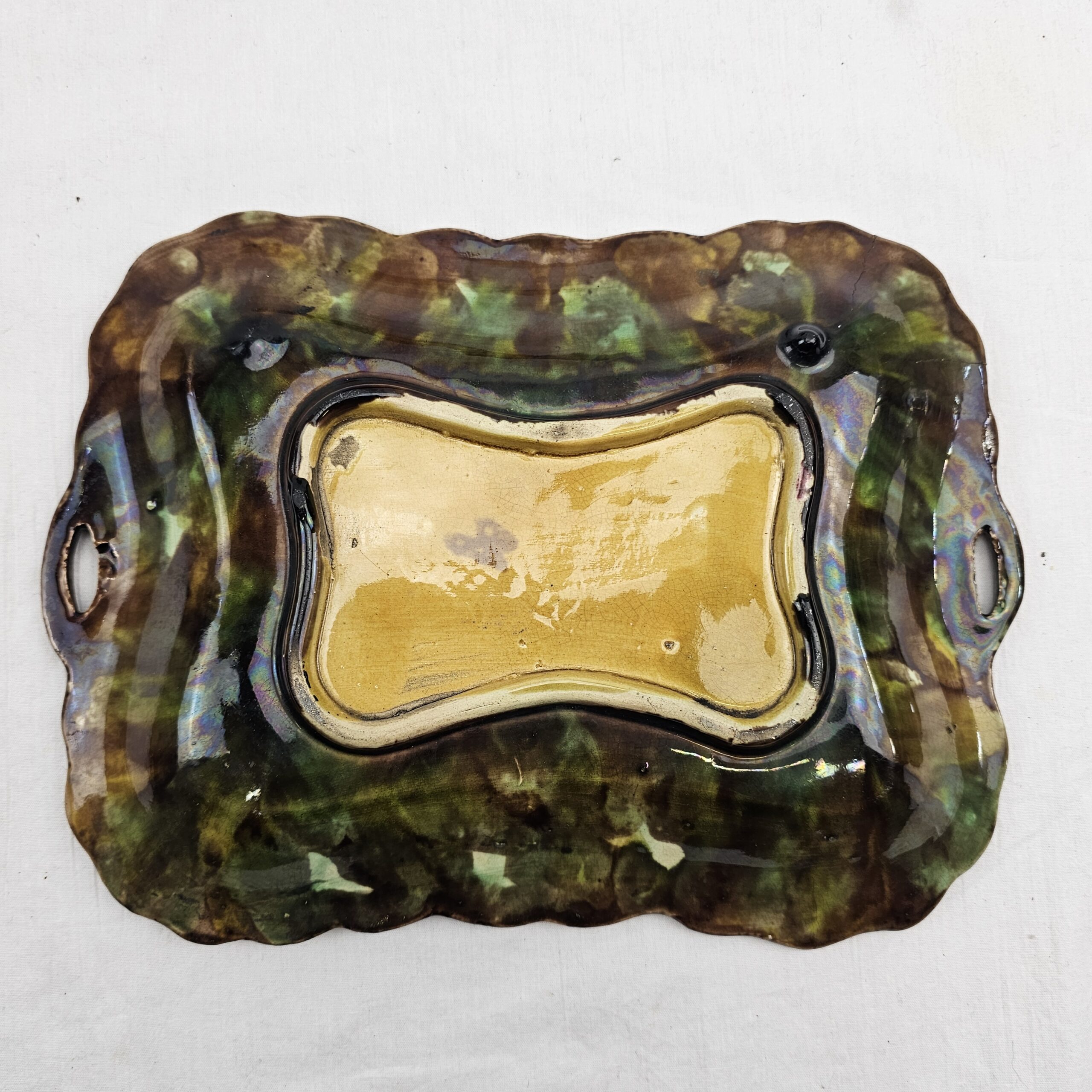
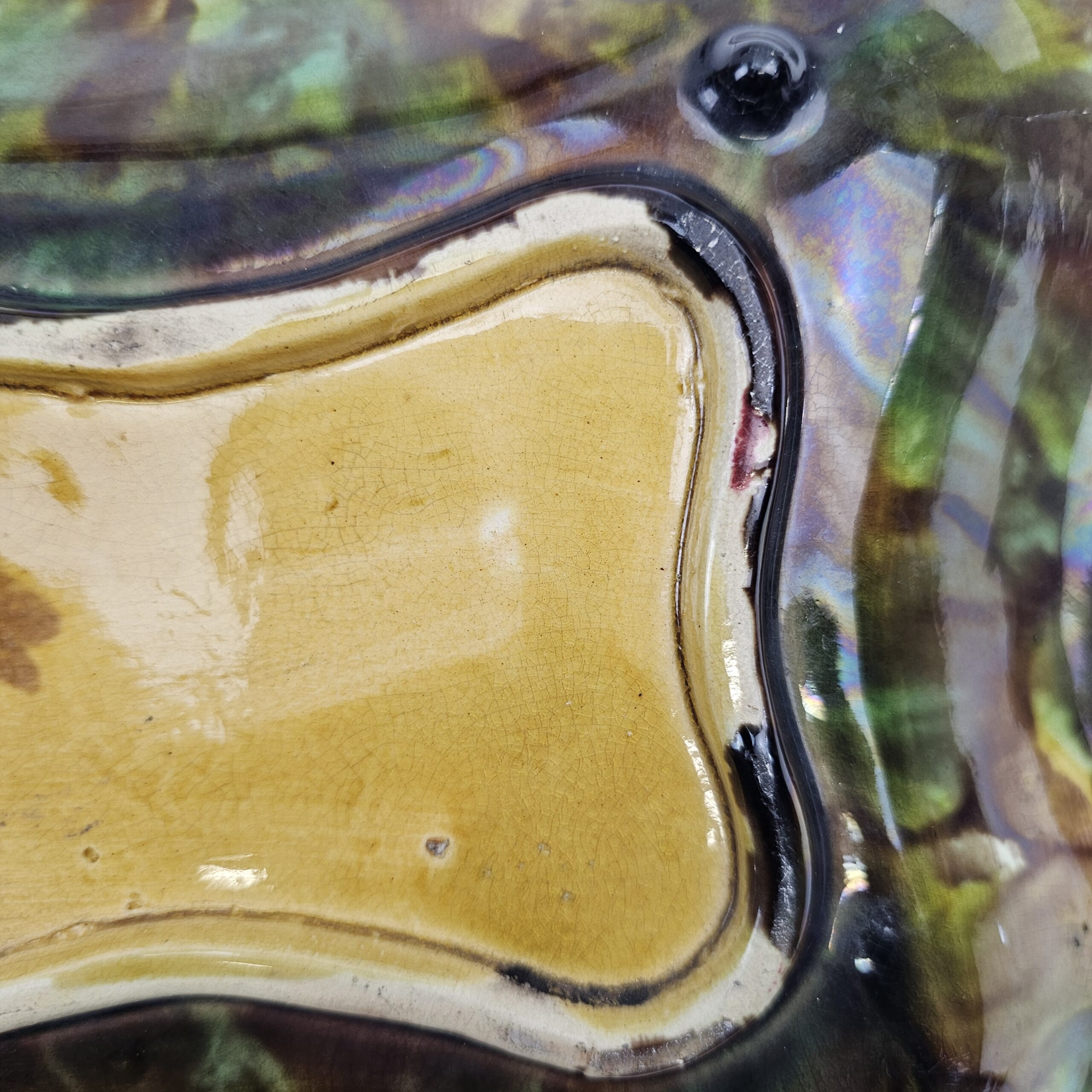
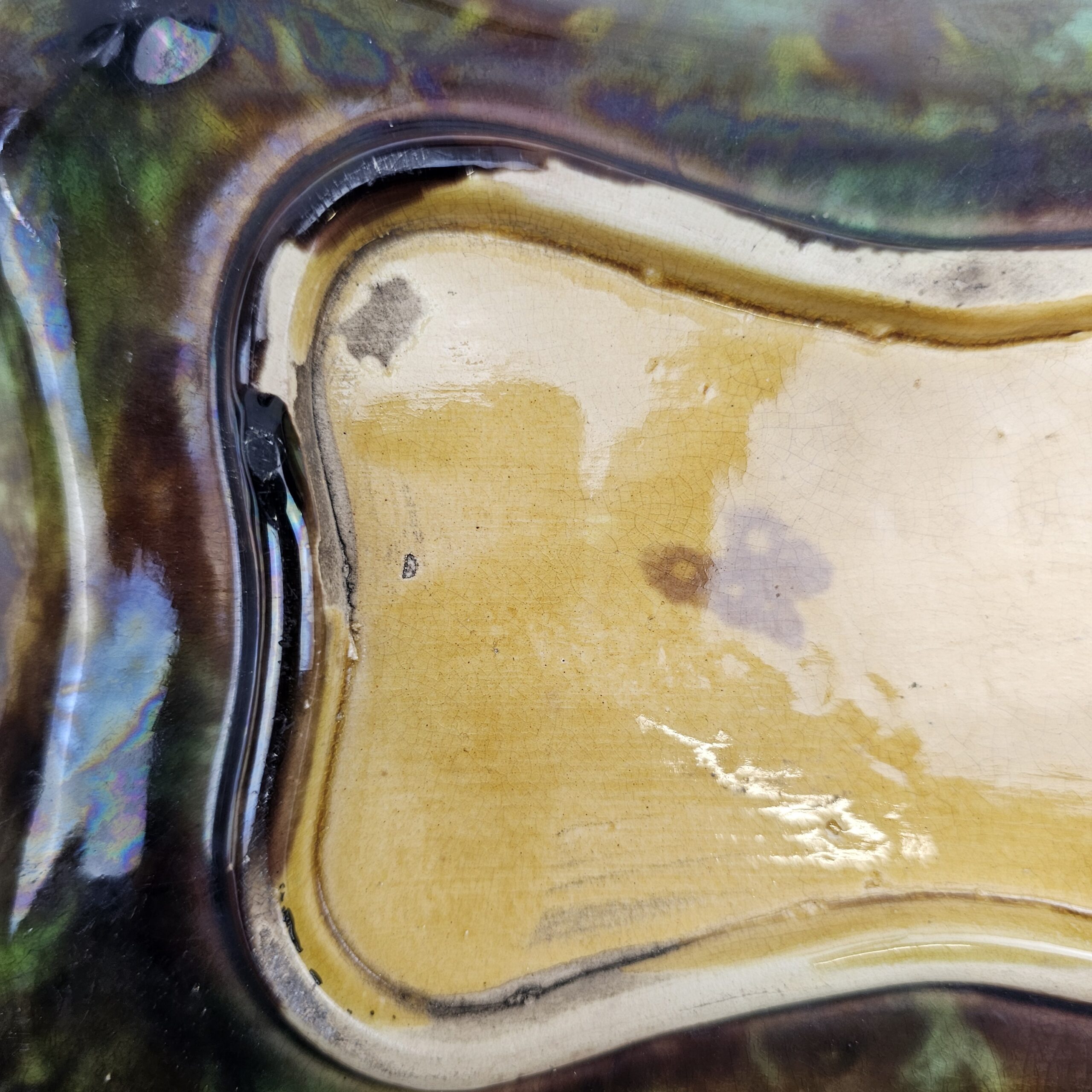
The glaze palette — deep claret, bottle and olive green, ochre and near-black — creates a sumptuously dark, jewel-like effect. The reverse (images 8–10) is fully glazed in a swirling mottled dark green, brown and aubergine iridescent glaze, with a characteristic cartouche-shaped recessed foot glazed in warm amber with age-crazing. No legible maker's mark is visible to the naked eye in the photographs, though the attribution to Sarreguemines is consistent with both the glaze character, the quality of the moulding, and the form of the base.
~ Historical Context ~
The Sarreguemines pottery (Utzschneider & Cie), founded in the Moselle region of Lorraine in 1784 by brothers Nicholas-Henri and Paul-Augustin Jacobi and partner Joseph Fabry, became one of the foremost Continental producers of majolica and faience during the 19th century, supplying both the French and export markets with wares of considerable quality and variety.
The Sarreguemines factory produced most of the original tiles used during the construction of the Paris metro. Majolica was added to its production in the 1860s.
Sarreguemines majolica is a type of earthenware decorated with coloured lead glazes, and the factory became renowned for its ambitious range of designs in the majolica style.
The barbotine technique — in which thick, heavily pigmented slip is applied to the surface in sculptural relief before glazing, producing the rich, almost painterly floral effects visible here — was particularly fashionable in France between approximately 1880 and 1900. This method allowed the Sarreguemines factory to produce highly naturalistic and decorative table wares that competed successfully with English majolica from Minton and Wedgwood, while bringing a distinctly French richness of colour and surface quality to the form. The dark, jewel-toned palette here — so different from the brighter turquoises and yellows of earlier mid-Victorian majolica — is characteristic of the late Victorian / Belle Époque period, circa 1885–1900.
At the conclusion of the Franco-Prussian War in 1874, Sarreguemines became German territory. In order to maintain the firm’s French nationality, two additional facilities were constructed in Digoin and Vitry-le-François.
~ Dimensions ~
The dish measures 20cm (8 inches) by 29cm (11 ½ inches).
It weighs 820g.
~ Condition ~
There is a protrusion to the base where during the manufacturing process the glaze when drying has formed into a drip or lump. This causes the dish to not sit quite level.
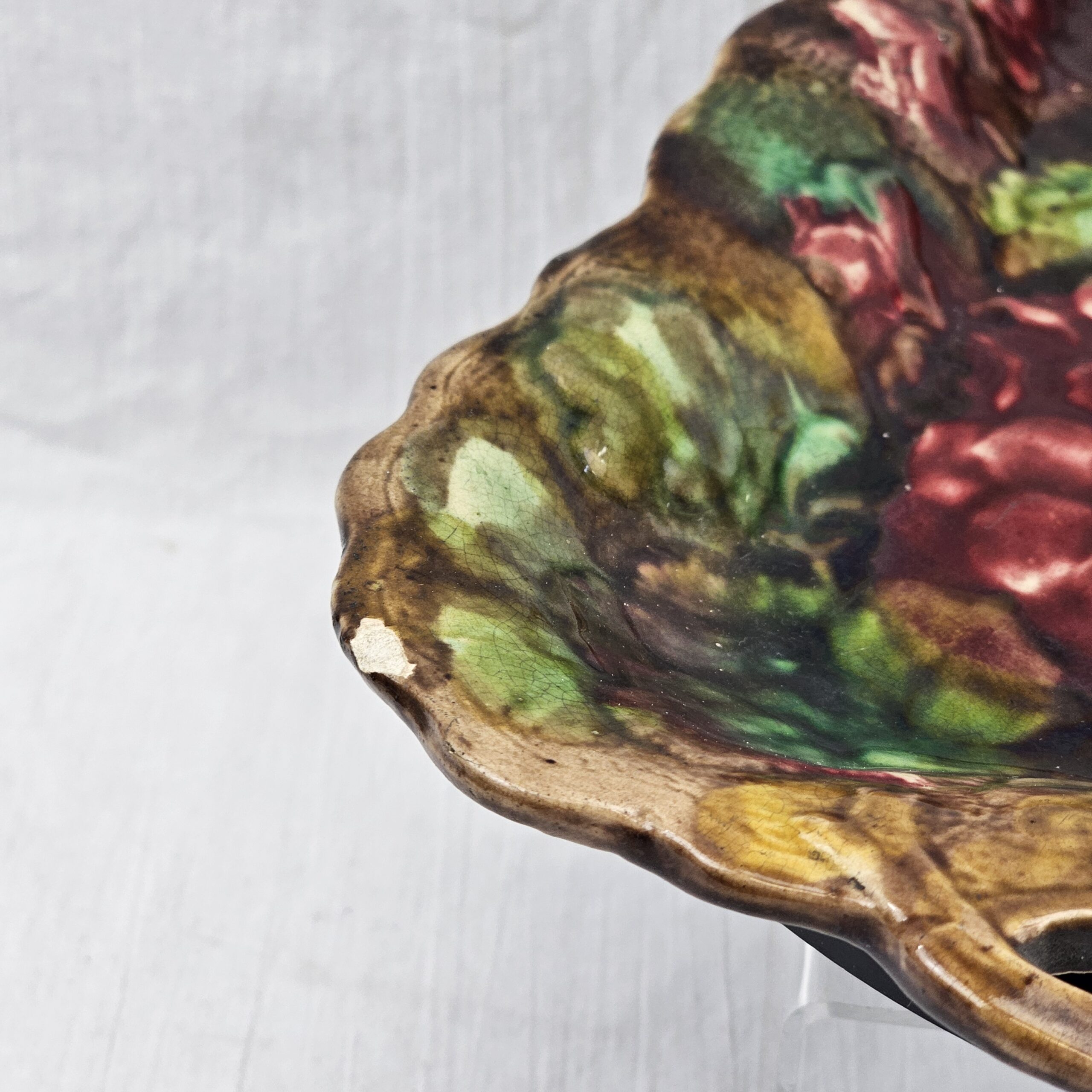
There are two hairline cracks to one edge, with chipping at the form of the crack and a chip to the opposite end.
There are a few marks to the centre of the dish, seemingly from the manufacturing process.
Overall the dish is in a nice condition and still presents well.
#7533