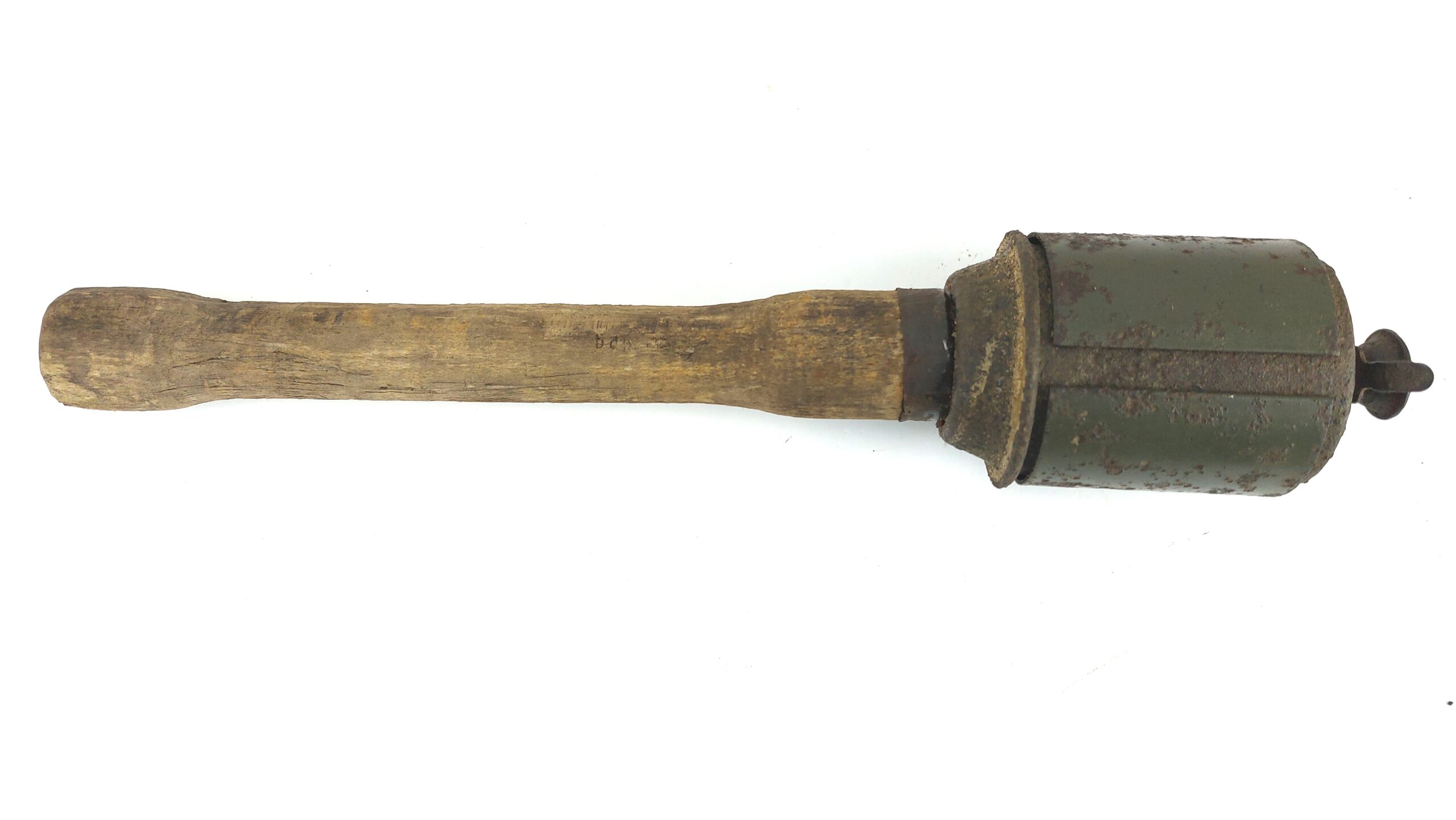
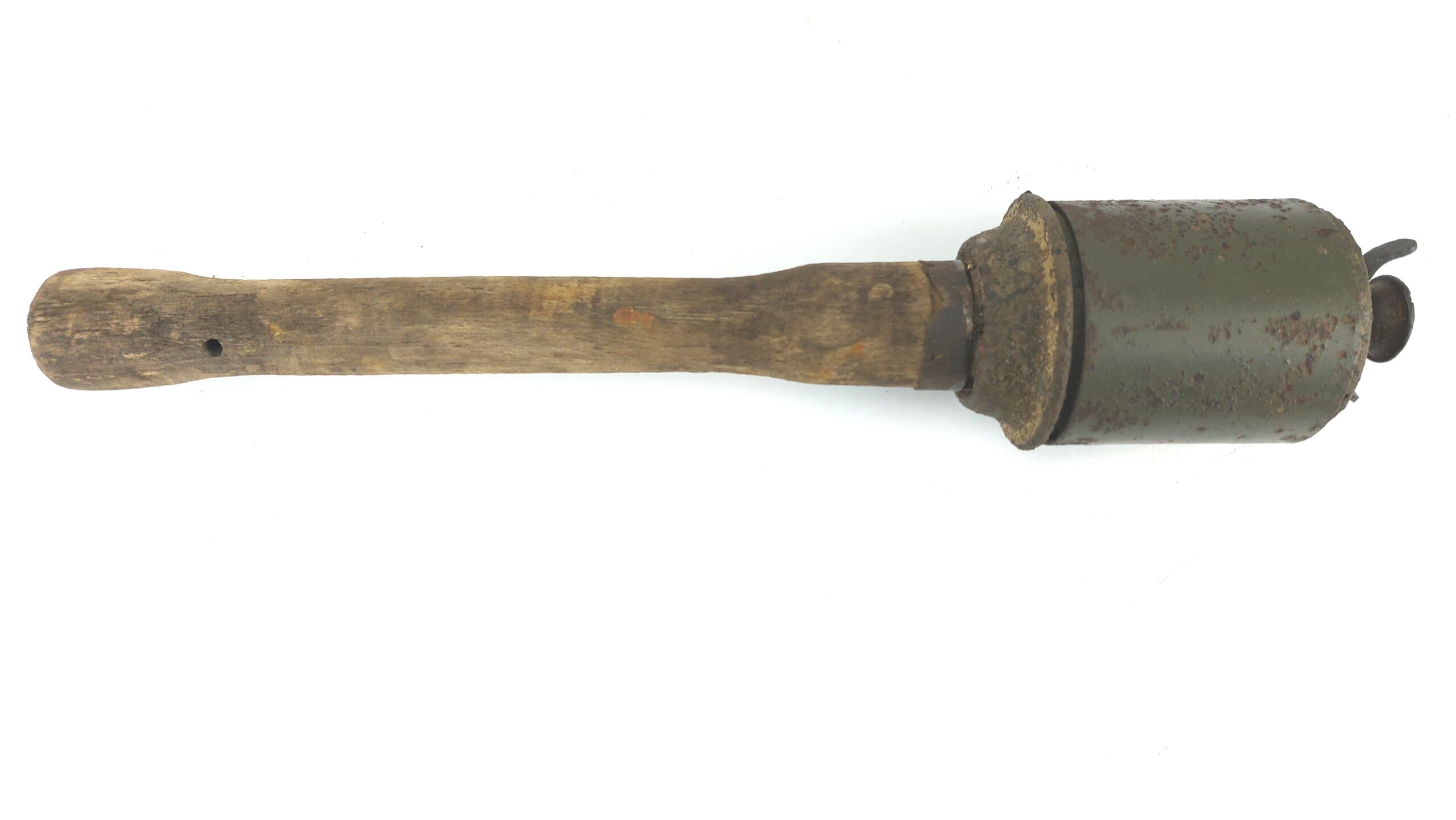
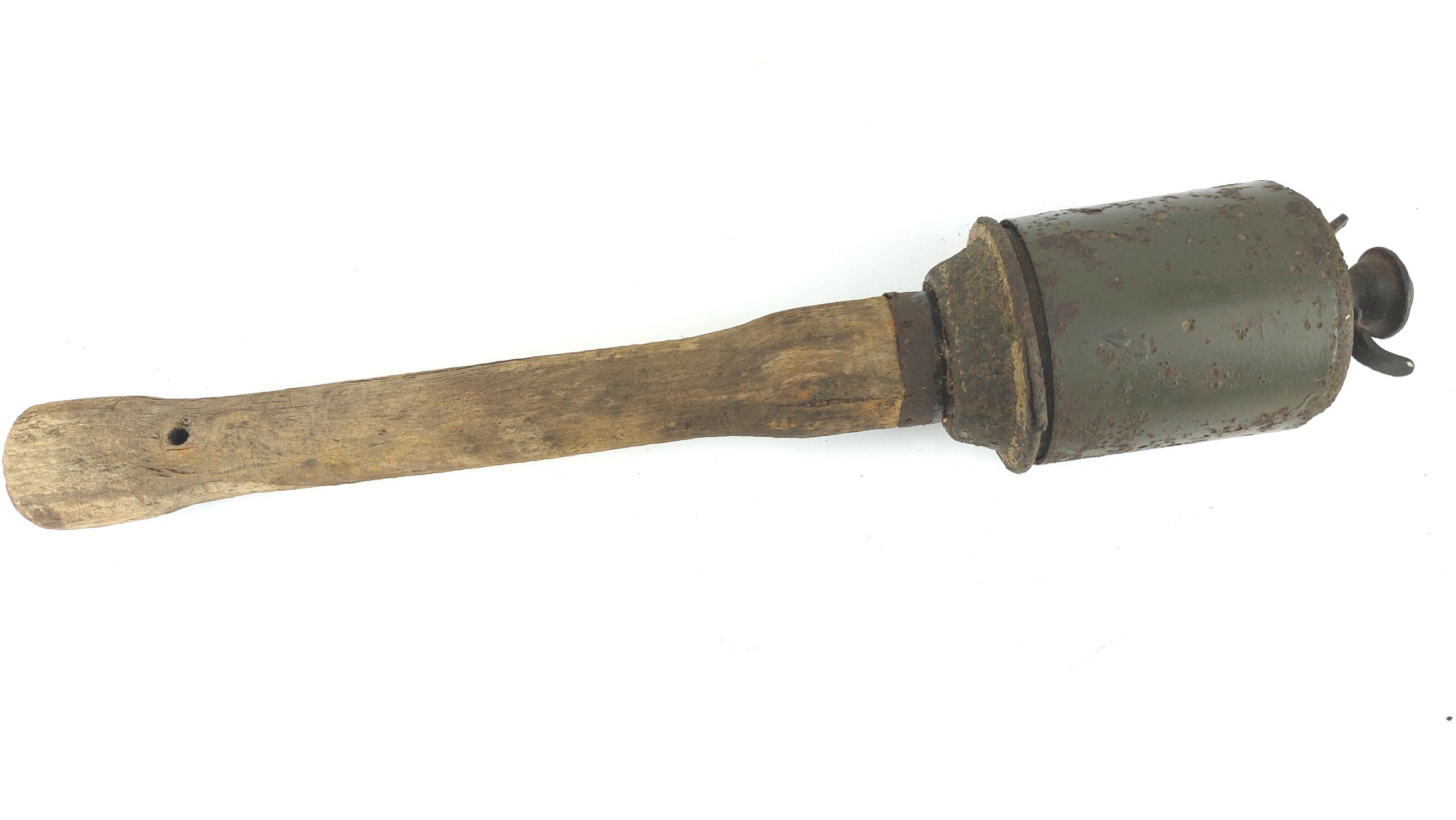
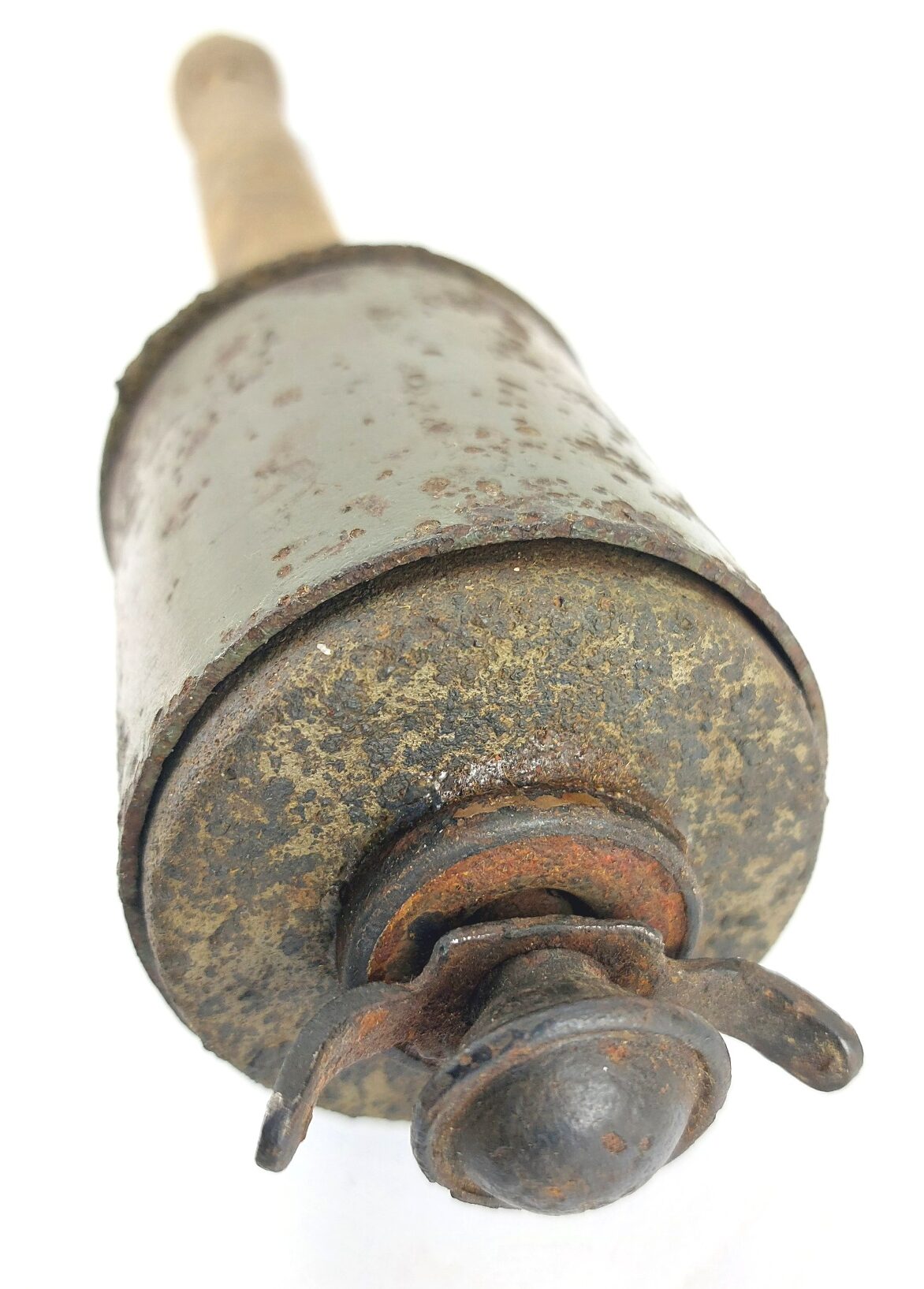
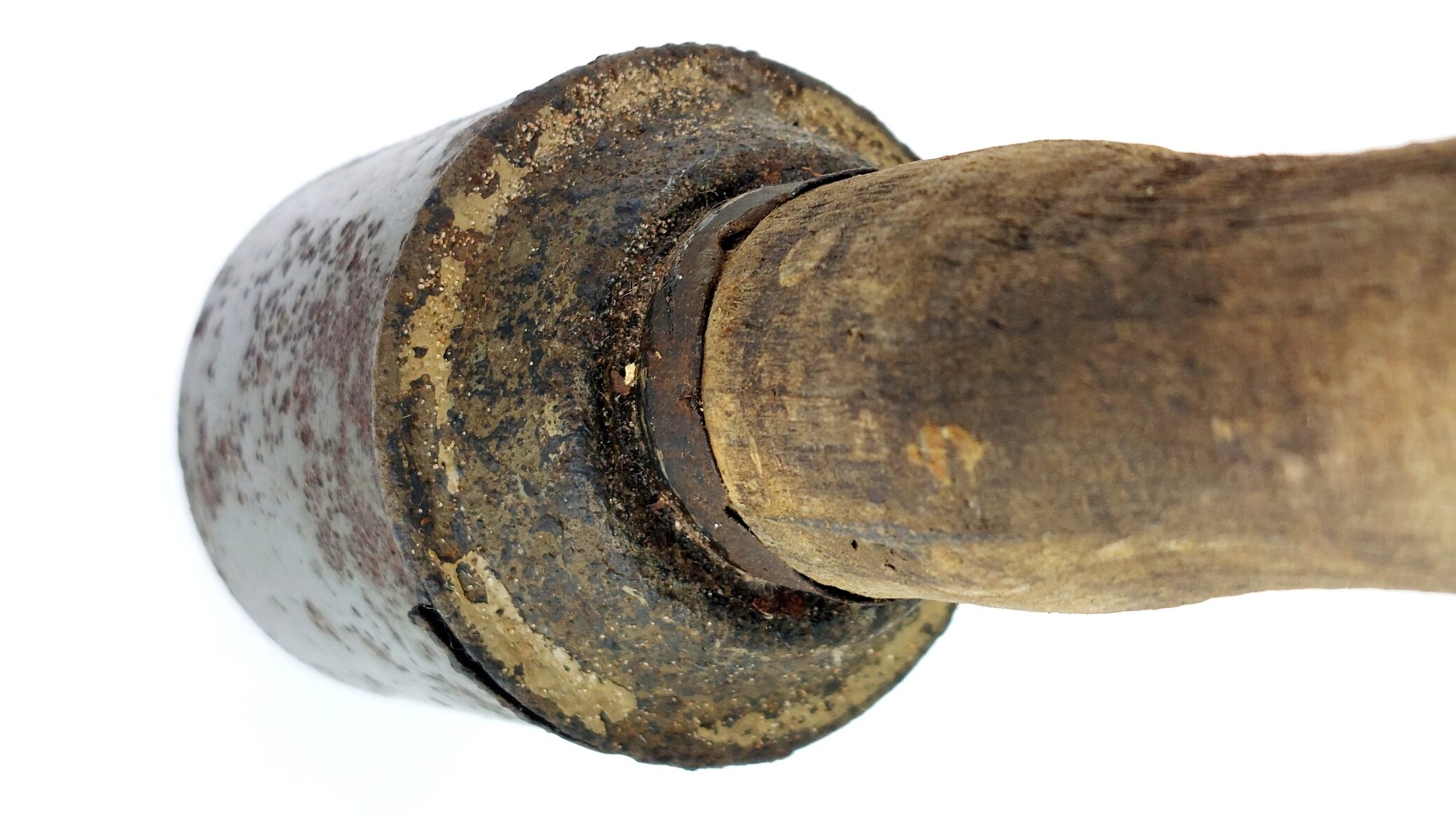
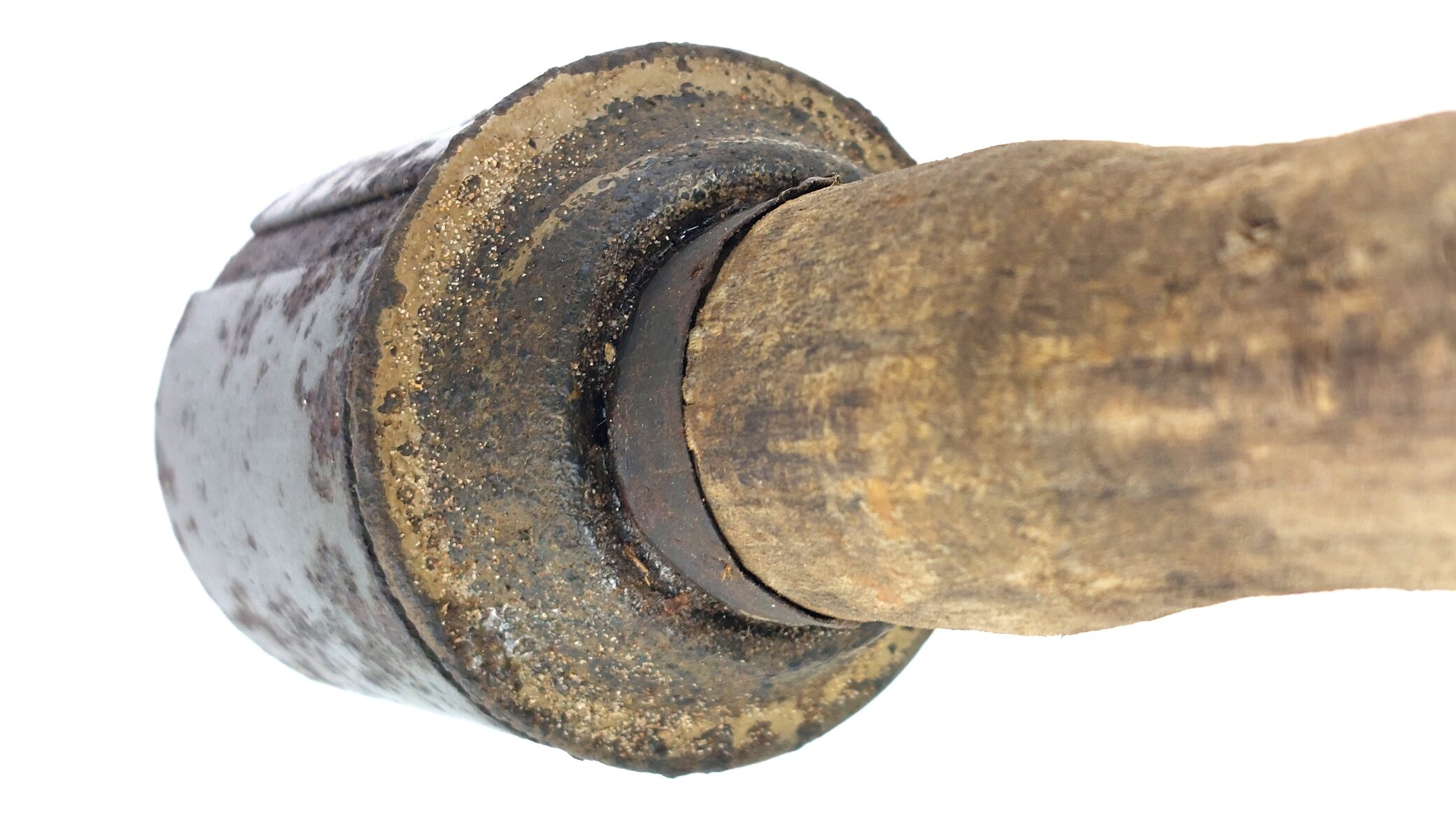
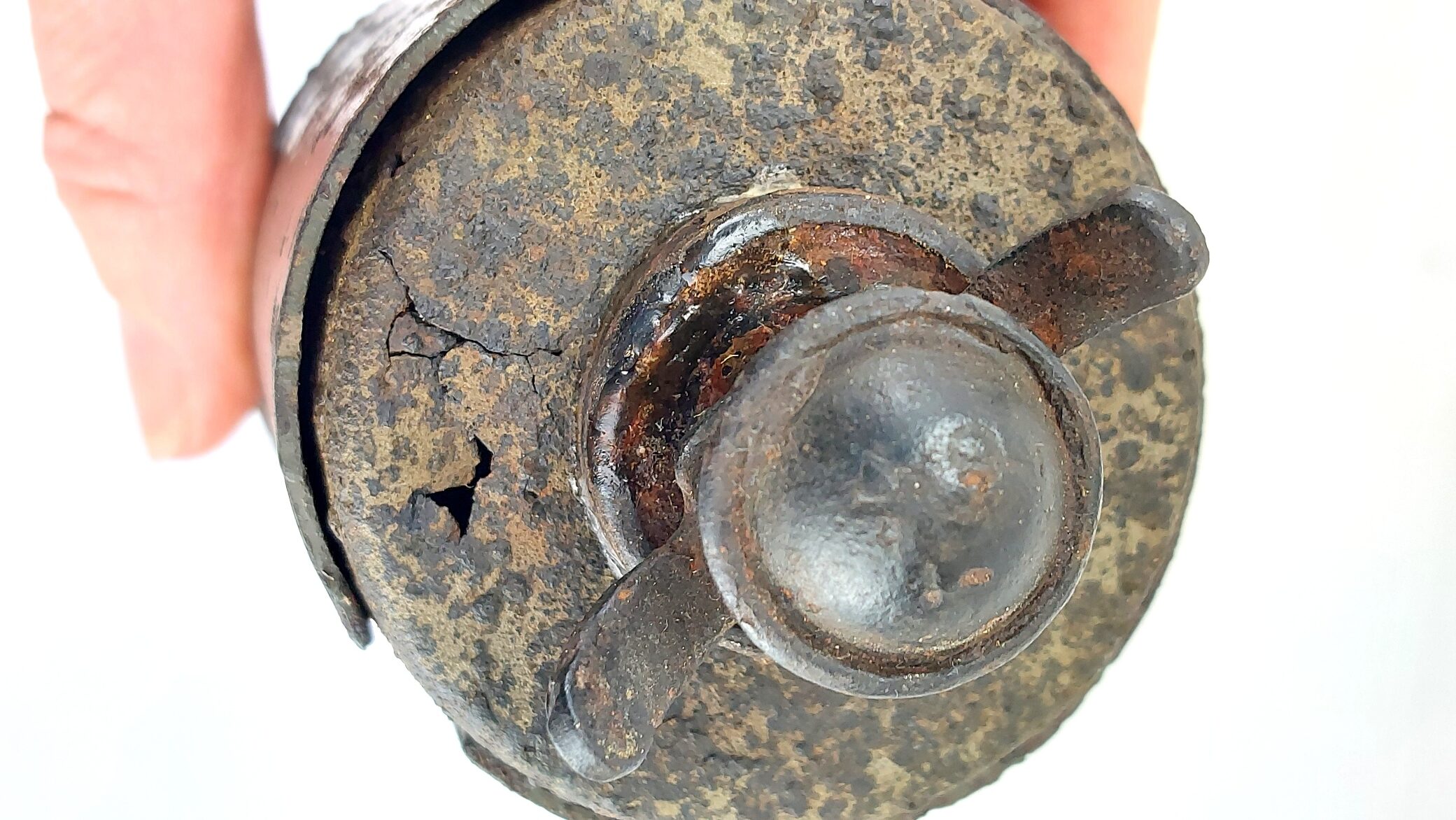
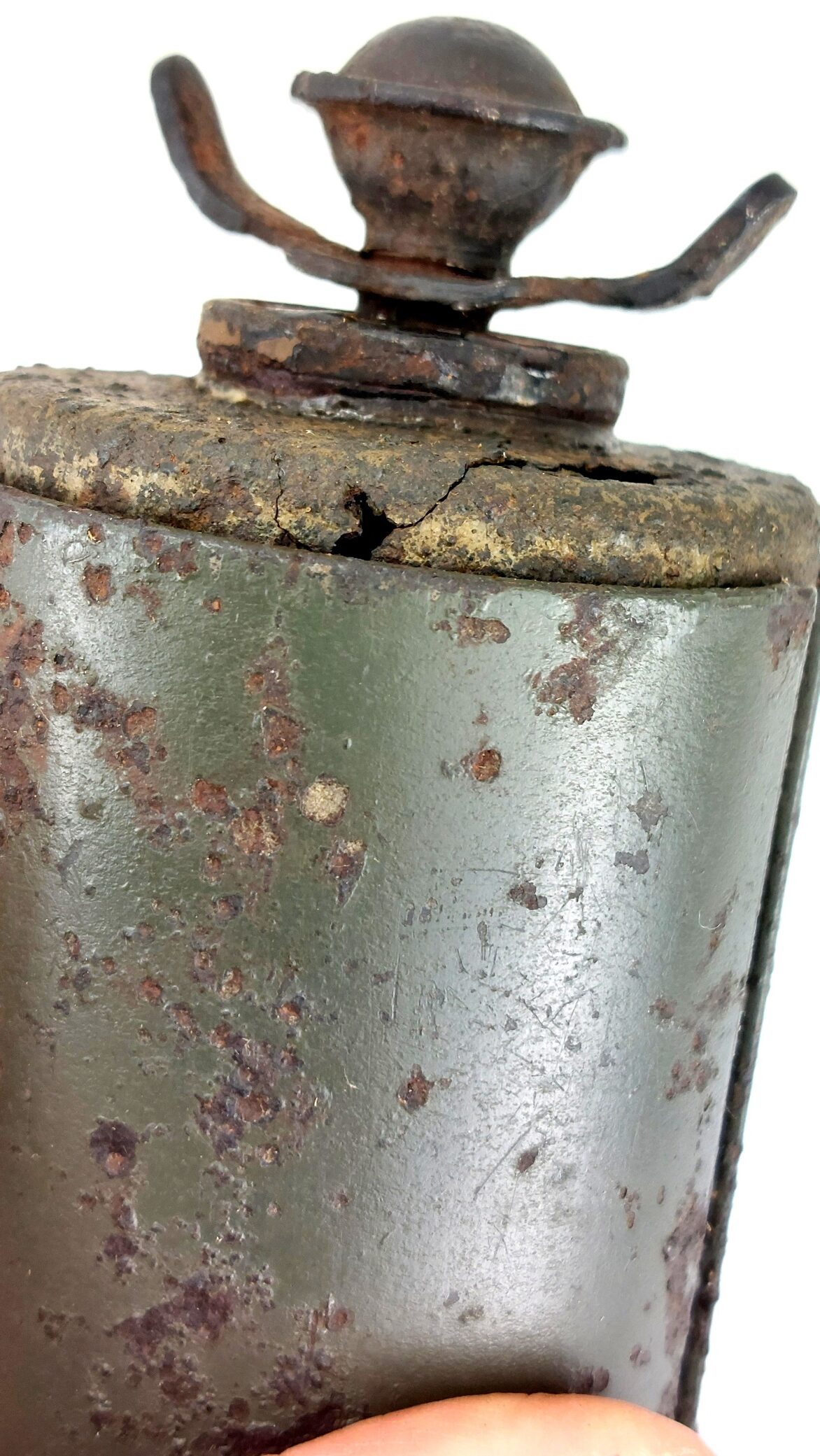
Original German Second World War M43 Stielhandgranate, retaining its original wooden haft and cylindrical sheet-steel grenade head. This example exhibits the correct late-war simplified construction associated with the M43 pattern, including the rolled-seam steel canister head, simplified screw-base attachment to the handle, and the integral striker cap with pull-ring assembly housed at the top of the grenade head.
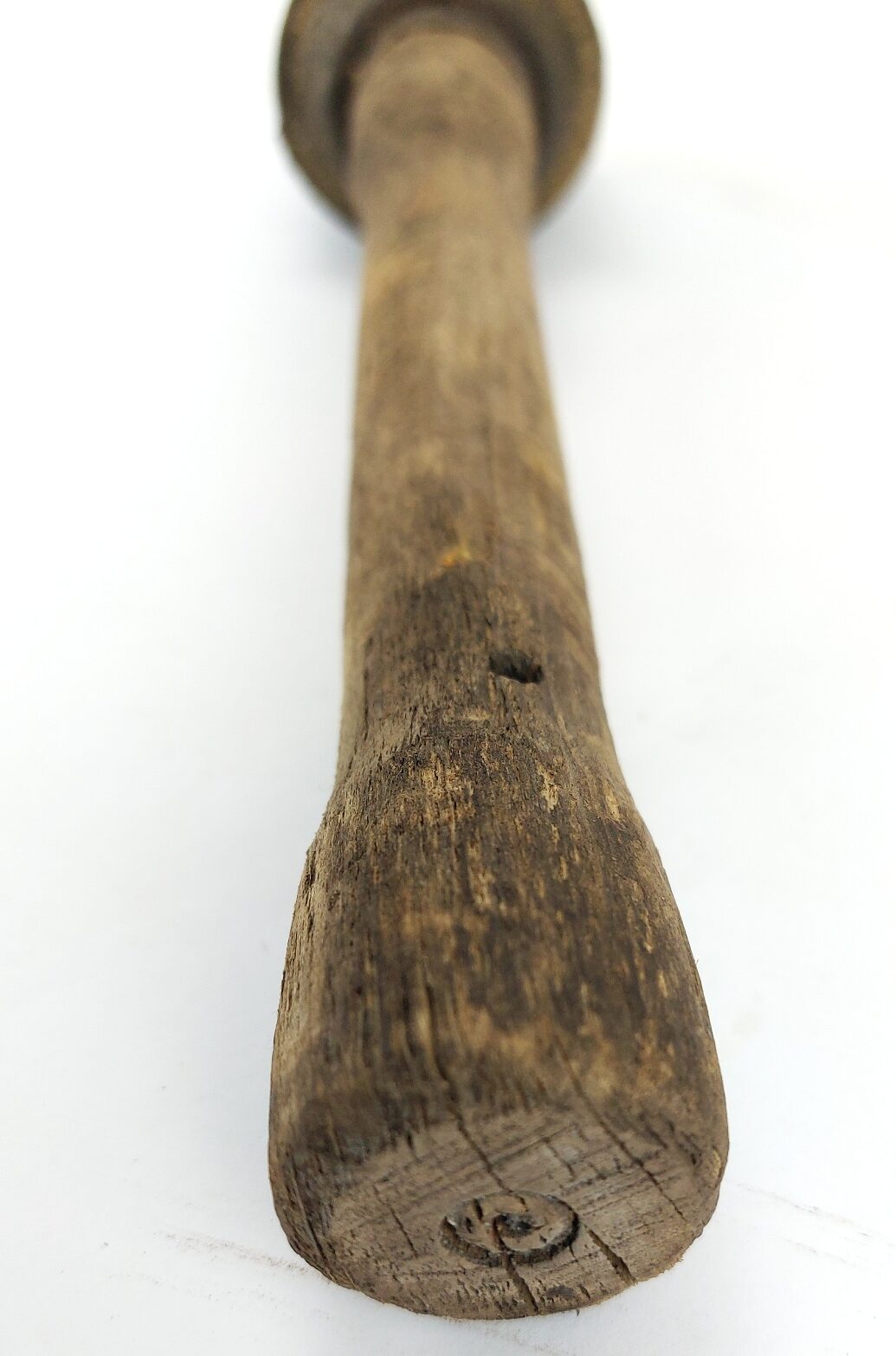
The wooden throwing handle is of solid wartime manufacture and displays the correct drilled vent hole near the base, with surface wear, shrinkage, and patination entirely consistent with age and service use. The steel grenade head shows extensive oxidation overall, with scattered remnants of original factory-applied field paint visible beneath corrosion. All features align with known M43 production characteristics introduced from 1943 onwards, reflecting Germany’s late-war material shortages and simplified manufacturing methods.
A strong, untouched example of one of the most recognisable German infantry grenades of the Second World War.
Approx. Measurements – Overall length: approx. 36 cm.
Historical Note: The M43 Stielhandgranate was introduced during the latter stages of the Second World War as a simplified successor to earlier German stick grenade designs, notably the Model 1924. Unlike earlier types, the M43 incorporated a simplified internal ignition system and a more economical construction, eliminating unnecessary components to speed production.
The grenade consisted of an explosive-filled steel canister mounted on a wooden handle, with the striker and pull-cord mechanism housed within the grenade head rather than concealed inside the haft. The head could be unscrewed and used independently, most commonly in booby-trap applications, and the grenade could also be adapted for fragmentation use through the addition of an external fragmentation sleeve or improvised materials.
Issued widely from 1943 until the end of the war, the M43 saw service across all branches of the German armed forces. Its distinctive silhouette earned it the well-known Allied nickname “potato masher,” and it remains one of the most iconic infantry weapons of the Second World War.
*Condition* Inert and safe for display. The steel grenade head shows heavy surface corrosion and oxidation throughout, with pitting, losses to finish, and wear consistent with wartime manufacture and prolonged storage. The striker cap and pull-ring assembly are present but seized with corrosion and not operational. The wooden handle displays age-related cracking, longitudinal splits, surface abrasions, shrinkage, and darkening, all commensurate with period manufacture and long-term storage. No restoration or cleaning has been undertaken. Please see photographs as part of the condition report.
*In order to complete the online purchase we will require a picture/scan of a photo ID (Driving Licence, Passport or an official document with a recent picture). If you don't posses any such document please call to buy. If we consider that the proof of ID is incorect or insuficient, we reserve the right to cancel the transaction.
*We also reserve the right to cancel the transaction with a full refund if there is any suspicion that the provided item will be used in any way contrary to the laws and legislation of UK.