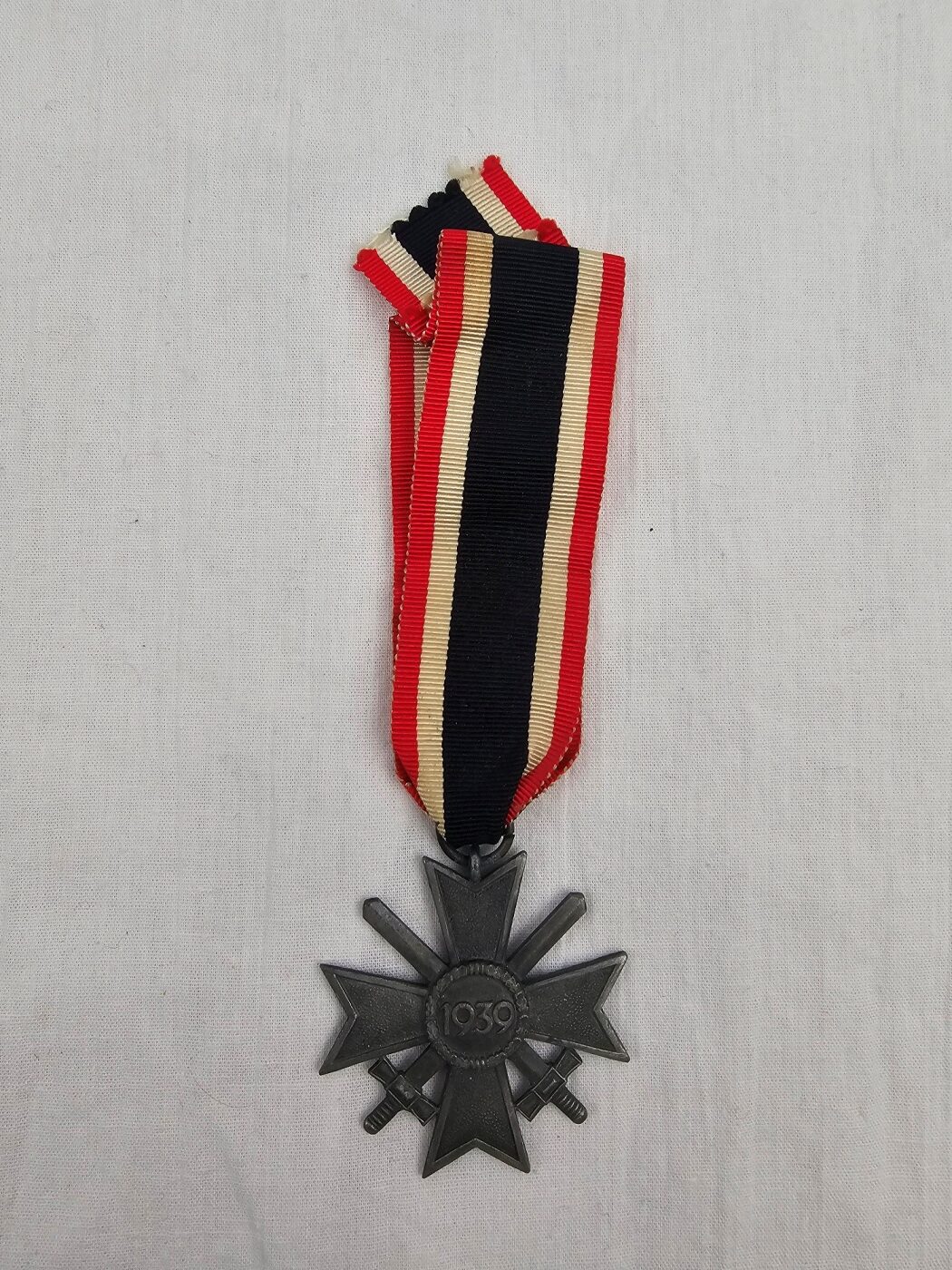
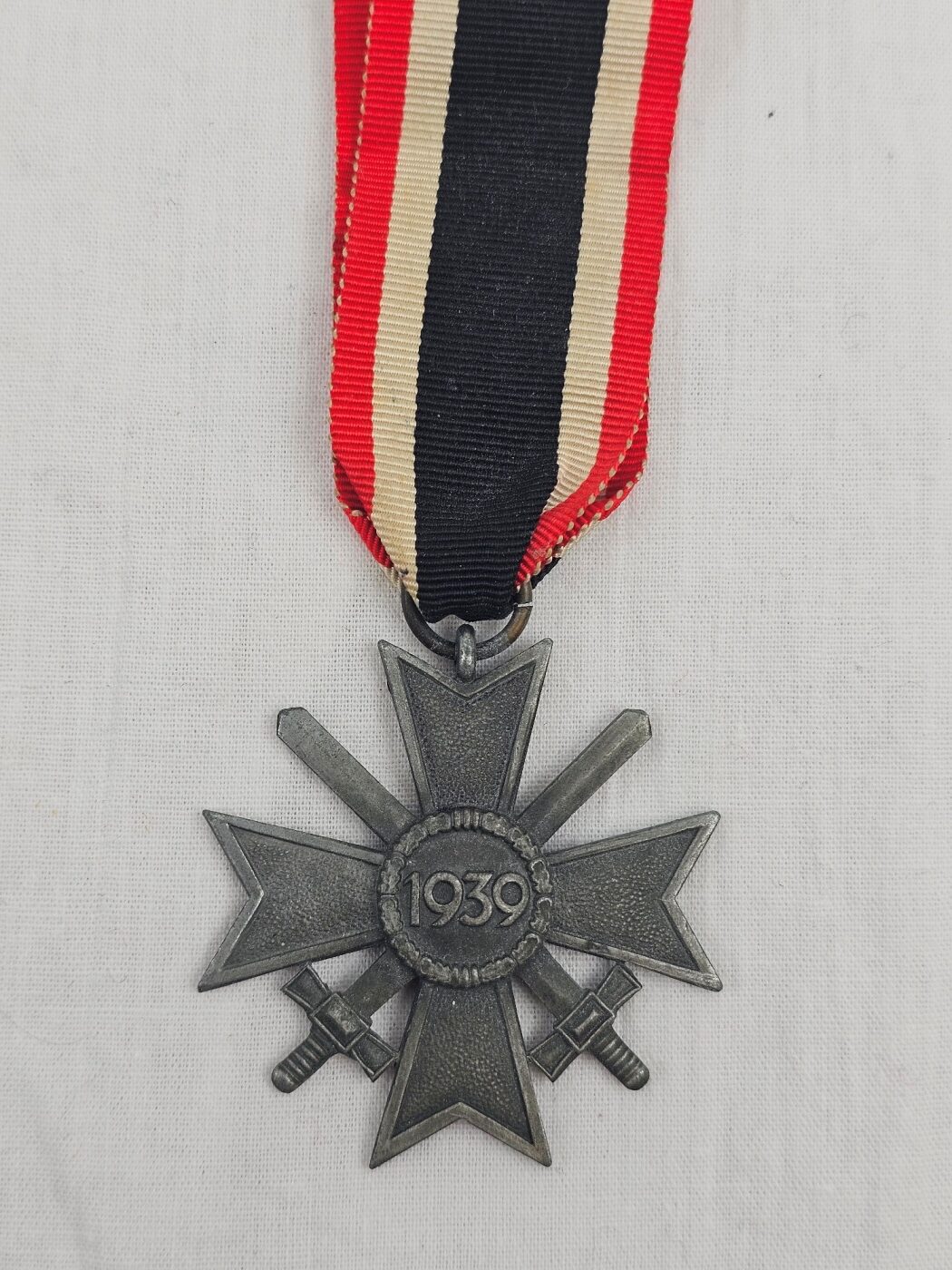
~ German Nazi WW2 Second Class War Merit Cross with Swords ~
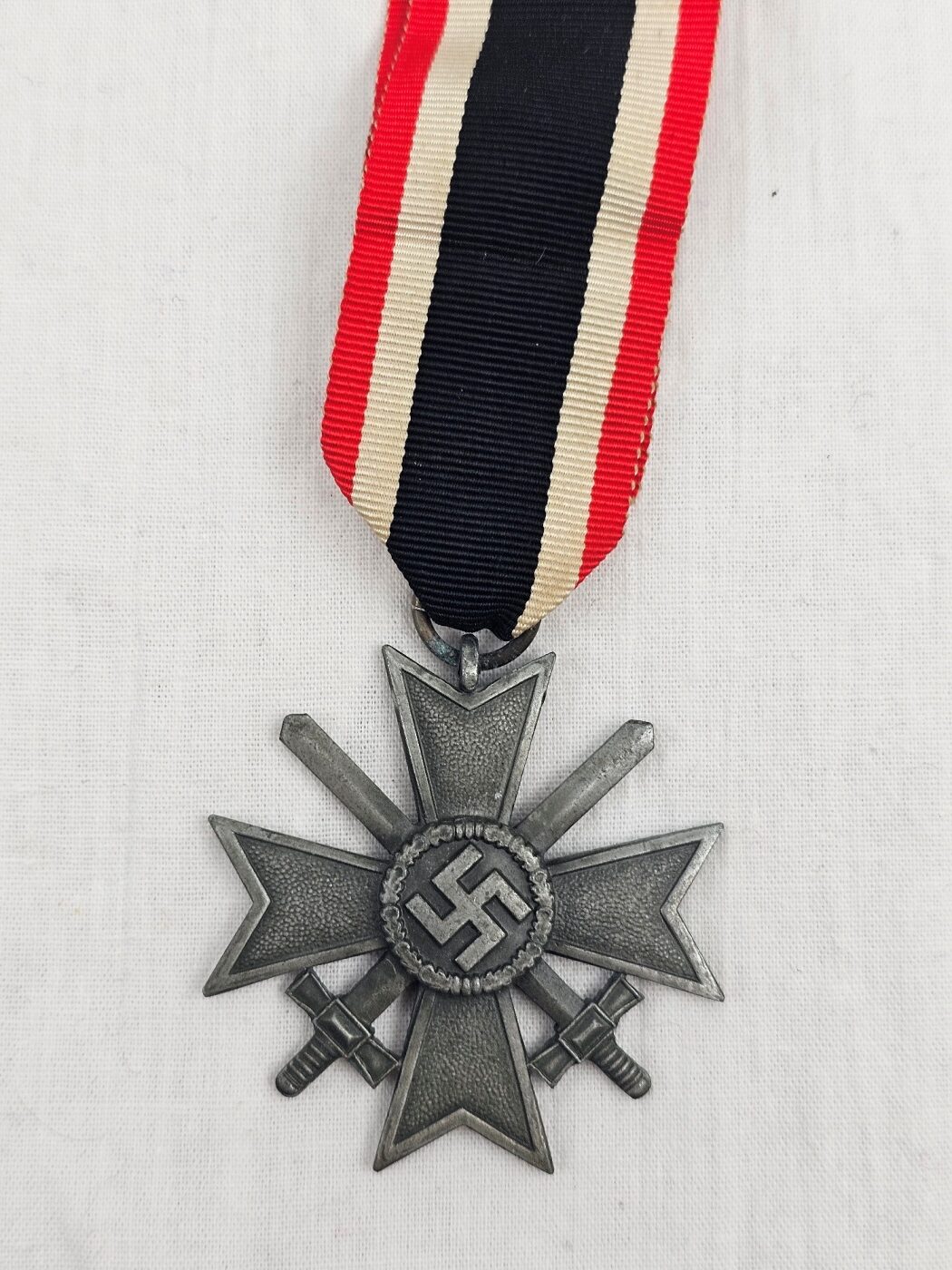
The War Merit Cross, Second Class with Swords, emerges from the turbulent years of the Second World War as an artifact marked by duty, hardship, and the heavy machinery of a nation at war. In form, it resembles an echo of older Prussian decorations—its eight-pointed Maltese outline precise and geometric, each arm tipped with a subtle flaring that lends the medal a quiet severity. At its centre lies the small but unmistakable swastika, framed within a circular wreath, a stark emblem of the regime under which it was created—an emblem that now stands as a reminder of the darkness of its time.
The cross itself, cast most often from zinc or bronze alloys, carries a muted, subdued weight. Years have dulled its surfaces to earthy tones, softening what was once crisp, wartime finish. Suspended diagonally across its front are the crossed swords, signalling that the award was earned not for civilian merit but under conditions touched directly by the violence of conflict—front-line service, exposed logistical work, or acts of resolve under fire.
The ribbon, with its bold stripes of red, white, and black, injects a note of colour against the medal’s subdued metalwork. Worn through the buttonhole or on a medal bar, it would have stood out sharply against the feldgrau of the German uniform. To its recipients, the decoration represented recognition of service carried out in the vast machinery of total war, where the boundaries between combatant and support blurred into a single national exertion.
Turned over, the reverse bears the date 1939, marking the year in which the award was instituted, and, in a sense, the moment Europe again descended into conflict. The inscription is plain, almost understated—yet it anchors the cross firmly within one of history’s most consequential and devastating periods.
Today, when held in the hand, the War Merit Cross with Swords carries an unmistakable sense of gravity. It speaks not of triumph but of a nation engulfed in ideological fervor and military ambition; of millions drawn into the war’s machinery; of lives shaped by decisions far beyond their control. Its materials are simple, its design functional, but its presence is heavy with the accumulated echoes of a world at war.