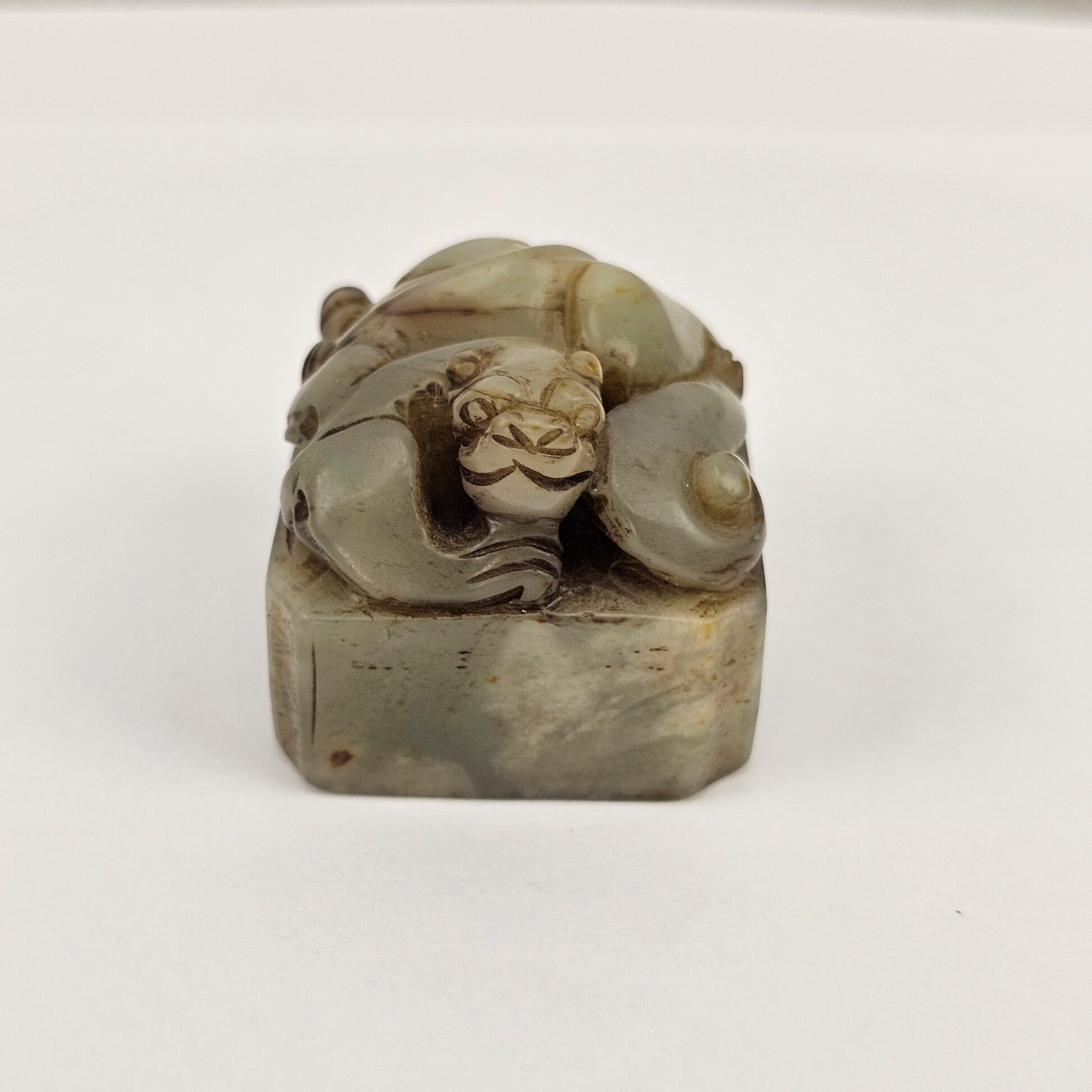
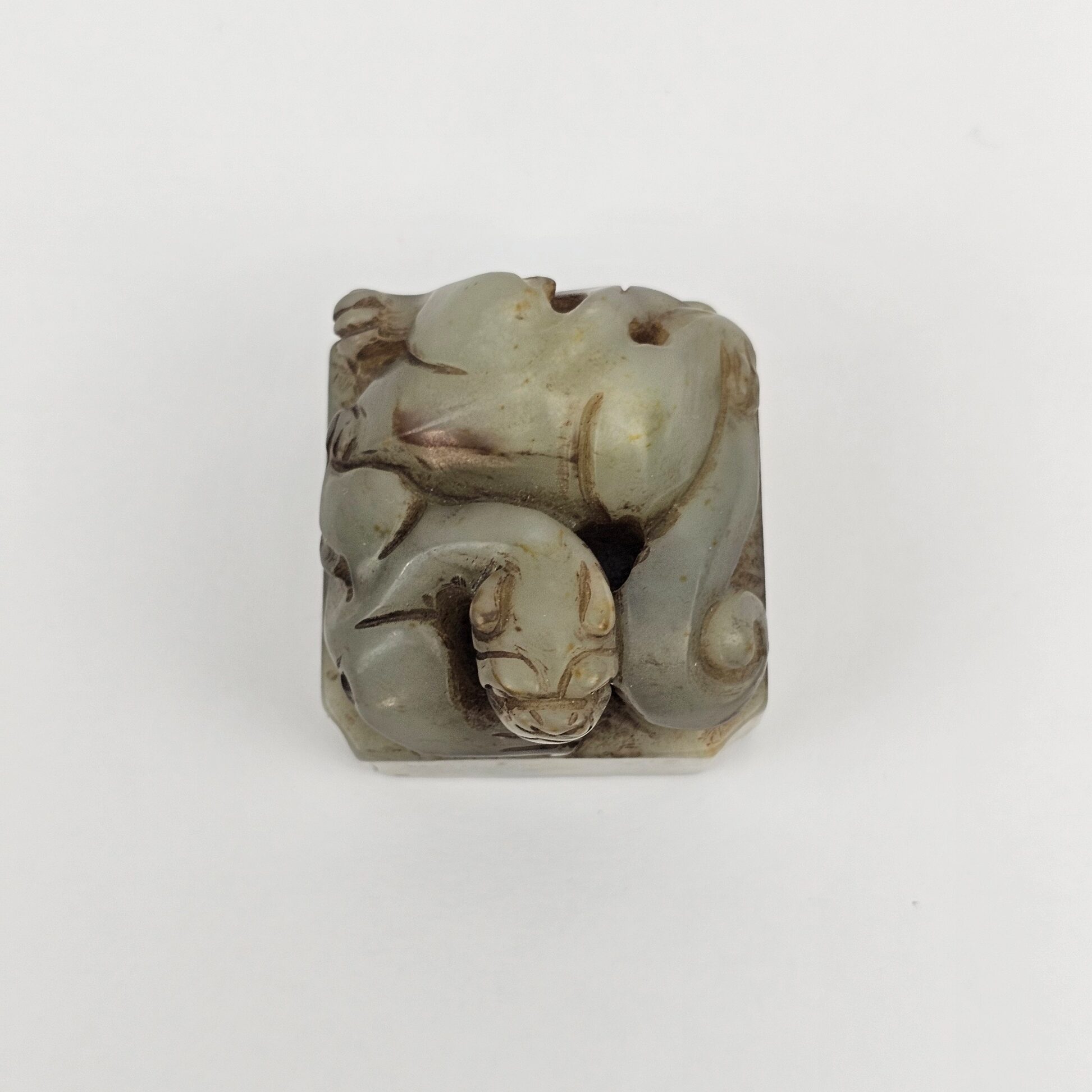
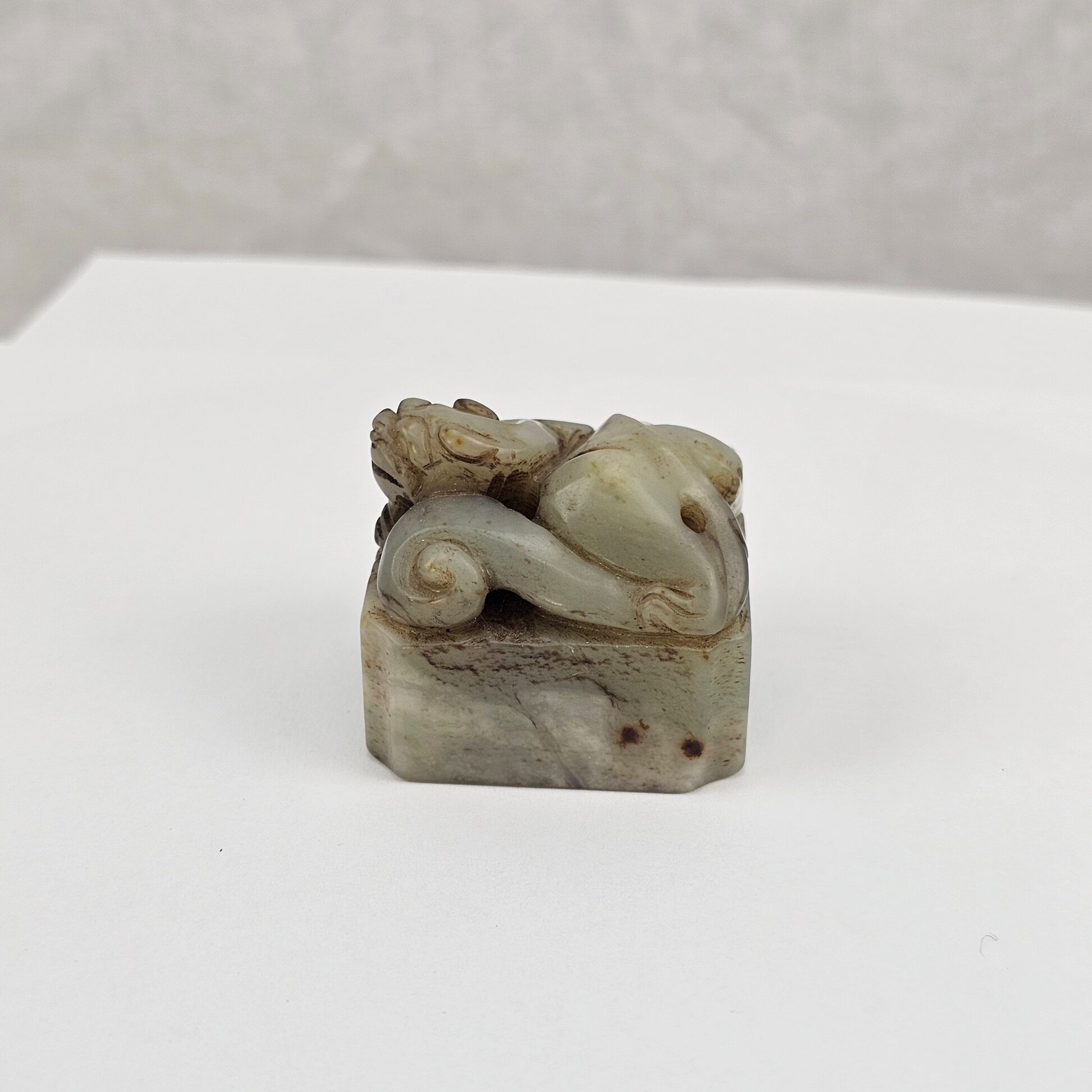
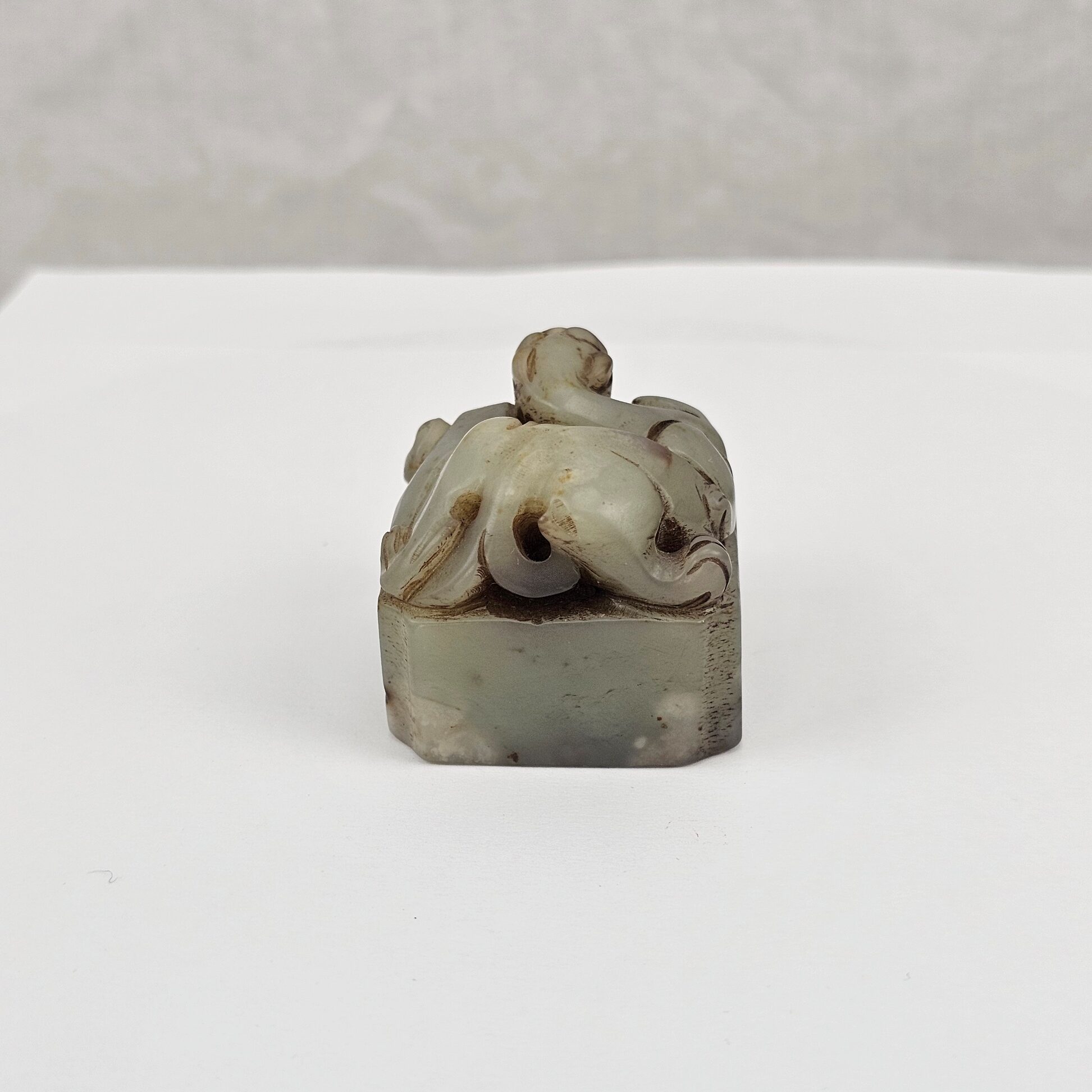
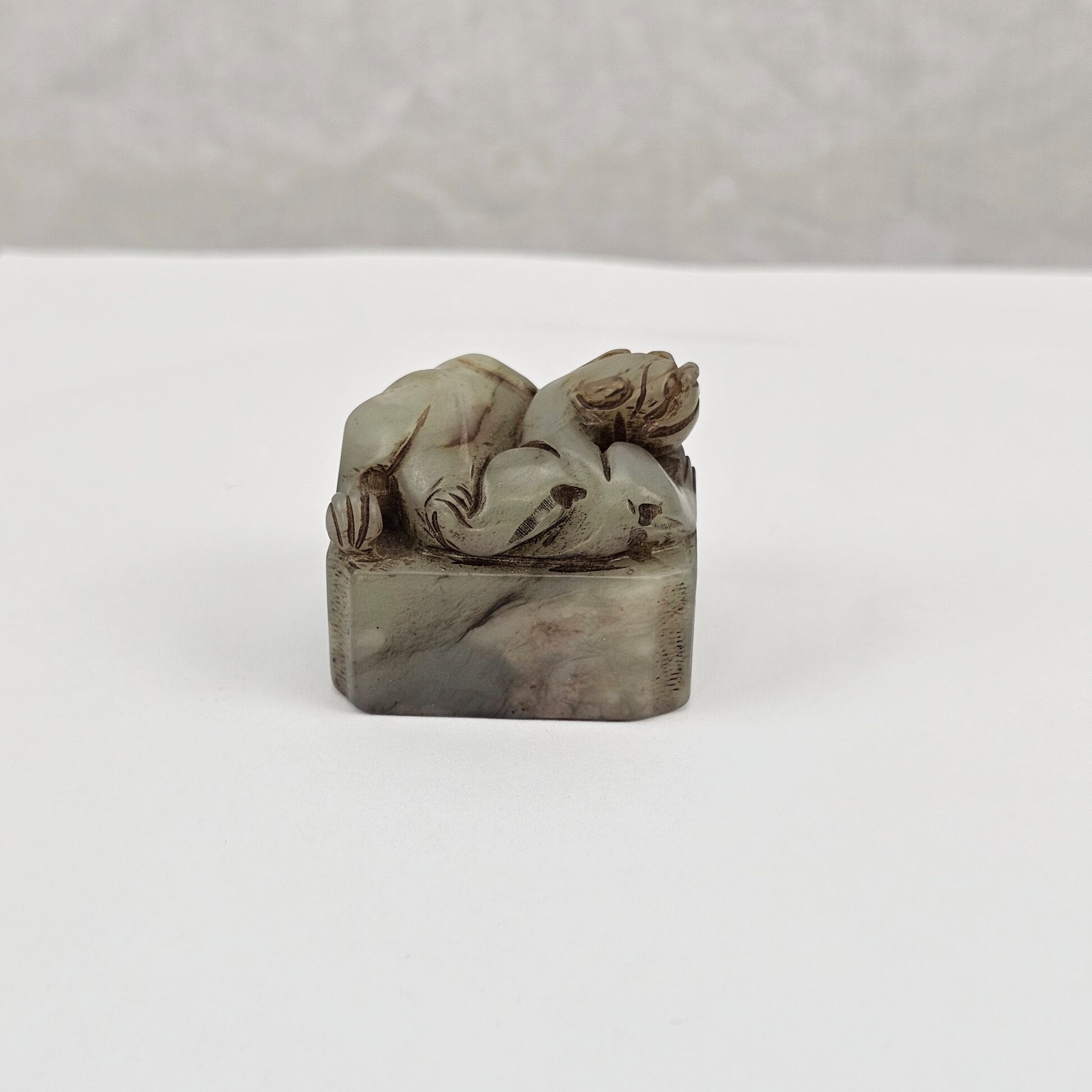
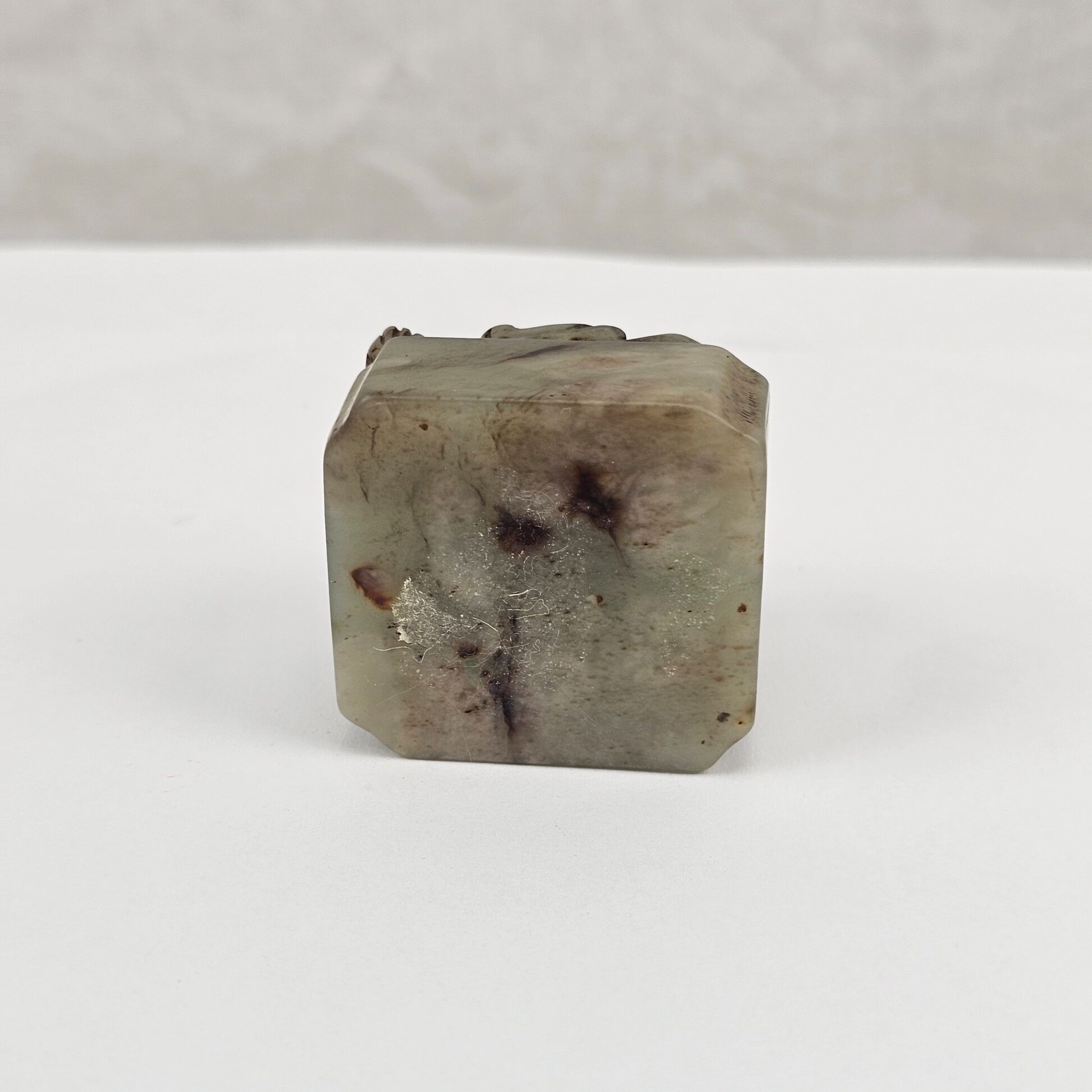
~ Chinese Qing Dynasty Jade Seal with Dragon and Bixie Finial, 18th to 19th Century ~
A hand-carved jade seal of square section with chamfered corners giving the body a softly octagonal profile at the upper edges, surmounted by a finely worked double-creature finial comprising a large coiling dragon and a smaller mythical beast, most likely a bixie or young dragon, in dynamic interaction. The main dragon is depicted with its body coiled and spreading broadly across the full top surface of the seal block, the form sinuous and muscular, with the tail curling in a tight spiral to one side. A drilled aperture passes through the body of the main creature at one point, a refinement commonly found on finer seal finials of the Qing period. The secondary creature, smaller and crouching lower, is visible from the front angle with a broad, expressive face, bulging circular eyes, an open mouth with incised lines suggesting teeth or a mane, and forward-facing confrontational stance, its body partially obscured beneath the coiling form of the larger dragon above. The two creatures together suggest a parent and offspring composition, or a protective encounter between two mythological beasts, a type well established in Qing Dynasty seal carving. The finial detail throughout is bold and confident, with incised lines defining scales, limbs and mane textures, and the contrast between the smoother, paler stone of the main dragon body and the more heavily patinated detail lines creates a strong visual effect. The seal block itself is well proportioned with smooth, flat faces and the chamfered corner treatment, resting on a flat base. One face of the seal block shows a plain or lightly worked surface with natural inclusions visible, and the carved inscription face, if present, is not clearly visible in the photographs provided. The stone is a grey-green nephrite throughout, tending toward a muted celadon in the paler areas, with considerable brown-red and dark russet mineral inclusions and mottling running through the body, particularly concentrated on certain faces of the seal block. Some areas of the finial exploit the paler zones of the stone for the main creature body while the darker, more heavily included areas occur in the recesses and the secondary creature.
Historical Context
The dragon is the supreme emblematic creature of Chinese imperial culture and cosmic symbolism, representing the emperor, celestial power, transformation and the benevolent forces of nature. As a finial subject for jade seals, the dragon was among the most prestigious choices available, associated with high officials, scholarly men of standing and those who wished to align themselves with imperial virtue. Two-dragon or dragon-with-beast compositions on seal finials were particularly favoured during the Qing Dynasty, carrying the additional symbolic resonance of generations or paired forces in harmony. The bixie or ward-off-evil creature, a horned leonine mythological beast, is a related protective figure from Chinese iconography, and its pairing with the dragon on seal finials represents a fusion of protective and imperial symbolism.
The chamfered-corner seal block form, which softens the strictly square section by cutting the corners to produce a subtly octagonal body, is a refinement particularly associated with seals of quality produced during the 17th to 19th centuries for scholar-officials and educated gentlemen, as distinct from the blunter, purely square blocks of more utilitarian pieces. Jade seals of this type were used to impress personalised marks in red vermilion paste onto documents, letters, paintings and books, functioning simultaneously as legal instruments of identity and as treasured studio objects. The grey-green nephrite with natural russet inclusions visible here, while not of the finest mutton-fat white quality, was a well-regarded stone type throughout the Qing period and was used extensively for seals and carvings produced for the mid-to-upper levels of officialdom and scholarly society.