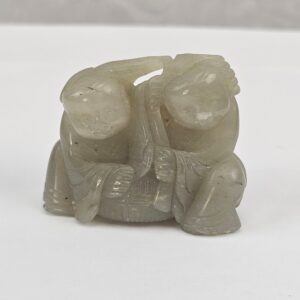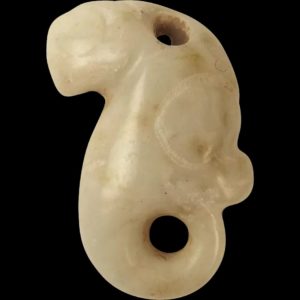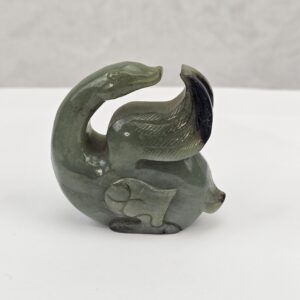
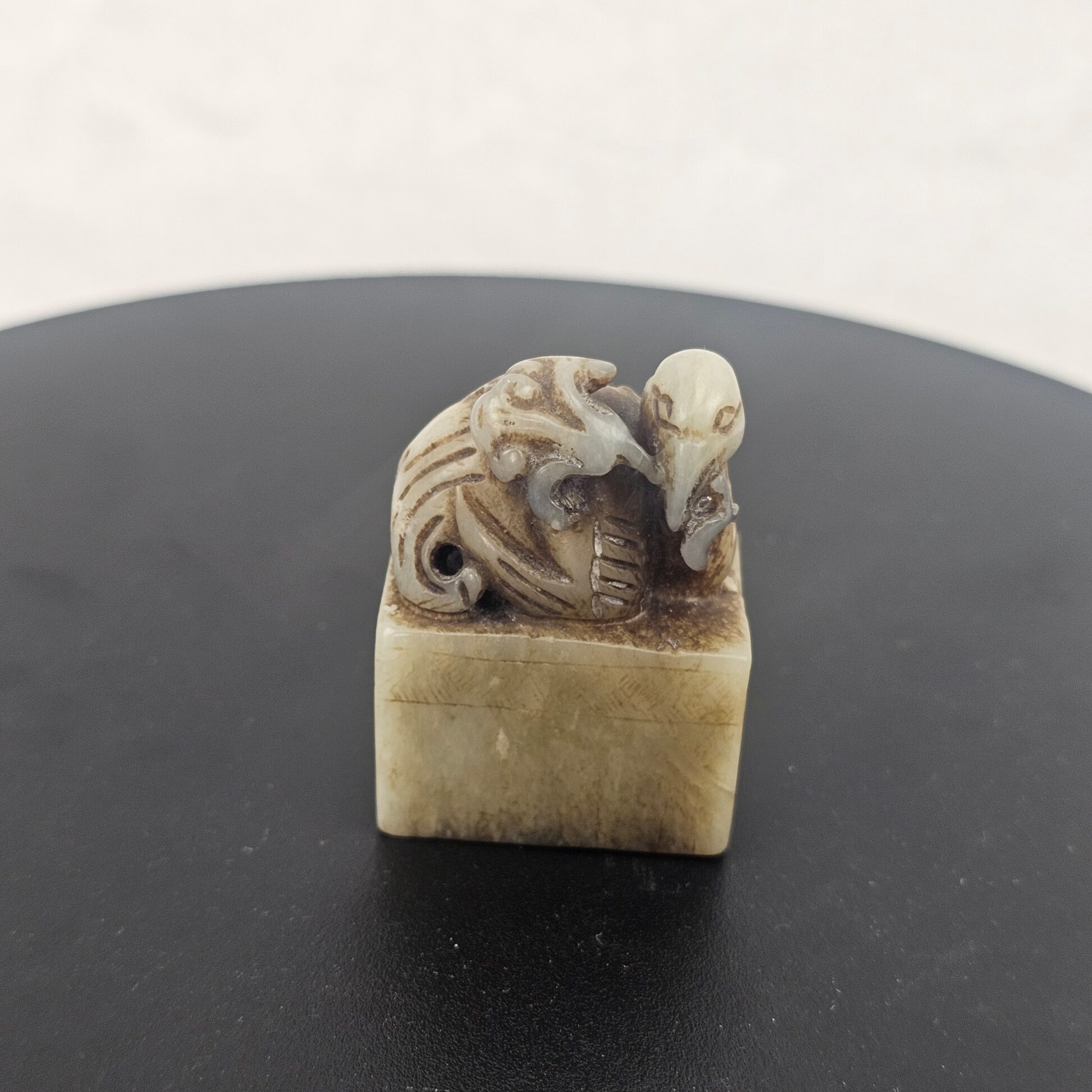
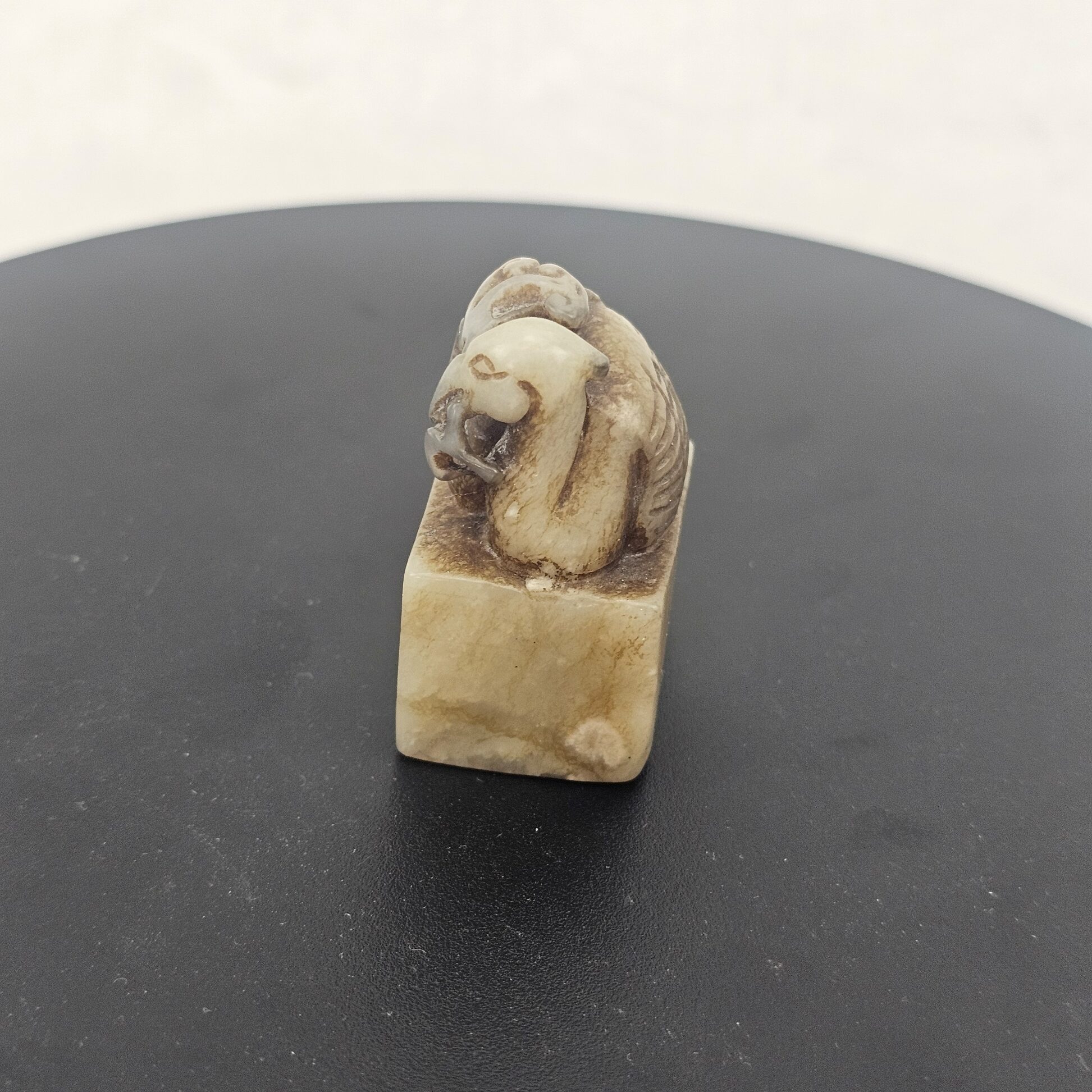
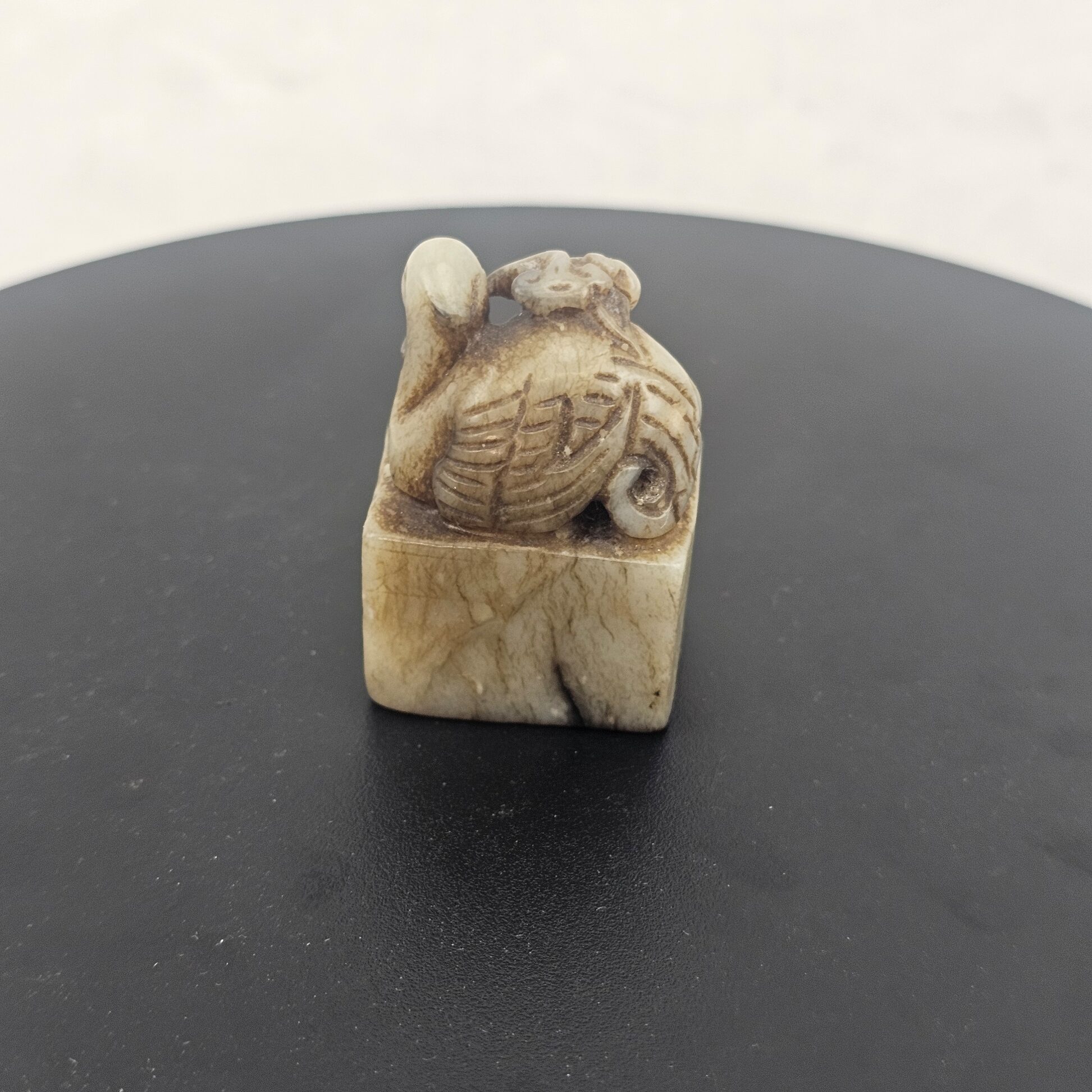
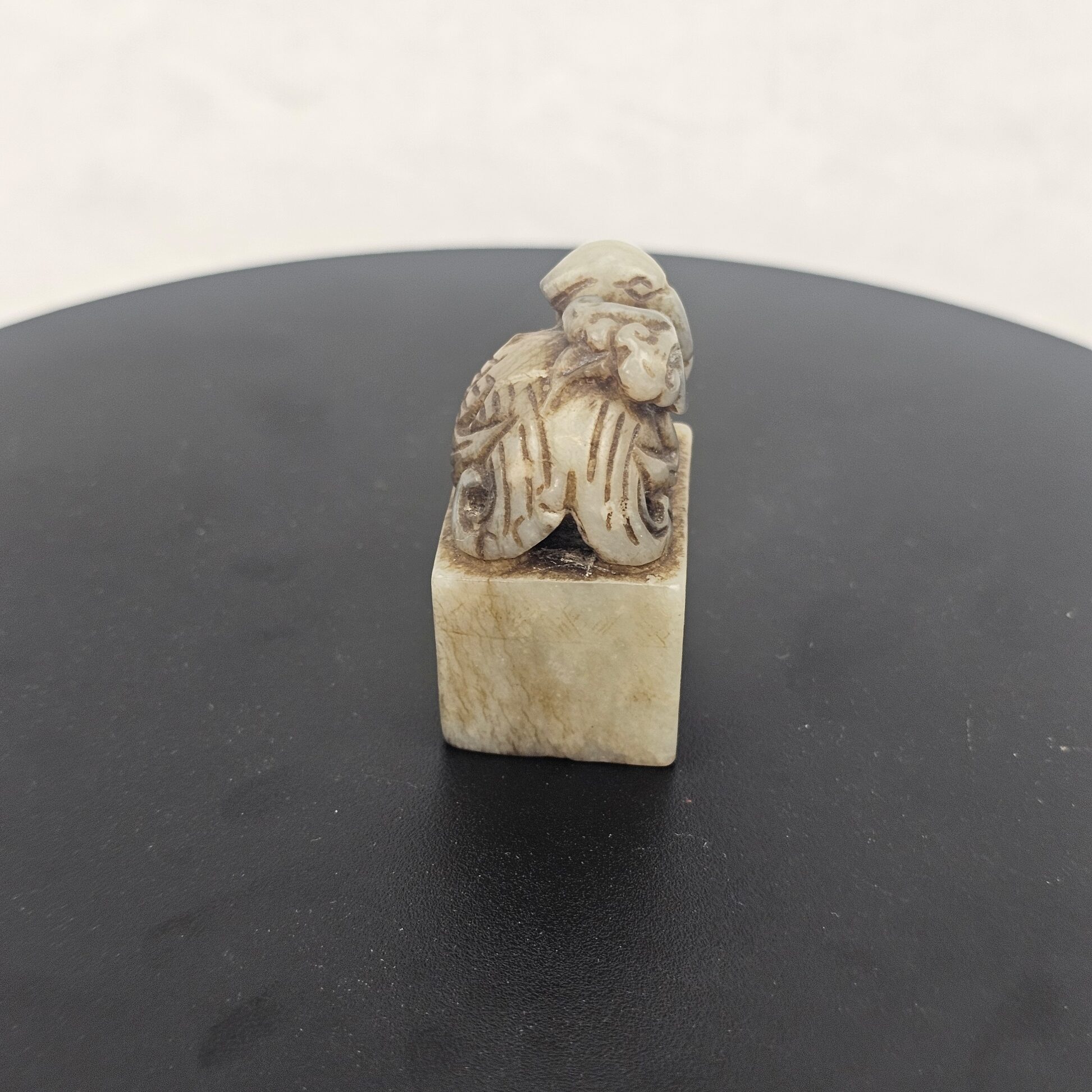
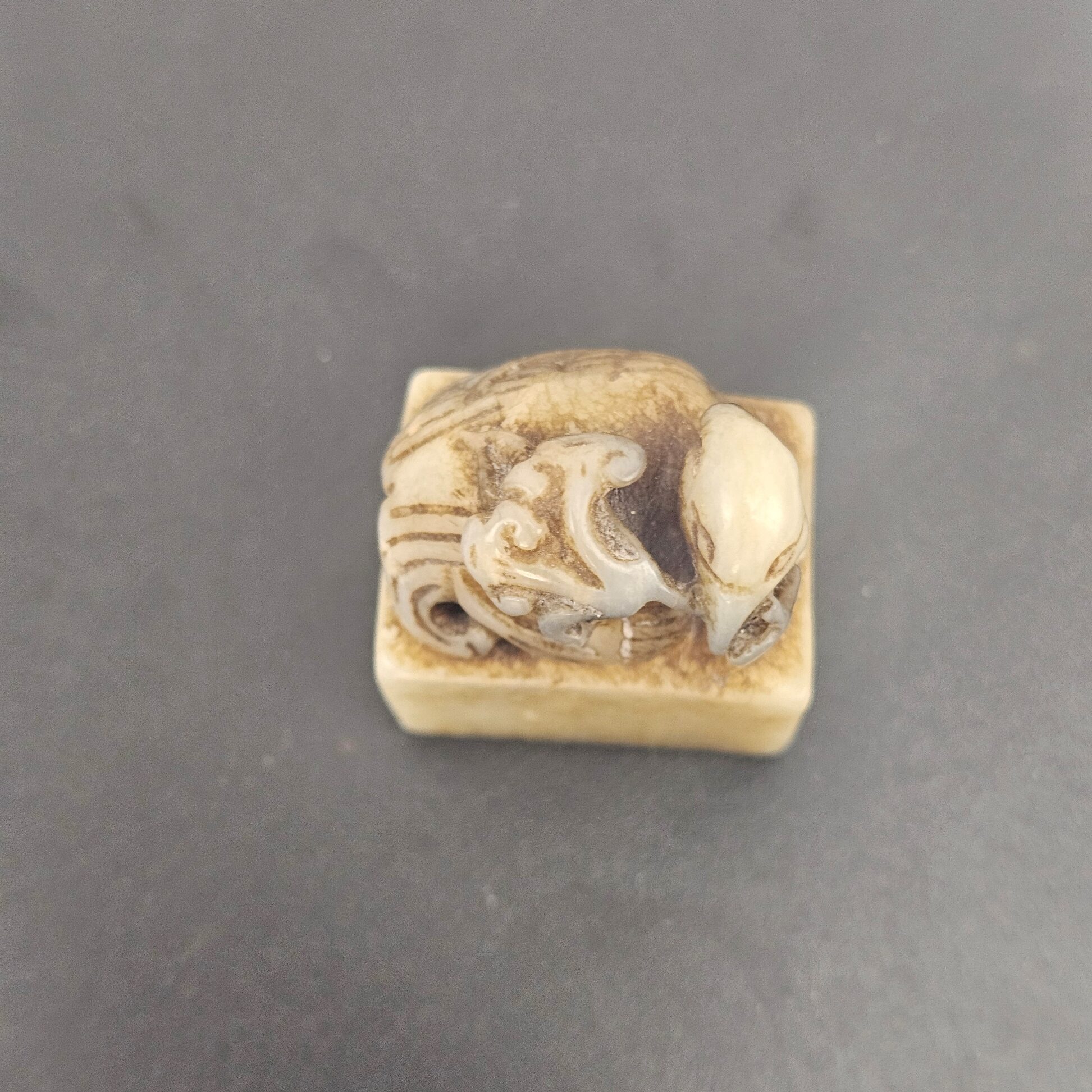
~ Chinese Qing Dynasty Celadon Jade Seal with Cormorant and Lingzhi Finial, 19th Century ~
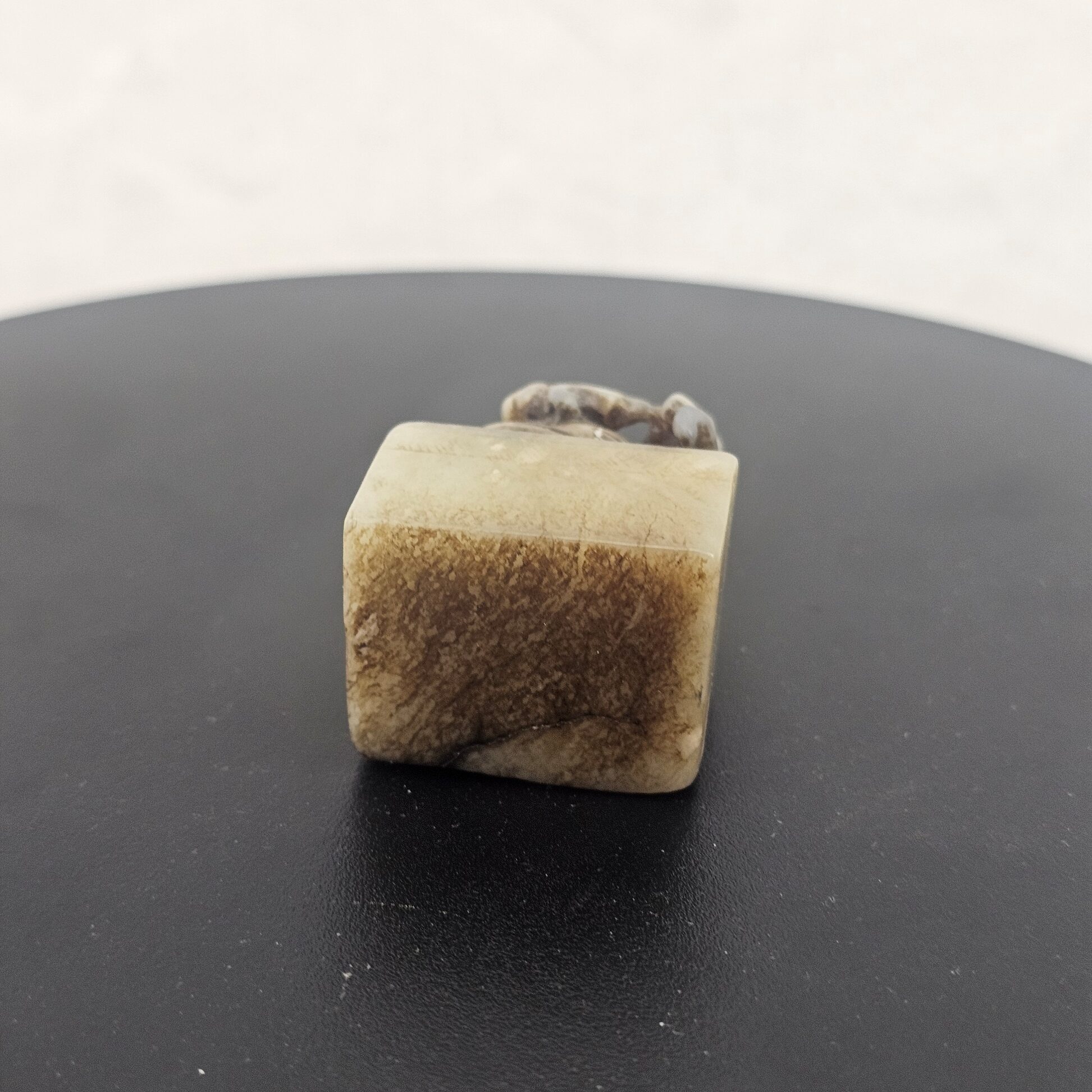
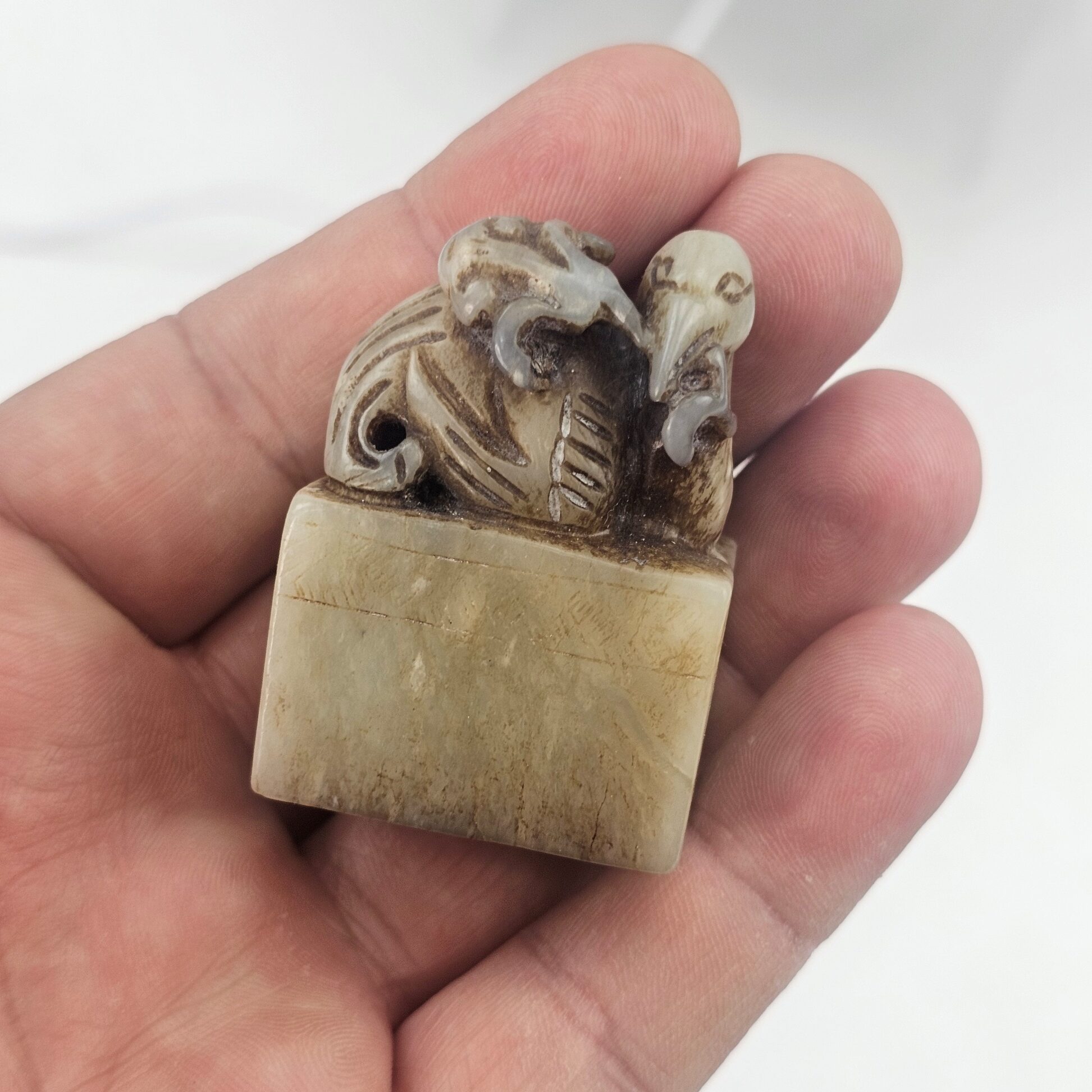
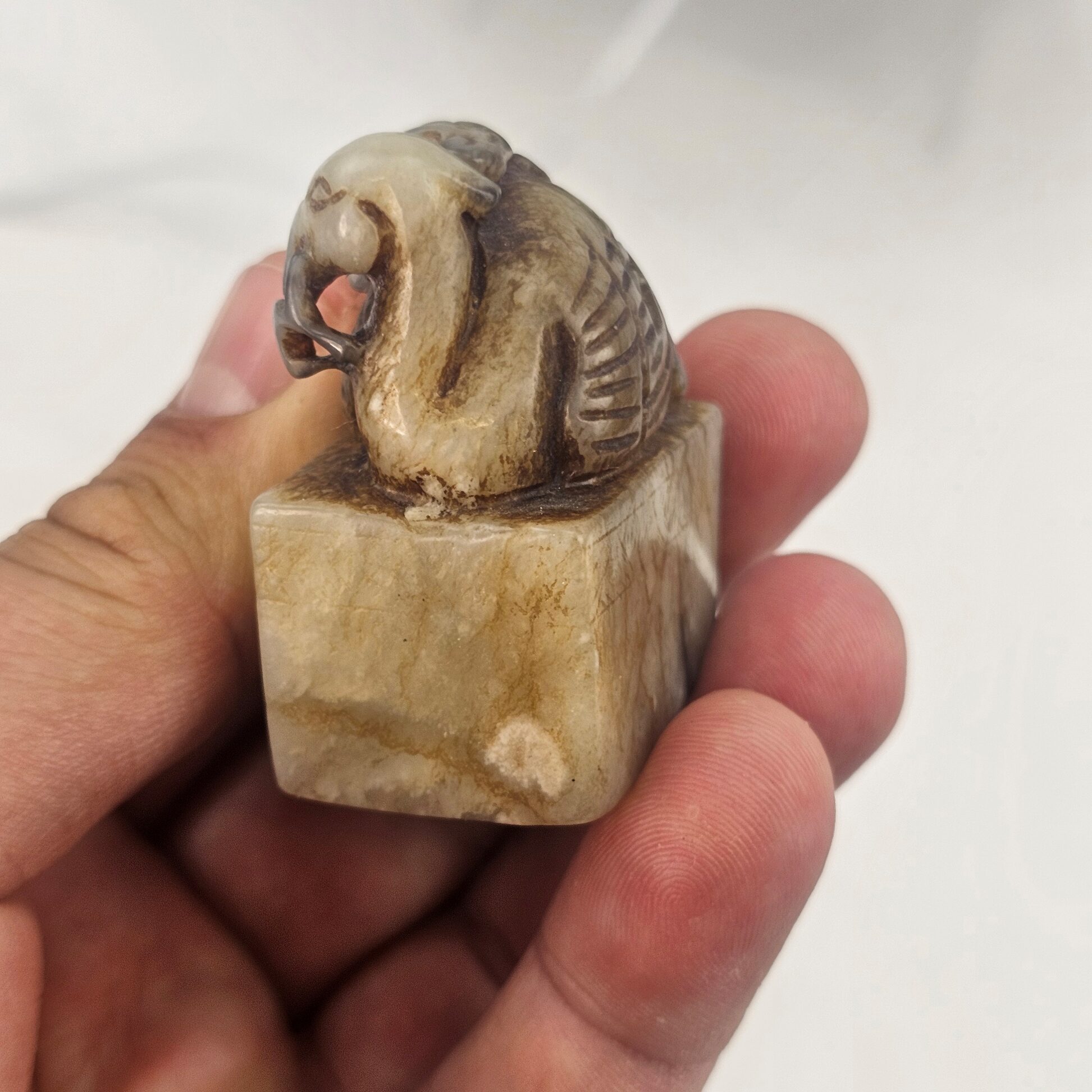
A hand-carved Chinese jade seal (yìnzhāng) of rectangular form, the square-section body surmounted by a finely detailed finial modelled as a crouching cormorant resting among lingzhi fungi. The bird is depicted with its head turned inward and downward toward its breast, the beak hooked and slightly open, the body compact and rounded. The plumage is rendered through incised hatching and fine layered lines suggesting feather texture across the wings and back, with scrolling cloud and wave motifs worked into the transitional zone where the finial meets the seal block. A curling lingzhi stem is visible to the rear and side of the bird, its lobed cap emerging from the base of the finial. The seal block itself is well-proportioned, with lightly bevelled upper edges and smooth, flat side faces. A decorative incised band runs around the upper portion of the block body. The seal face (base) is flat and, consistent with its function as an ink seal, was originally intended to carry a carved inscription. The stone throughout is a warm celadon tone, pale grey-green in the lighter areas and deepening to a rich amber-brown in the naturally occurring russet inclusions, particularly concentrated across the lower faces of the seal block. Natural veining runs through the stone. The piece is small and intended for hand use, fitting comfortably within the palm. Approximately 4.5 to 5 cm in overall height.
Historical Context
The Chinese personal seal, or yìnzhāng, has been in use for over two thousand years and was an essential object for scholars, officials, and merchants throughout imperial China. By the Qing Dynasty (1644 to 1912), the tradition of the carved seal had reached extraordinary refinement, and seal-making occupied a respected place within the broader category of the scholar's studio (wénfáng). Seals were carved from a range of materials including nephrite jade, soapstone, ivory, bamboo and crystal, with nephrite jade being among the most prized for its hardness, translucency and deep cultural resonance. Celadon jade, a warm grey-green nephrite, was particularly favoured and was sourced principally from the Khotan region of Xinjiang.
The choice of the cormorant as a finial subject is comparatively uncommon and carries specific symbolic weight. The cormorant was intimately associated with fishermen and with abundance drawn from nature, and in Chinese culture more broadly with good fortune and prosperity. Paired here with the lingzhi fungus, a sacred mushroom representing immortality, longevity and divine blessing, the combined motif would have been considered highly auspicious. Lingzhi appears frequently in Qing decorative arts alongside cranes, deer and other longevity symbols, and its inclusion here elevates the seal beyond a purely functional object into one carrying spiritual and aesthetic significance. The incised wave and scroll work at the base of the finial is consistent with decorative conventions of the mid to late Qing period, suggesting a date in the nineteenth century.