~ Victorian Staffordshire Flatback Pottery Group, Courting Couple Under an Arbour, circa 1850–1870 ~
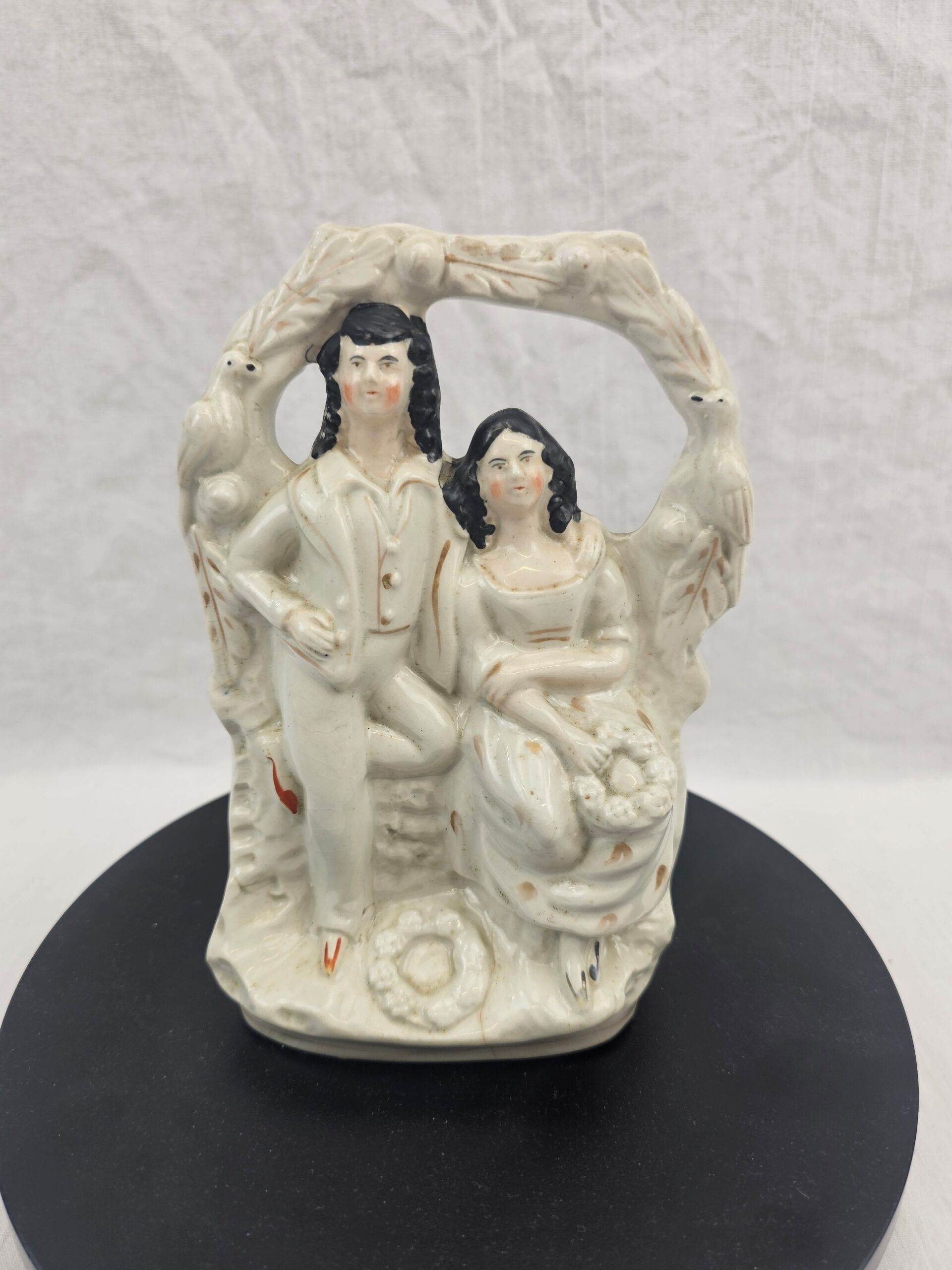
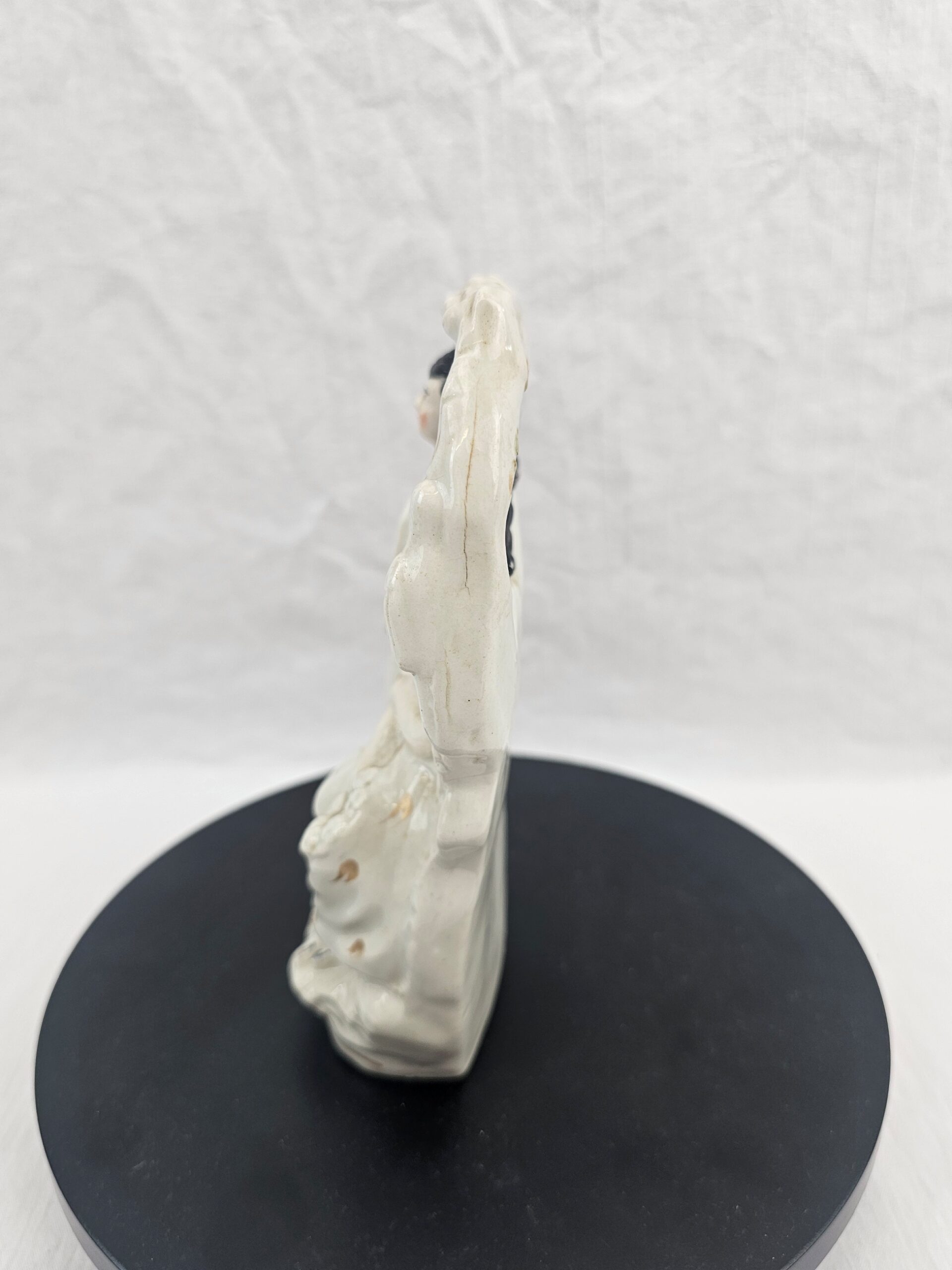
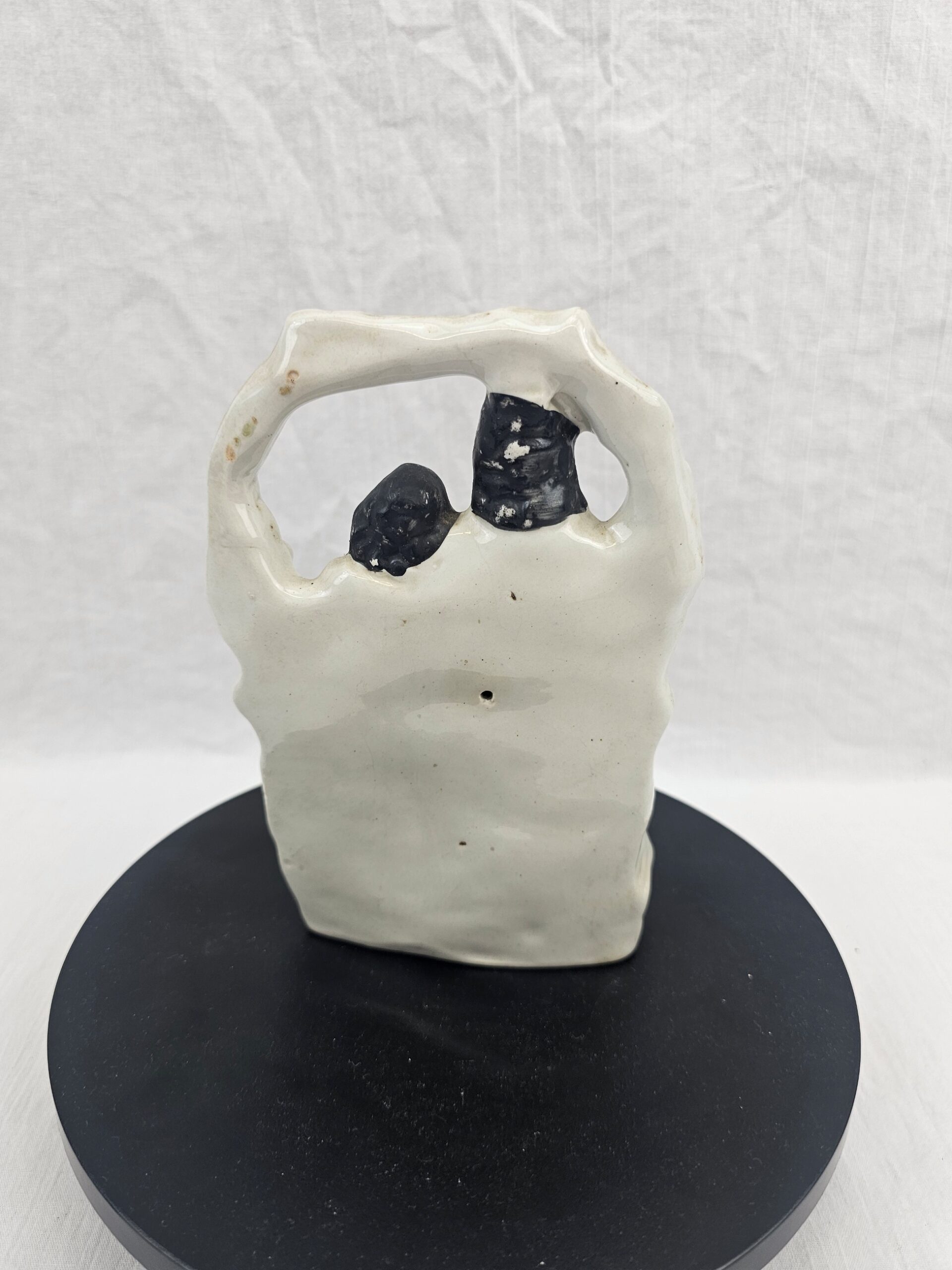
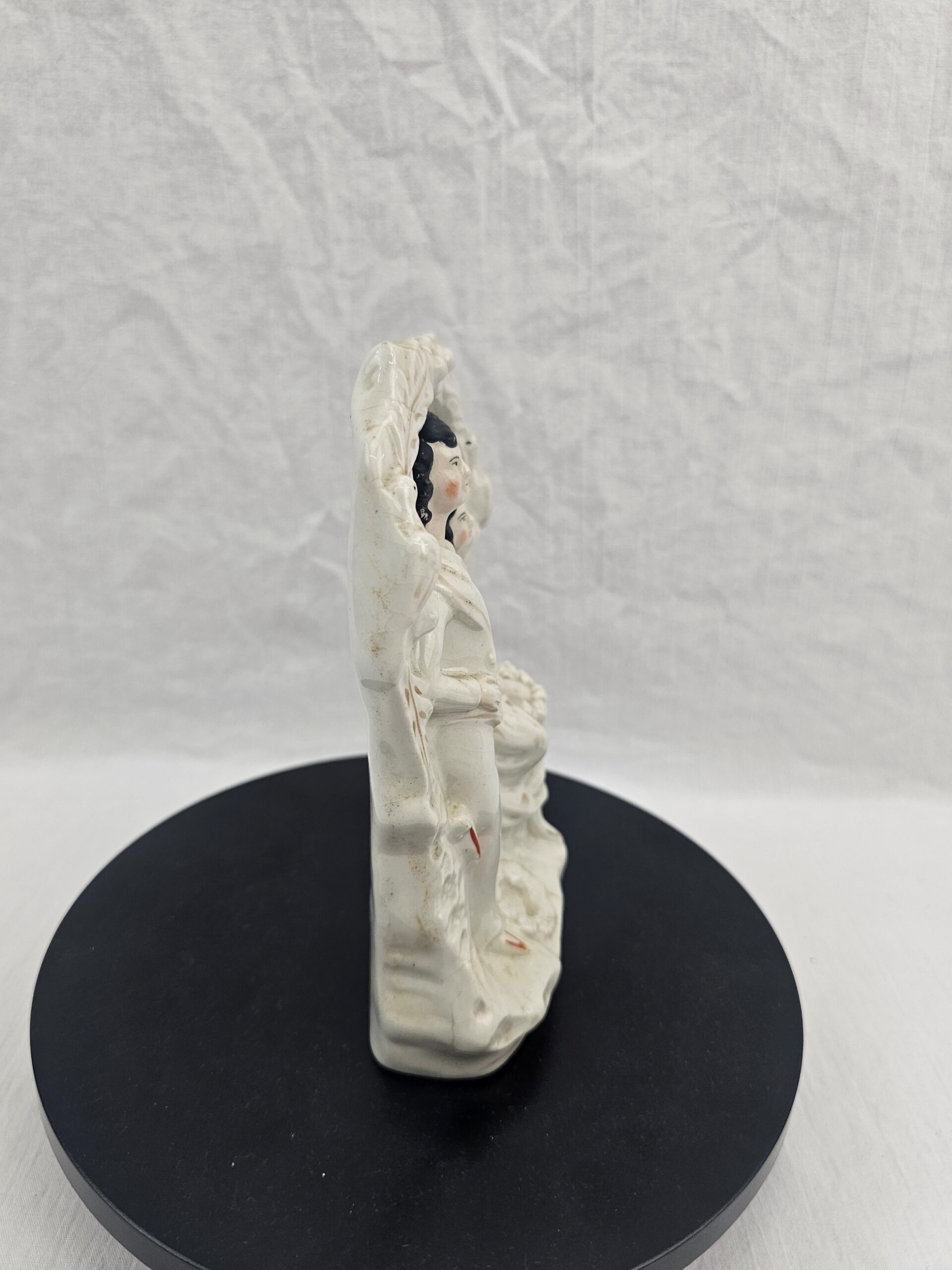
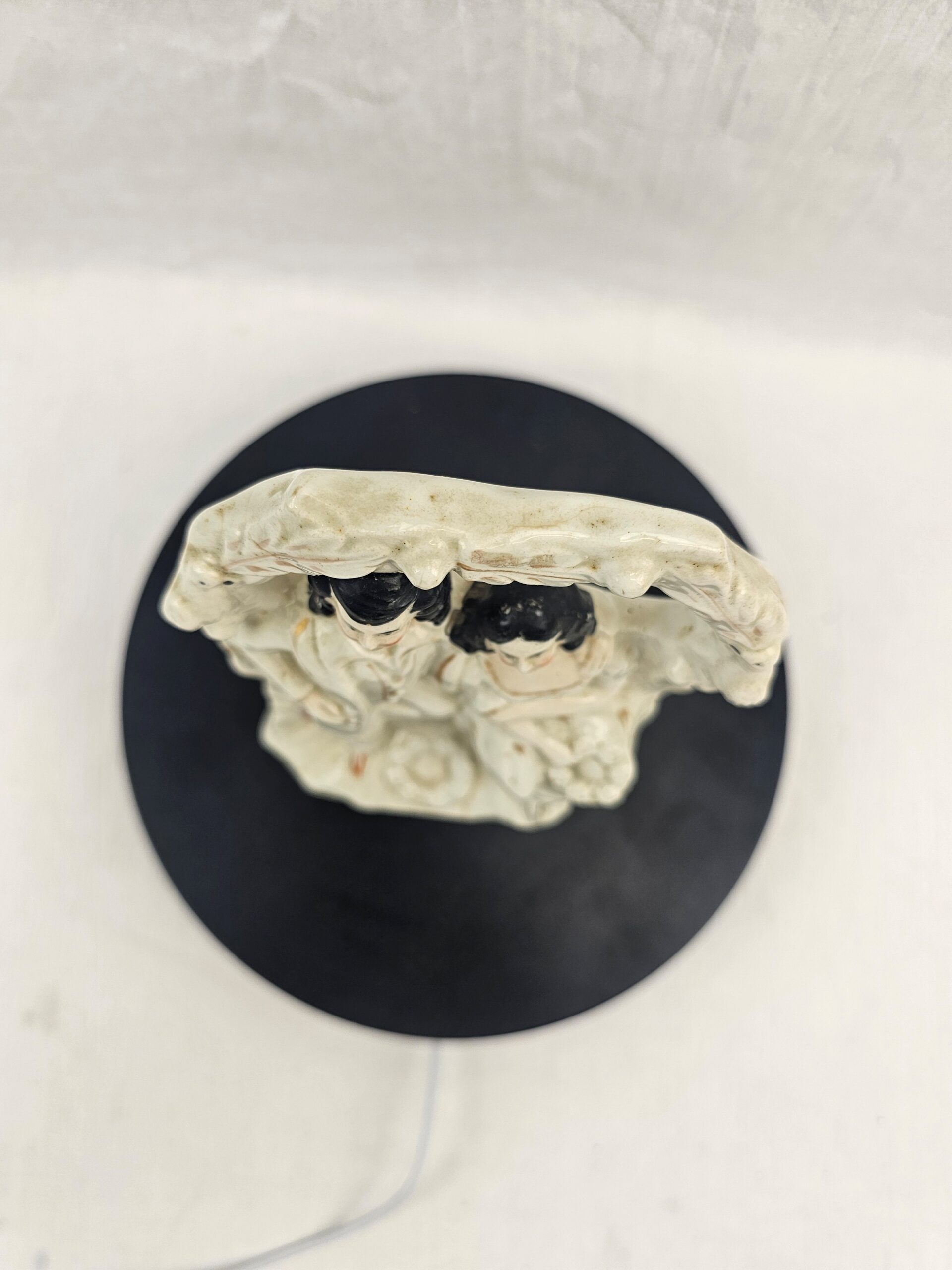
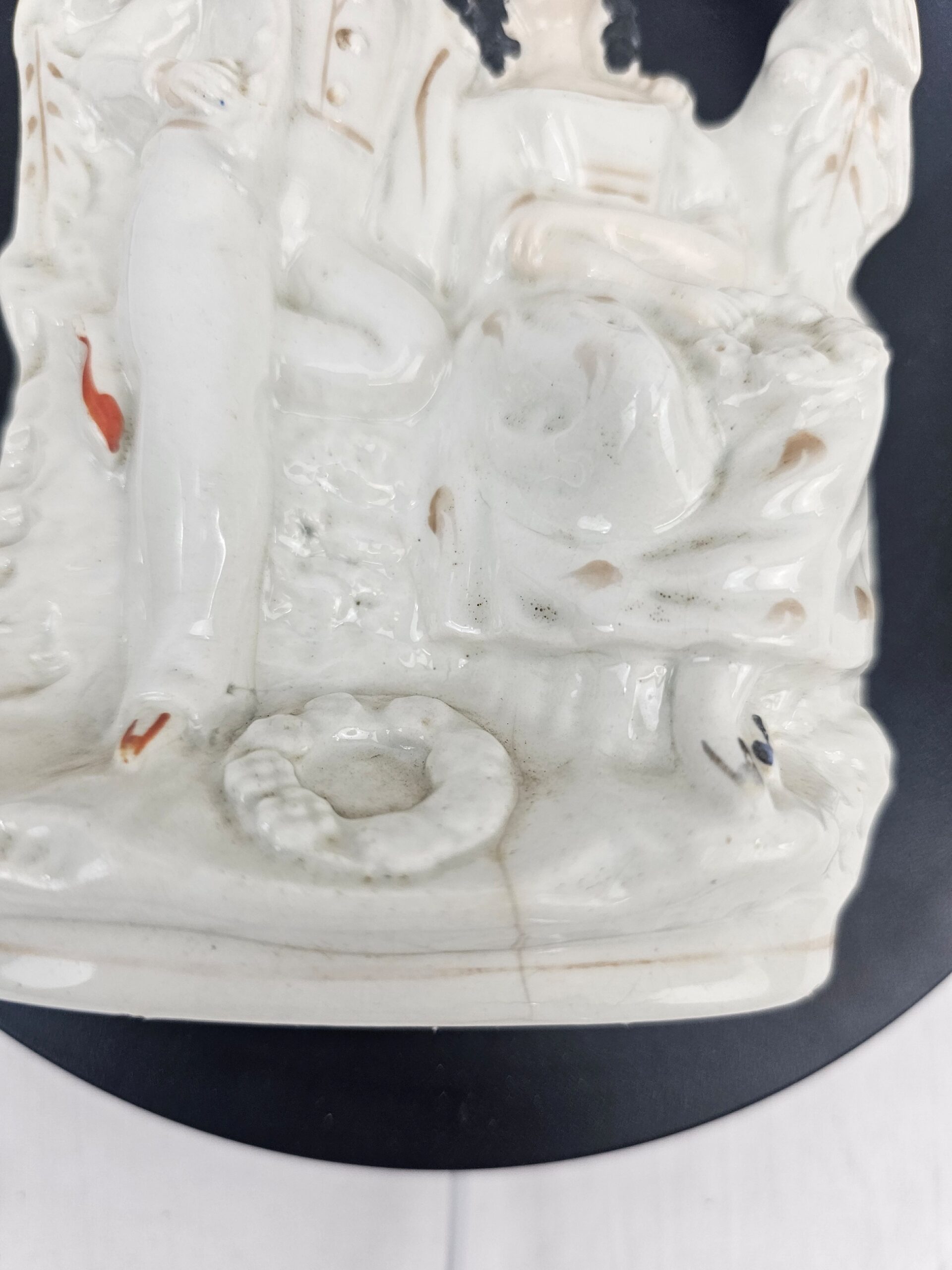
A characterful Victorian Staffordshire earthenware flatback figure group depicting a romantic couple seated together beneath a naturalistic arch or arbour, one of the most enduring and recognisable compositional forms in Victorian Staffordshire figure production. The group is modelled with the man standing to the left, his long dark hair swept to his shoulders, dressed in a white coat and trousers; the woman sits to his right in a white dress, her dark hair falling loose, with what appears to be a garland or floral wreath gathered in her lap. The arch above them is formed by two tree-trunk uprights, each supporting a naturalistically modelled bird, probably doves, which perch on either side of the curving bough that frames the couple's heads. The mound base at the front is decorated with a moulded open flower rosette. The piece is produced in the predominantly white-ground tradition, with enamel colour restricted to the dark hair of both figures, orange-red accents to the base flowers and birds, and minimal flesh-tone painting to the faces, a palette typical of budget or earlier production Staffordshire groups intended to evoke the appearance of white porcelain. The reverse is entirely plain and undecorated, confirming flatback construction intended for mantelpiece or shelf display against a wall.
~ Historical Context ~
The arbour or bower group, in which a romantic couple is framed by an overhead arch of branches, flowers or foliage, was one of the most widely produced of all Victorian Staffordshire flatback compositions. Staffordshire figures were made from around 1740 to 1900 by various pottery factories in England. Most bear no maker's marks. Victorian flatback examples were undecorated on one side because they were designed to sit on a shelf or fireplace mantel and only viewed from the front or sides. Romantic figures, buildings, farm animals and domestic pets were popular subjects.
The arbour group drew on a long tradition of bocage and bower figures in European decorative ceramics, and the specific subject of a young couple sheltering beneath intertwined trees carried strong romantic and sentimental associations for the Victorian mantelpiece-buying public. Some arbour groups of this type were produced with specific literary identifications, most commonly Shakespeare's Lorenzo and Jessica from The Merchant of Venice, or Romeo and Juliet, though many were sold without titles as generic romantic groups. A Staffordshire figure of Lorenzo and Jessica, showing a loving couple under a bower, circa 1860, is a well-documented type, and the composition of this piece closely follows that tradition. The predominantly white palette with minimal enamel colour is consistent with mid-Victorian production aimed at a broad market, and with the fashion for white-bodied wares that mimicked the appearance of porcelain at an earthenware price point. Unmarked, as was standard for virtually all Staffordshire figure production of the period.
~ Condition ~
This piece has a number of condition issues that must be fully disclosed to prospective buyers:
Arch crack (right upright): A significant crack is clearly visible running down the right-hand tree-trunk upright of the arch, from the upper section toward the base of the arch. This is the most significant condition issue. It may be a firing crack from the original kiln manufacture, or a later structural crack from handling, close in-person examination is recommended to determine its nature and stability.
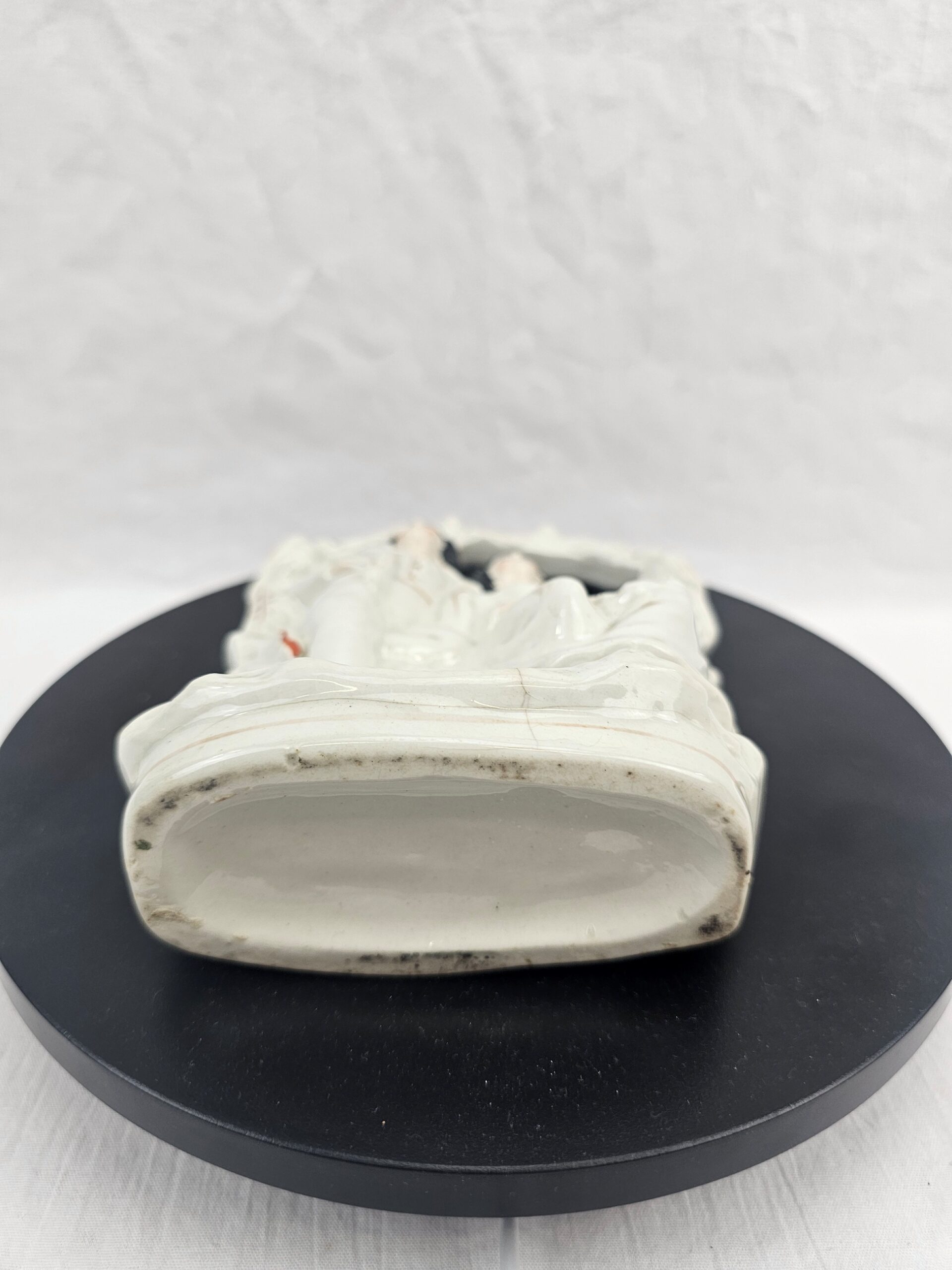
Base crack: A hairline crack runs horizontally across the base, visible in the underside photograph (image 6) and in the close-up of the lower front (image 7). This is a clear structural hairline and must be disclosed.
Enamel: The minimal original enamel decoration, black hair, orange-red accents, is intact and stable; the limited palette means enamel loss is not a significant factor.
Back: Plain flatback reverse with a small central firing vent hole; no chips or damage to the back face observed.
Base underside: Oval hollow glazed base; no maker's mark visible; surface grime consistent with age.
Overall: Structurally intact but with the crack issues noted above; the group holds together and displays adequately, but the condition is honestly that of a well-used piece.
~ Dimensions ~
The figurine measures 6.5 inches (16.5 cm) tall by 4 inches (10.2 cm) wide and 2 inches (5.1 cm) deep. It weighs 350 g.