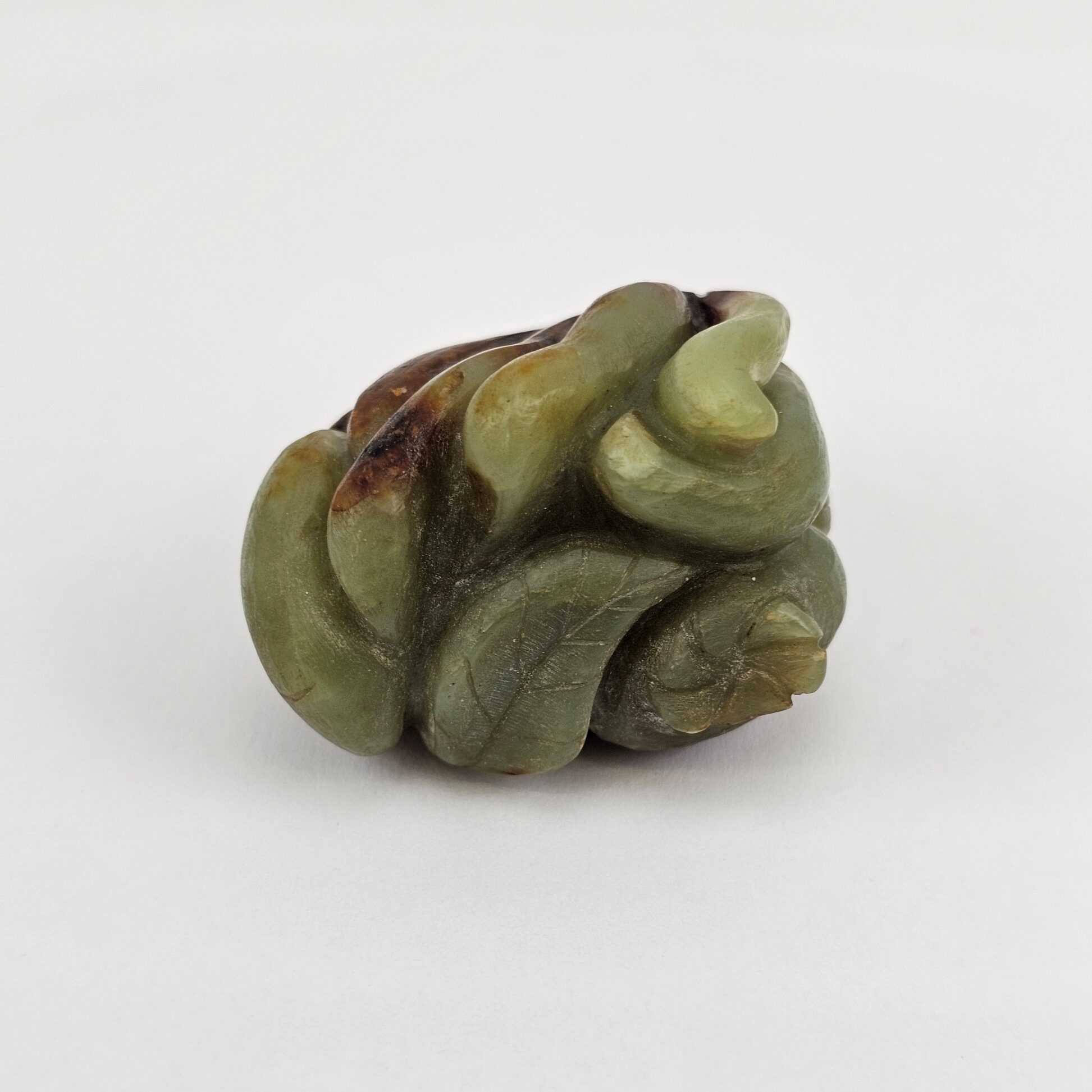
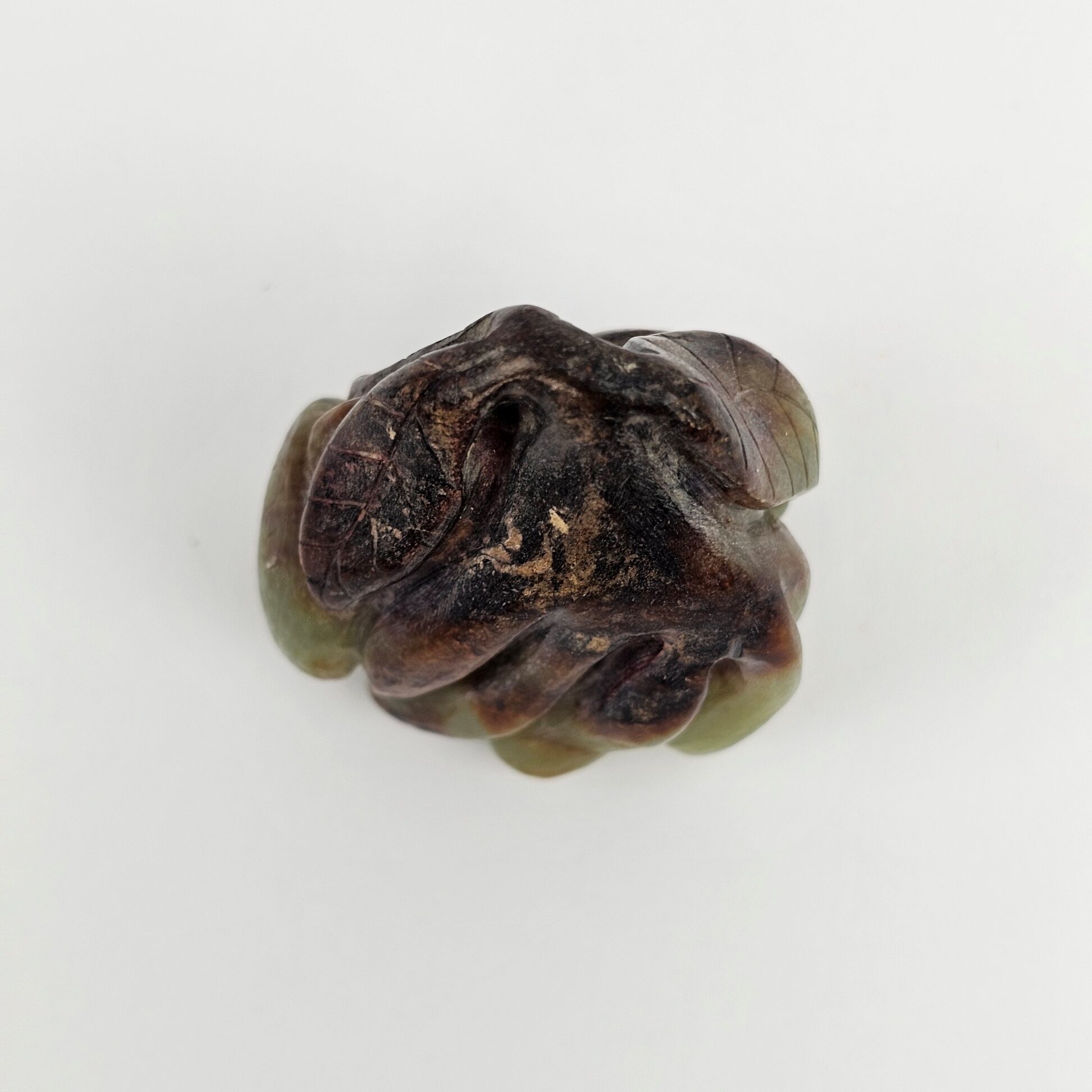
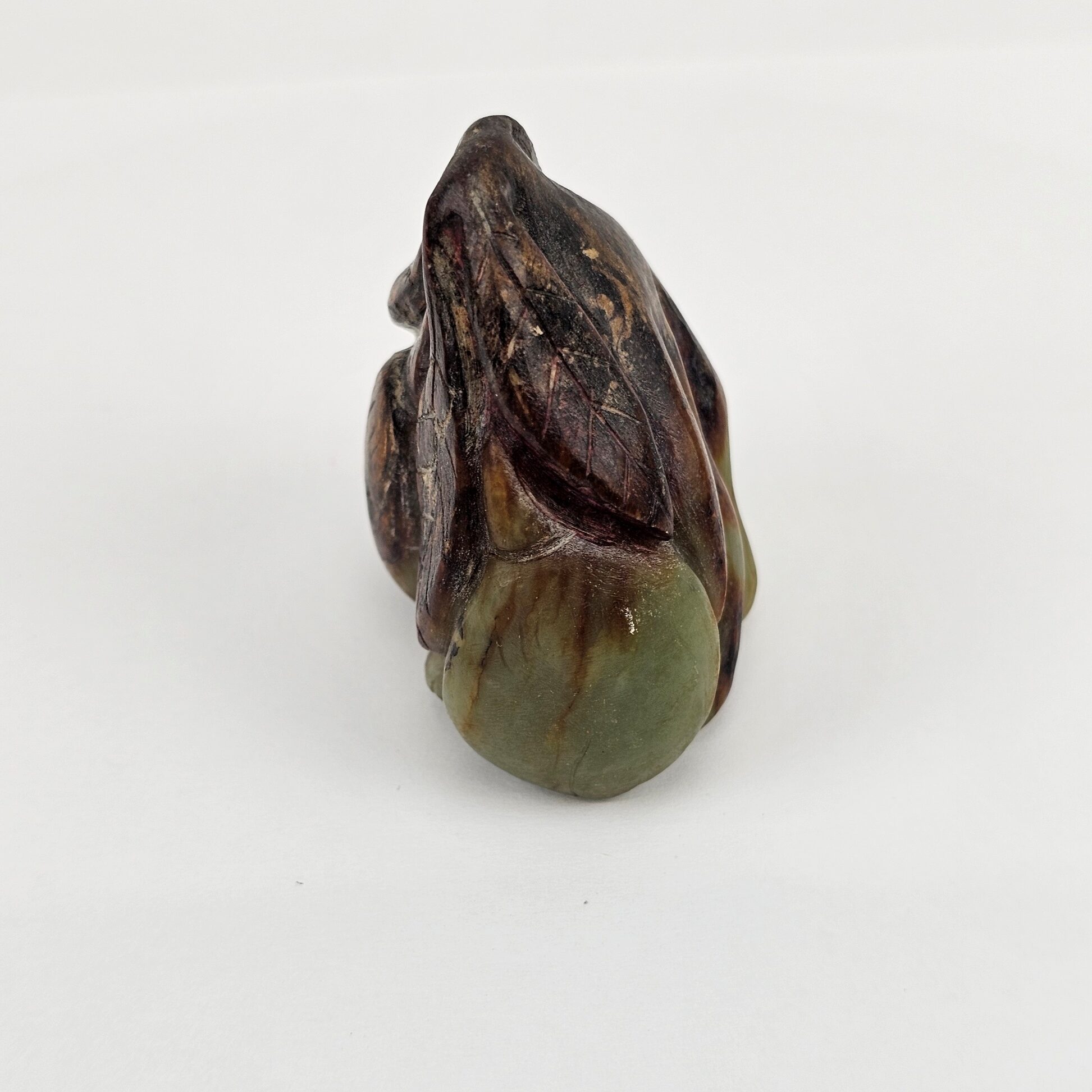
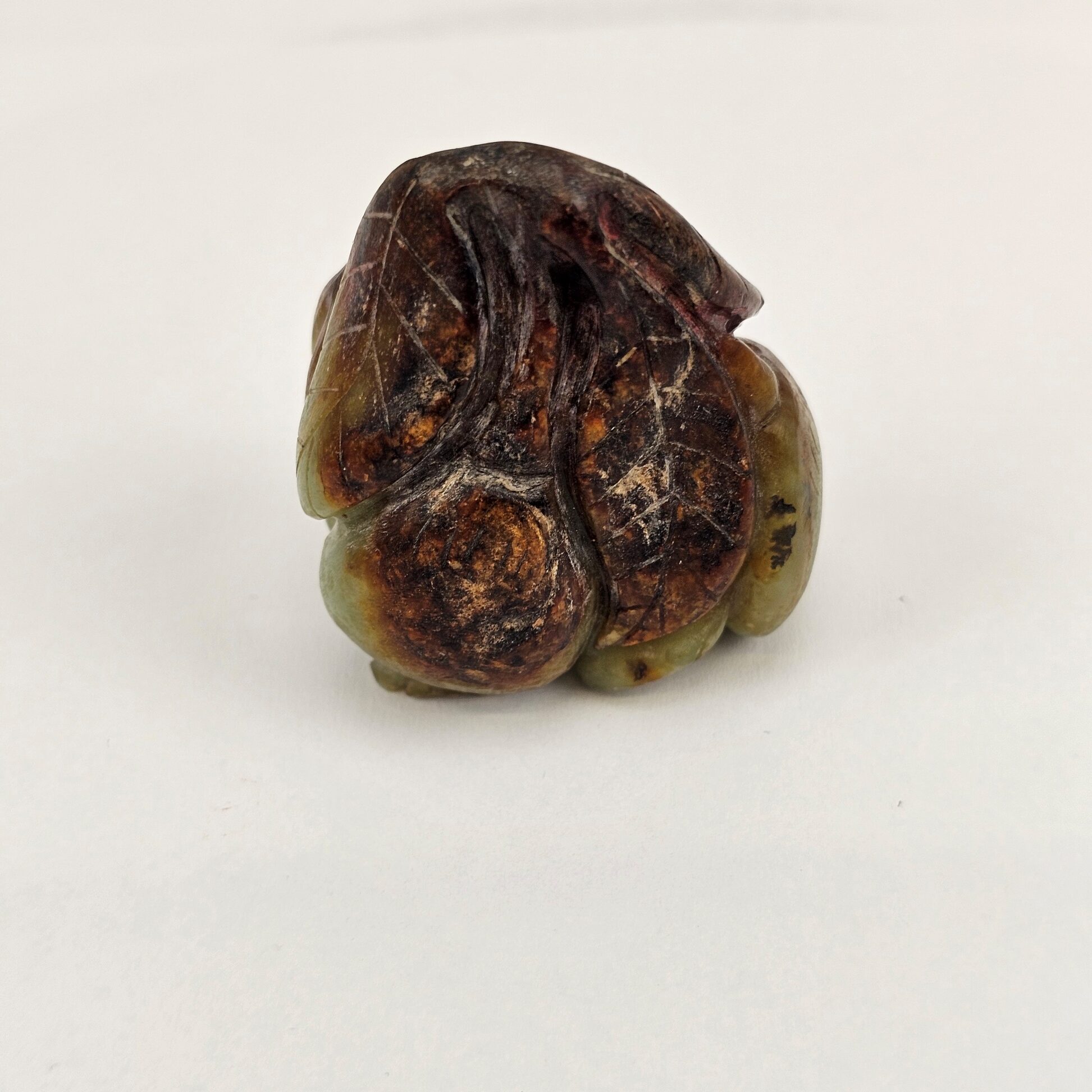
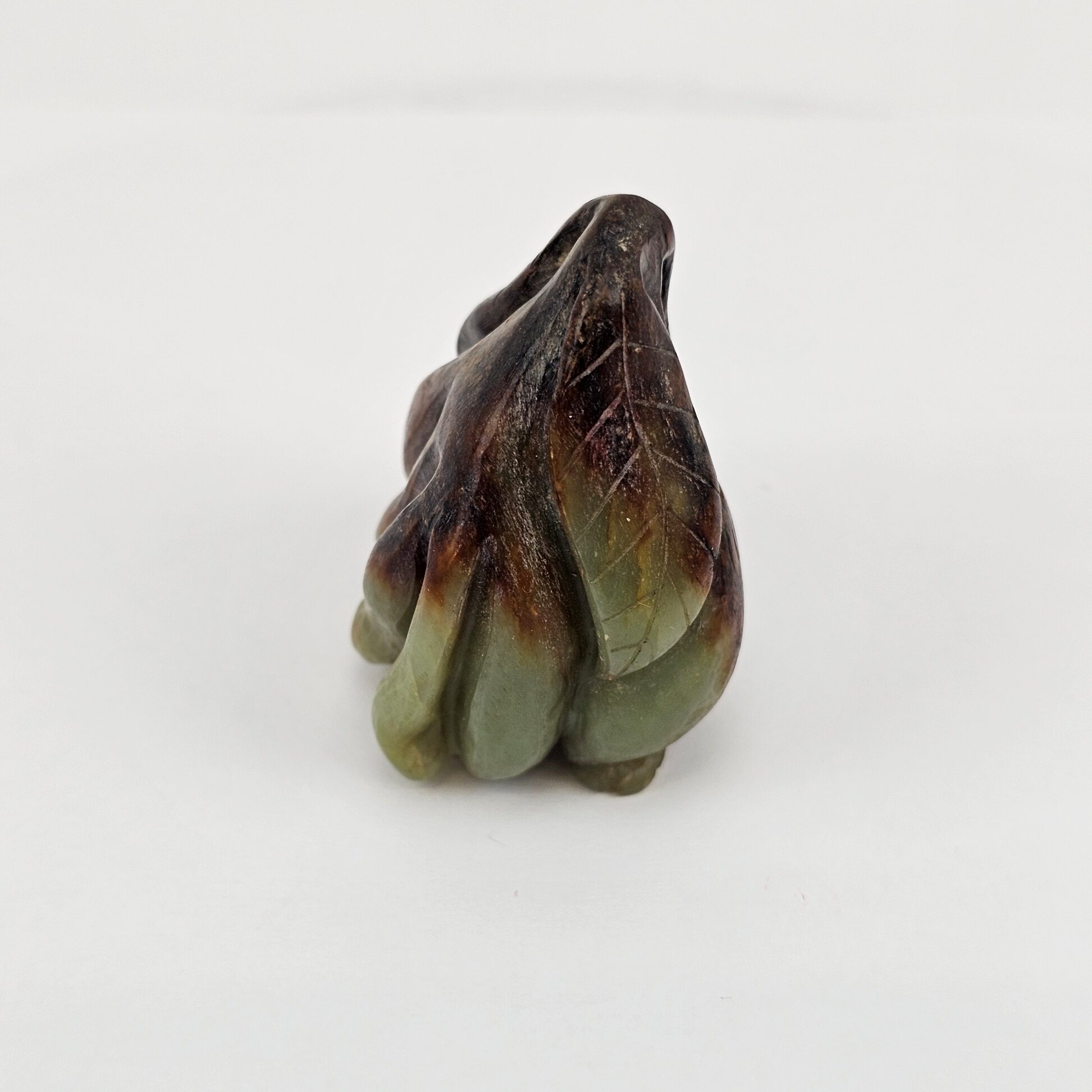
~ Chinese Nephrite Jade Carving of a Buddha's Hand Citron with Leaves, Possibly Ming Dynasty, Pre-18th Century ~
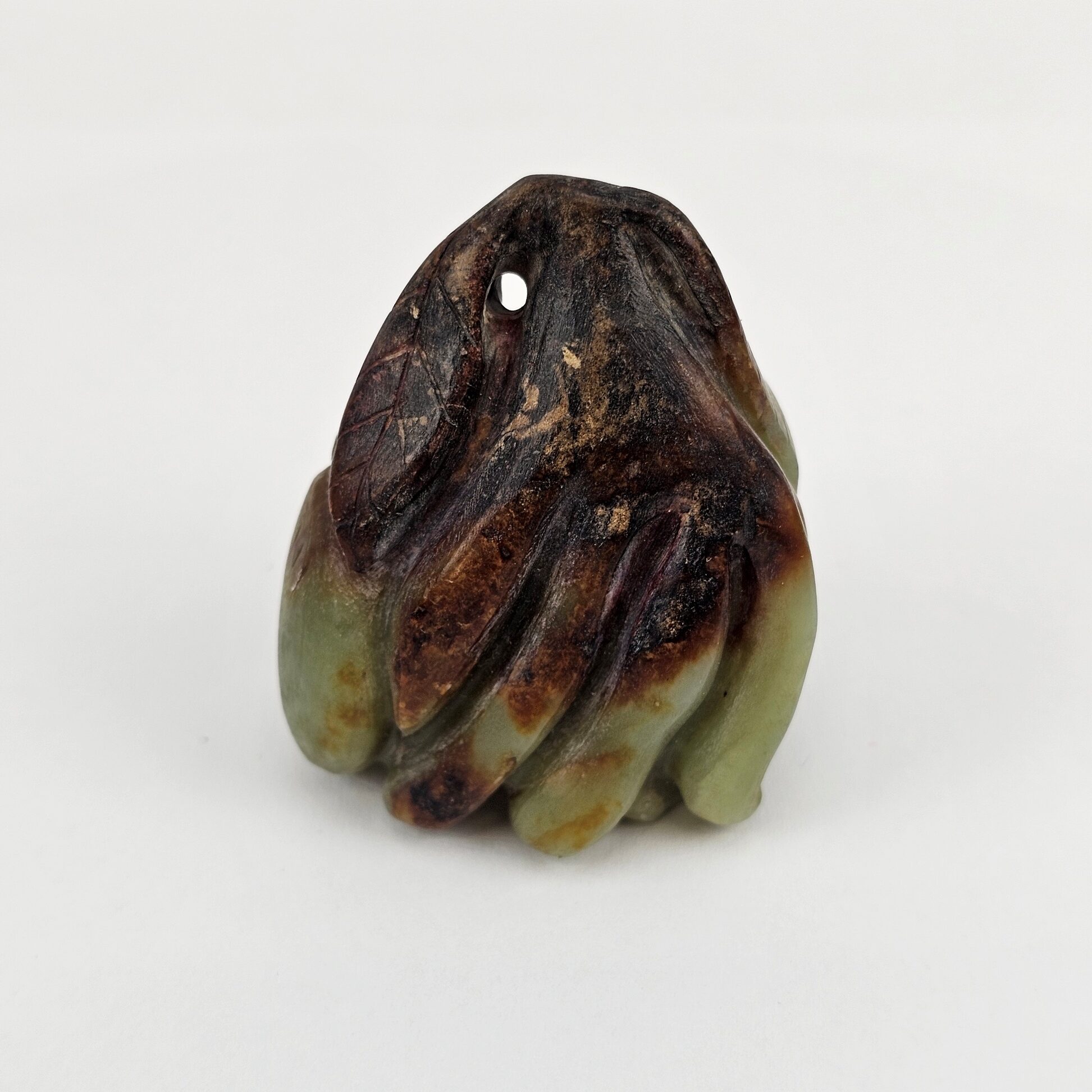
A boldly carved jade pendant or amulet in the form of a Buddha's Hand Citron (fóshǒugān 佛手柑), the famous finger-like citrus fruit that is one of the three most auspicious symbols in Chinese decorative art. The piece is carved fully in the round from a single stone, with the characteristic elongated finger projections of the citron spreading outward and downward from a central body, each finger clearly differentiated and well modelled. The fingers transition from pale celadon green at their tips to deeper olive-green tones, with the upper body and surrounding leaf forms showing extensive dark brown, black, and russet-amber surface alteration. A large leaf is carved wrapping around and over the body of the fruit, with incised veination, and a further secondary element, possibly a smaller subsidiary fruit or bud, is present at the rear of the composition. A suspension hole is drilled through the upper portion of the piece, confirming its use as a pendant or toggle. The stone displays dramatic bipartite colouring, with the pale green celadon core stone emerging at the lower finger zone, and the heavily altered dark skin dominating the upper portion. This colour contrast has been consciously exploited in the carving to evoke the natural appearance of the ripe citron and its accompanying foliage.
The reverse of the piece (images 3 and 5) shows the dark-altered surface in detail, with a complex texture of marks, possible natural fissures, and incised lines that should be examined closely in person. There are what appear to be linear scratch marks within the dark zone, the precise nature of which, whether age-related, natural, or subsequent damage, requires expert examination.
~ Historical Context ~
The Buddha's Hand Citron (fóshǒu 佛手, literally "Buddha's hand") is one of the most important and widely depicted auspicious symbols in Chinese art. Its name is a homophone for "happiness and longevity" in Chinese, and the fruit's characteristic open-fingered form was said to resemble a hand in the gesture of Buddhist blessing. Buddha's hand fruit are auspicious in Chinese culture, with their name "Fo Shou" a homophone for "Happiness and Longevity," and they are often placed as offerings on Buddhist altars. Together with the peach and the pomegranate, the Buddha's hand forms one of the Three Abundances, representing happiness, longevity, and many sons respectively, and this trio is among the most consistently depicted groupings in Ming and Qing decorative arts.
The carving of jade in the form of the Buddha's Hand, along with the Three Abundances generally, became particularly popular during the Ming dynasty and continued throughout the Qing period. The combination of Buddha's hand citron, peaches, and pomegranates was a standard subject for jade carvers of the 18th and 19th centuries, often accompanied by bats and foliate elements in richly conceived compositions. The use of the natural skin alteration of the stone to create tonal contrast, placing the dark surface against the pale inner jade to suggest leaf, fruit, and bark, is a carving technique with a long history in Chinese jade production, particularly associated with quality Ming and Qing workmanship.
~ Condition ~
Fingers/lower carving: The pale celadon green finger projections appear intact with no obvious chips or losses visible in photographs.
Leaf forms: Carved leaf elements and incised veination are present and legible throughout.
Upper/dark zone: The heavily altered dark surface shows a complex texture. Linear marks are visible in images 3 and 5, the origin of which requires in-person examination to determine whether they represent natural fissures, age marks, incised decoration, or subsequent surface damage.
Suspension hole: Present and intact at the upper portion of the piece.
Overall: The piece is structurally coherent with no fractures or losses apparent from photographs. The extent and character of the dark surface alteration is the primary condition and authenticity question for this piece.
~ Dimensions ~
The sculpture has a height of 2 inches (5.1 cm), a width of 1.6 inches (4 cm) & a depth of 1.2 inches (3 cm).
It weighs 110 g.